Ask Ariely: On Deconstructing Dieting, Advising Advantages, and Judging Jokes
Here’s my Q&A column from the WSJ this week — and if you have any questions for me, you can tweet them to @danariely with the hashtag #askariely, post a comment on my Ask Ariely Facebook page, or email them to AskAriely@wsj.com.
___________________________________________________
Dear Dan,
My diet goal is to stop eating so many sweets and start eating more vegetables. Would it be easier for me to focus on avoiding what I don’t want to eat or on eating more of what I should?
—Charlotte
Whether you focus on the positive goal or the negative one, the key thing to keep in mind is what social scientists call the principle of “friction”: People tend to follow the course of action that requires the least effort.
What this means is that you should arrange your environment to make it easier to achieve your goals. Place vegetables in a visible spot in your refrigerator and make sure that you serve them first at mealtimes, so you will have to expend minimal effort to eat them. Do the opposite with sweets—place them out of sight or on the highest shelf in the pantry, making them harder to reach.
___________________________________________________
Dear Dan,
At my company, management is encouraging employees to seek advice and feedback from one another to improve our performance. But in my experience, it’s really hard to get people to give you useful, honest feedback, because they are afraid of giving offense. Is there any way to make this process work, or is it going to be a waste of time?
—Patricia
You’re right that people are unlikely to give accurate and honest feedback to their co-workers; there is a lot of social pressure against offering criticism, and people who receive it are likely to take offense.
But while it’s often hard to change our behavior in response to feedback, it turns out that giving advice can be more useful than receiving it. A recent study published in the journal Psychological Science shows that people who gave advice were more motivated when it came to challenges like controlling their tempers, saving money and finding jobs. In a follow-up study, high-school students who gave advice earned higher grades than those who received it.
This research suggests that giving advice can be a powerful confidence-booster—so your company’s initiative might be useful overall, even if people don’t act on the advice they receive.
___________________________________________________
Dear Dan,
I’ve noticed that jokes that are meant to be funny sometimes come across as painful or offensive. Is there a way to know whether a joke is going to hurt people’s feelings?
—Pete
According to the behavioral scientist Peter McGraw of the University of Colorado, Boulder, jokes are funny when they involve “benign violations”: They transgress a social norm but not so much that they become objectionable. The trick is to hit the sweet spot between amusing and offensive.
For example, The Onion recently ran the headline “Harvard Officials Say $8.9 Million Donation From Jeffrey Epstein Was From Brief Recovery Period When He Wasn’t A Pedophile.” When I asked my friends how funny they found this headline, the ones from Harvard found it much less funny.
See the original article in the Wall Street Journal here.
 Tweet
Tweet  Like
Like Liars in Literature
Sometimes people ask me what I like to read. Sadly, I don’t have a lot of time to read non-work related things, but here are a few of my favorite lie- and liar-based texts!
1) The complete works of Sigmund Freud.
A list of the best books related to human nature, lying, and cheating would be nowhere without Freud and the explanatory power of rationalization. I know I should choose just one of them, but I’m not at home and can’t look through my books, and it’s been so long since I’ve read them, and I think I lost my notes…
2) Three Men in a Boat (To Say Nothing of the Dog) by Jerome K Jerome.
My abiding love for this particular book has to do with many things—its comical style has aged well these last 100 plus years. Moreover, Jerome nicely captures our tendency toward dishonesty; we’re all a little dishonest, but only inasmuch as we can justify to ourselves:
“I knew a young man once, he was a most conscientious fellow and, when he took to fly-fishing, he determined never to exaggerate his hauls by more than twenty-five per cent… “But I will not lie any more than that, because it is sinful to lie.””
3) A Million Little Pieces by James Frey.
A monument of embellishment, this highly fictionalized nonfiction account of Frey’s life offers a fresh take on the stories we tell to and about ourselves, that is, he shows us that people don’t just lie to make themselves look better. Where most people would elide events, Frey makes them more violent and grotesque. But of course, he had a whole lot to gain from doing so.
4) How to Lie with Statistics by Darrell Huff.
I think it’s important to acknowledge that the scientific process, though we often look to it as revealing the truth about the things around us, is also full of problems. Duff sets about showing, in highly comedic fashion, how to skew a sample population, alter graphs to belie findings, disguise the actual nature of the claim, and so on.
5) White Coat, Black Hat: Adventures on the Dark Side of Medicine by Carl Elliott.
Conflicts of interest, which are everywhere, underlie a lot of unintentionally dishonest behavior. This book takes a good, long look at the ways they bedevil medicine and create an amazing array of problems for everyone involved – with a very high cost for patients and society.
6) The Adventures of Huckleberry Finn
Huck begins his narrative with the nature of lying and authorship: “There was things which he [Mark Twain] stretched, but mainly he told the truth. That is nothing. I never seen anybody but lied one time or another…” We can learn a lot watching Huck navigate the tricky of nature of truth and deception as he navigates the Mississippi, which is, incidentally, an adventure he inaugurates by faking his own death.
Happy reading!
The Encyclopedia of Ethical Failure…
Wondering whether you can ask someone to give you a PhD in exchange for a kickback? Curious whether you can get away with stuffing ballot boxes? Allow me to introduce you to the Encyclopedia of Ethical Failure. Every couple years the Department of Defense publishes the Encyclopedia (Word doc), which is likely the most sarcastic government document out there. Interestingly, golf and taxes seem to turn up a lot.
Of course, ethics for U.S. government employees and military includes a number of rules that most citizens don’t have to abide by, such as not endorsing candidates for office while in uniform. However, it doesn’t take a law degree to recognize the problems with many of these incidents. Here’s a tiny sample:
– “For a period of several years, two top executives at the Naval Undersea Warfare Center had an astonishing work record—they took nearly no vacation time at all. The reason, investigators soon discovered, was that the executives had been taking “religious compensatory time” instead. Curiously, the executives’ absences seldom fell on any traditionally observed religious holidays. Instead, investigators found that the pair’s so-called religious observances took place on days when they had medical appointments, sightseeing trips, and golf tournaments. Asked whether golf tournaments could be considered religious observances, one executive replied, “They could be for some people.”
– A Forest Service employee decided that while she was fulfilling payments for the Service using government checks, she would write a couple to her boyfriend, who had contracted with the Forest Service once upon a time. The checks she wrote under the guise of payment for firefighting services totaled over $600,000, and apparently went to pay for general expenses and, fittingly, for gambling.
– And in the quintessential story of government corruption, two VA employees are in jail for accepting more than $100,000 in kickbacks for red tape. Yes, actual red-colored tape.
The Encyclopedia shows not only that cheating (in all its myriad forms) is wrong, but also that it carries substantial repercussions; the size of the document serves as an indication that getting caught is fairly probable. The question I have is whether over time readers of the Encyclopedia will remember the instances as examples of what people do, forget where these examples came from, and perhaps start thinking of them more as clever and daring schemes than cautionary tales….
Swiss Army People
Plato once said that people are like dirt. They can nourish you or stunt your growth. This seems sage and reasonable, but I think people are more like Swiss Army knives (To be fair, Plato did not have the benefit of knowing of such a tool, so I don’t think I’m detracting from his comparison in the least). Swiss Army knives, as we all know, are incredibly versatile, and have a tool for almost any situation. Need to open a package—it’s got a knife! Sharing beers with friends on the beach—it’s got an opener! Have something in your teeth—there’s a toothpick for that! Need to do a little electrical work—it’s a got a tool that can strip wires! The downside is that Swiss Army knives are not particularly good for any specific purpose because any really intricate task is going to require much more specific tools.
People are a lot like Swiss Army knives from this perspective, and I am saying this with tremendous appreciation. A lot of the research in behavioral economists criticizes people for various ineptitudes: why we don’t save money, why we don’t exercise, why we text and drive. And it’s true, there’s a lot to criticize and a lot that goes wrong in our decision-making processes, but when you consider just how versatile we are, it’s very impressive. Essentially, we do a lot of things sort of OK. We can reason moderately well about money, we’re often pretty good with various relationships, we’re fairly moral, and most of the time we don’t kill ourselves or others. Not bad if you think about it this way!
Now, some people are more like the specialty tools, like post hole diggers, or lemon zesters, or cigar cutters; in these cases these individuals are truly excellent in certain domains. But often these people aren’t the best at navigating the world in a pragmatic fashion. There are often savants, like Kim Peek (the person that Rain Man is based on), who certainly can’t handle the day-to-day on their own, but have extraordinary abilities in other spheres. And plenty of geniuses have similar problems; take Bobby Fischer’s statelessness and detentions, or van Gogh’s famously self-detrimental tendencies and ultimate suicide. If everyone were like these folks, our species would surely be in peril. If people were all specialized, and could only think numerically, or long-term, or probabilistically, what would life be like? Neither rich nor long.
Of course these people provide inspiration and spur progress, and we admire and celebrate many of them (who don’t put their genius to antisocial use), but we should be grateful that most of us are more like Swiss Army knives.
Turning the Tables: FDR, Tom Sawyer, and me
Before television and the internet, political candidates had two primary means of getting their image out into the public: live appearances and campaign posters. And given the limited reach of the former, posters were a crucial element in political strategy. How else were candidates supposed to project an image of decisiveness and gravitas?
So when Franklin D. Roosevelt ran for governor of New York in 1928, his campaign manager had thousands of posters printed with Roosevelt looking at the viewer with serene confidence. There was just one problem. The campaign manager realized they didn’t have the rights to the photo from the small studio where it had been taken.
Using the posters could have gotten the campaign sued, which would have meant bad publicity and monetary loss. Not using the posters would have guaranteed equally bad results—no publicity and monetary loss. The race was extremely close, so what was he to do? He decided to reframe the issue. He called the owner of the studio (and the photograph) and told him that Roosevelt’s campaign was choosing a portrait from those taken by a number of fledgling artists and studios. “How much would you be willing to pay to see your work hung up all over New York?” he asked the owner. The owner thought for a minute and responded that he would be willing to pay $120 for the privilege of providing Roosevelt’s photo. He happily informed him that he accepted the offer and gave him the address to which he could send the check. With this small rearrangement of the facts, the crafty campaign manager was able to turn lose-lose into win-win.
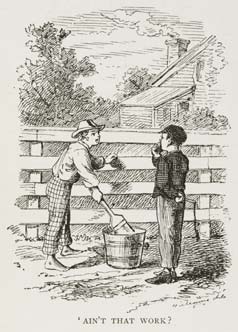
This story reminds me of the famed trickster, Tom Sawyer, who duped the neighborhood boys into trading him toys and apples for the chance to whitewash a fence. When one of the boys taunted him for having to work instead of going swimming, Tom responded with all seriousness, “I don’t see why I oughtn’t to like it. Does a boy get a chance to whitewash a fence every day?” Then when the boy asked for a chance to try it, Tom hemmed and hawed until finally the boy said he would give up his apple for a chance to whitewash the fence. Once Tom had one taker, outsourcing the rest of the work to other boys was a snap.
I conducted a similar experiment in a class I was teaching on managerial psychology. One day, I opened my lecture with a brief reading of a poem by Walt Whitman, after which I informed the students I would be doing a few short poetry readings, and that space was limited. I passed out sheets of paper providing students with the schedule of these readings along with a survey. Half of the students were asked whether they would be willing to pay $10 to come listen to my reading; the other half were asked whether they would be willing to listen to my reading in exchange for $10. Sure enough, those in the second group set a price for enduring my poetry reading (ranging from $1 to $5). The first half, however, seemed quite willing to pay to attend my poetry reading (from $1 to about $4). Keep in mind that the second group could have turned the tables and asked to be paid for listening to my recitation, but they didn’t.
In all of these situations, people (the campaign manager, Sawyer, and myself) were able to take a situation of disadvantage or ambiguous value and spin it to their (my) advantage. Once Sawyer pretended to be unwilling to part with the privilege of whitewashing, other boys wanted it, because obviously Tom was hoarding all the fun. When I told my students that space was limited and gave a suggested price for the recitation, I created the idea that this was an experience they would definitely want to have (as opposed to the other group, to whom I insinuated that listening to my reading of Whitman might be less than enjoyable).
I think Twain summed this strategy up best when he wrote the following about Tom: “He had discovered a great law of human action, without knowing it – namely, that in order to make a man or a boy covet a thing, it is only necessary to make the thing difficult to attain.”
A joke from my father (don’t blame me)
A 70-year-old, extremely wealthy widower, shows up at the Country Club with a beautiful and very sexy 25 year-old blond who knocks everyone’s socks off and who hangs over Bob’s arm and listens intently to his every word.
His buddies at the club are all aghast. At the very first chance, they corner him and ask, “Bob, how’d you get the trophy girlfriend?” Bob replies, “Girlfriend? She’s my wife!” They’re knocked over, but continue to ask, “So, how’d you persuade her to marry you?”
“I lied about my age,” Bob replies, “I told her I was 90!!”
Also see this:
Last night I was on the NEWSHO…
A new mac vs PC — my personal favorite
Being poor for a few hours
Recently I had an interesting experience being poor. It didn’t last too long but it was quite distressing and I learned how difficult this is. The story is as follows. I was out of the country for a month and during that time my car insurance expired. When I got back I called my insurance agent and I asked them to renew my policy. “No, no, no, ” they said, “If your insurance has elapsed you can’t do it over the phone and you have to come to our office in person.” Well at that time I was living in Princeton and my insurance agency was 300 miles away in Boston. So I took the train up, got to the insurance office on time and I was ready to hand them a check and renew my insurance.
Well, here again, I was wrong. It turns out I could not do it by check. The insurance company would not take a check from me because, after all, I have shown I am financially irresponsible. “Will a credit card do?” I said. “Of course not. Only cash.” The limit I can take out with my ATM card is $800 a day and the insurance was almost $3,000 (needless to say they also increased my premium). So I could not solve it this way. “Luckily” the insurance agent had a solution at hand that was designed for this very particular problem. There is another company they told me that would finance my insurance fee. Interestingly enough, the cost of this financing included 20% interest rate on the loan itself plus a $100 fee just to enroll in this program.
I had no choice but to take this particular loan. So I paid the $100 fee, I paid the 20% in interest, and I got my insurance. I took the train back to Princeton. A few days later, of course, I canceled this terrible loan and paid it off. But here is what I learned from this distressing lesson, the moment you make one financial mistake the chances that you will be hit with all kinds of fines, all kinds of difficulties, all kinds of financial obstacles, are much, much higher.
If I was on the verge of financial difficulty there is no question that this particular incident would have pushed me over the edge, making my financial life much more difficult and maybe even impossible. I think that this is, in fact, what we do to people with financial constraints all the time. We impose substantial penalties on the people who violate financial responsibilities, not taking into account their viability and therefore make their lives much, much worse.
How can we get over this issue? I think we have to reconsider the punitive systems all the financial institutions use (insurance, banks, credit cards, etc.), and think more carefully about how we want to share responsibility and payment across people. After all when someone goes bankrupt, they of course suffer, but so does the whole system around them. From this perspective, it is easy to see how the punitive systems we are using are not only bad for the individuals but they can be very damaging for the whole society.