Where are the students?
Watch this video about my online class on coursera, A Beginner’s Guide to Irrational Behavior. (And if you haven’t checked out the other short videos, they should also be pretty entertaining.)
If you haven’t signed up yet, do it now!
 Tweet
Tweet  Like
Like The Little Bank That Did.
Over the last few years, I’ve had some harsh words for bankers, banks, and the culture of the industry. In truth, I could have said worse, and it would have been justified.
That’s why the story of this bank—the Hancock Bank of Mississippi—deserves to be told, watched, and learned from. This is a case where banks play the role they are ideally meant to play, that is, they invest in the stabilization and growth of the community they’re part of, and wind up profiting in the long run from those investments.
It’s the way they did this that’s particularly remarkable—by literally laundering debris-covered dollar bills and handing them out to people in the days immediately following the Hurricane Katrina. How and why they did this is best left to the film clip; suffice it to say that Hancock gave out around $50 million in cash, with handwritten IOUs for contracts, and lost (only) about $200,000 of that when all was said and done. But in the 3 months following the storm, Hancock grew by $1.4 billion. It’s not hard to imagine that the kind of genuine investment they made in their community—both customers and not—earned so much loyalty.
Banks and their leadership have a long way to go to get out of the hole they’ve dug for themselves in the minds of most people. While disasters provide a great opportunity to show caring, I don’t think that banks need to wait for another hurricane to do something –there are many ways to show care and commitment to the community, and it’s in everyone’s interest that they start soon.
The IKEA Effect
Sign up for A Beginner’s Guide to Irrational Behavior. It’s not only FREE and open to everyone, but will surely keep you amused for the next six weeks.
Why we need underdogs in March Madness

Every year, March Madness gives us an underdog story and millions flock to a momentary allegiance with a college they could not locate on a map. In the past it has been George Mason, Virginia Commonwealth University and Butler, and this year we eagerly await a new momentary hero.
So why do we love underdogs?
Well, no matter whether you are Republican or Democratic, work for Microsoft or Apple, or are a janitor or CEO, you most likely see yourself as somewhat of an underdog.
In America, especially compared to other countries, the underdog narrative is an honorable and respectable narrative. From the American patriots in 1776 to the George Mason Patriots in 2006, the Cinderella story, as it is specifically called in the NCAA tournament, has always been an attractive one.
So with underdogs you have 1) a narrative people like and 2) a narrative people see themselves in. Is it any wonder people want to cheer for underdogs? It’s like cheering for yourself.
These serve to energize us with the hope that people like ourselves can do anything. People like to believe that those above us aren’t that great after all, and that people like us are just as good, if not better than the people in power.
In fact, the narrative is so strong that Neeru Paharia, of the Harvard Business School, and colleagues named a psychological effect after it, simply “the underdog effect.” They found that companies gain goodwill from consumers when companies present themselves as a group that has overcame disadvantages through sheer determination. This effect was stronger for people who personally related with the narrative and stronger in cultures (e.g., America) where the narrative was more prevalent.
This narrative dominates American culture not only in sports but in all other popular media. From Luke Skywalker to Cinderella, Americans crave stories about underdogs. Even the more privileged characters in storylines, such as the elite James Bond or billionaire Tony Stark, end up in situations where they must overcome disadvantages through sheer determination.
Even politicians are forced to conform to the narrative, regardless of reality. This is a challenge that proved difficult for Mitt Romney and may have greatly have hurt his campaign.
The underdog narrative doesn’t only sell fiction, politics and sports, it also sells nonfiction books in my field of social science. The nearly unparalleled success of Malcolm Gladwell’s “Outliers” owes a lot of that success to the intuitive appeal of his “10,000 hours doctrine.” Gladwell concludes that if someone spends 10,000 hours at something they can become an expert, implying to readers (who don’t carefully read Gladwell’s other more nuanced chapters) that they can make it just by trying hard.
Hip Hop artist Macklemore of the “Thrift Shop” fame even opens his chart-topping first album with a song called “Ten Thousand Hours.” He directly references Gladwell’s name in the song, chants “Ten thousand hours, felt like thousands hands, they carry me,” and then raps “Take that system!”
Oddly enough, many political pundits on both sides of the spectrum have argued (mostly for political reasons) that such a dream is fading in America. But psychological research shows that when beliefs we value are threatened, we try to find ways to defend such beliefs and keep the belief alive. Believing that an underdog will win in Atlanta this year might be a good way to keep alive that wonderful American underdog dream.
This article was originally published in the Providence Journal and can be read here.
~Troy Campbell~
Cash versus Credit
Sign up for A Beginner’s Guide to Irrational Behavior. It’s not only FREE and open to everyone, but will surely keep you amused for the next six weeks.
Distance from Money
Sign up for A Beginner’s Guide to Irrational Behavior. It’s not only FREE and open to everyone, but will surely keep you amused for the next six weeks.
The “What-the-Hell” Effect
Sign up for A Beginner’s Guide to Irrational Behavior. It’s not only FREE and open to everyone, but will surely keep you amused for the next six weeks.
In celebration of “A Beginner’s Guide to Irrational Behavior”
Today is the day that my free online class on coursera, A Beginner’s Guide to Irrational Behavior, opens to the public.
And in honor of this class, my three books will be available as an e-bundle at a discount ($19.99 for all three) until the day after the class starts, March 26th — but only until that date.
You can purchase the e-bundle through Kindle, Nook, iBookstore, Kobo, or Google.
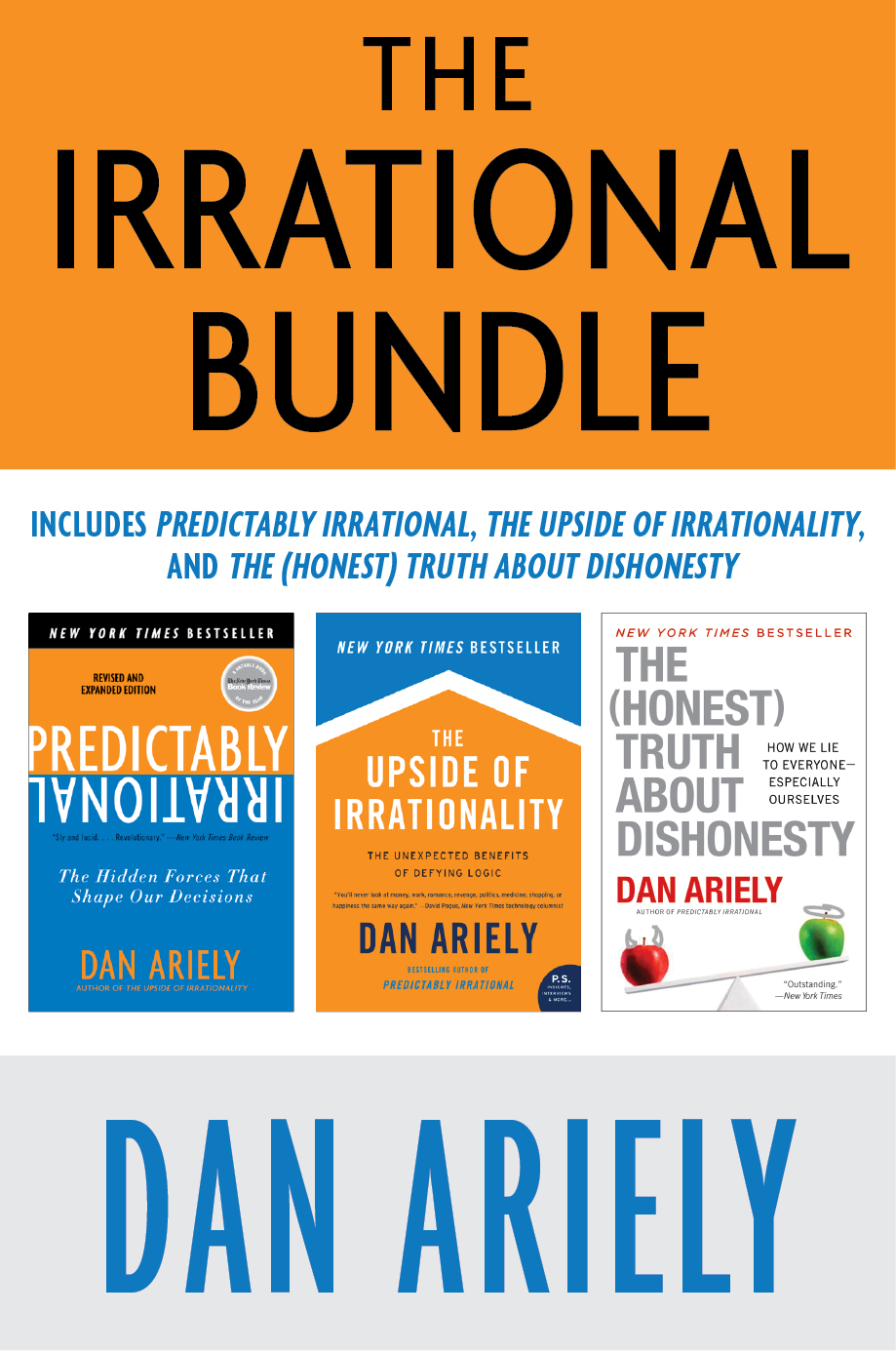
And if you haven’t already signed up for A Beginner’s Guide to Irrational Behavior, it’s the perfect time to do it now! It’s not only FREE and open to everyone, but will surely keep you amused for the next six weeks.
Irrationally Yours,
Dan
Ask Ariely: On Marriage, Restroom Stalls, and Twitter
Here’s my Q&A column from the WSJ this week — and if you have any questions for me, just email them to AskAriely@wsj.com.
______________________________________________________
Dear Dan,
My boyfriend and I have been together for a while, and people ask us whether we’re going to get married. We get along great and love each other very much, but I just don’t see the point of marriage. Why not just live together in a civil union and be happy the way things are? Aside from the cost, is there any point to this elaborate ritual?
—Janet
I have no research on this topic, but allow me to share a story that might help you to think about the question.
When I was 19 and spending time in a hospital in Israel, recovering from severe burns, I had a friend there named David, who had been badly injured in the army while disassembling a land mine. He lost one of his hands and an eye and also had injuries to his legs and some scars. When Rachel, his girlfriend of several months, broke up with him, the other patients in the department were furious with her. How could she be so disloyal and shallow? Did their love mean nothing to her? Interestingly, David was better able to see her side, and he was not as negative as the rest of us about her decision.
Think about Rachel in the story above. Does her behavior upset you? How might your feelings differ if it had been a longer-term relationship, if they were engaged or in a civil union, or if they were married? And how would you behave if you were in Rachel’s position in each of these relationships?
I suspect that your level of scorn for Rachel will depend to a large degree on the type of relationship she had with David. I also suspect that your predictions about your own decision to stick with a partner who just experienced an awful injury would similarly depend on the type of relationship. If your assessment changes when you stipulate that David and Rachel were married, this suggests that publicly saying “for better and for worse” really means something to you.
Obviously, marriage is not some magical superglue for relationships; the high divorce rate is no secret. But marriage can serve a very real purpose by bolstering commitment and feeling in long-term relationships, all of which inevitably hit rough patches. So while I wouldn’t advocate marriage in all situations, I do think it’s worth thinking about the ways in which it can strengthen the bond between people.
______________________________________________________
Dear Dan,
When I go to a public bathroom, I often think about which stall I should use. Any advice?
—Cathy
I assume that your practical aim is to figure out which bathroom stall is likely to have been used the least. But what you are really asking is what drives other peoples’ choices in this important domain.
If those who patronize public bathrooms usually choose a stall based on which toilet they think is used the least, they will all choose the one they think is used least—which as a result, ironically, would be that most of them would use the same toilet. Therefore, you would be advised to pick the opposite (i.e., the stall that people think gets the most traffic). Following this logic, if people expect the stall farthest from the entrance to be the most popular, they will avoid using it—leaving it relatively more clean and unused than the others.
But what happens if people are more sophisticated than that? What if they come to the restroom with this same understanding and as a consequence pick what they think is the opposite of what other people think, or the opposite of the opposite?
All of this boils down to a more essential question: How sophisticated do you think other people are?
Personally, I believe people generally take about one step in their logical thinking. So I would say: Choose the opposite of the opposite and select the stall that people think will be used the most.
______________________________________________________
Dear Dan,
I enjoy Twitter, but I find that some people tweet very frequently, sometime as often as a dozen times an hour. When their face shows up again and again, I begin ignoring their messages. By contrast, when people tweet just once a day, I’m more likely to pay attention to what they say. Is this just me or does it reflect a larger principle?
—Heidi
I suspect that this feeling is very common. I also imagine that very few people have dozens of interesting things to say a day, much less an hour. Perhaps Twitter is a place where a system based on limits and scarcity (maybe two tweets a day) would be better for everyone.
See the original article in the Wall Street Journal here.
Wealth Inequality in Motion.
I recently came across this video that some talented person made of a study I conducted on wealth inequality a few years back with Mike Norton. It does a great job covering the main findings regarding the differences between what Americans think the distribution of wealth is (somewhat even), what they would prefer (more even than socialist Sweden), and how wealth is actually distributed (the bottom 40% of Americans possessing less than 0.3% of total wealth, the top 20% possessing 84%). The graphs, and a longer explanation, are also available here.
The only thing I wish he emphasized a little more is how similar the results were for Democrats and Republicans, which I found very hopeful. Even with all the ideological polarization in Washington, the moment we ask the question of ideal wealth distribution in a general and less self-interested way, we seem to be a country that cares a lot about each other.