Introducing Pocket Ariely – the greatest app ever created!
What can you do with Pocket Ariely?
READ! life-changing advice from a “genius at understanding human behavior” [James Surowiecki, staff writer at The New Yorker and author of The Wisdom of Crowds], and never make another bad decision!
WATCH! lectures and entertaining videos from “one of my heroes” [George Akerloff, 2001 Nobel Laureate in Economics], and never let anyone else make a bad decision either!
LISTEN! as a man described as “surprisingly entertaining” [USA Today] interviews the leading scientists of the day, and learn everything there is to know about humanity!
LOOK! at visual illusions that will twist your brain into knots, and remind yourself of your own irrational tendencies wherever you are!
TASTE! the culinary confections of a man widely acknowledged as the finest improvisational chef in three states, and never go hungry again! (Well, not really…)
With Pocket Ariely in your pocket, you can take me with you wherever you go. You’ll be happier (since you’ll never make another bad decision), healthier (since you’ll never make another bad decision), wealthier (since you’ll never make another bad decision) and wiser (yes, you guessed it: since you’ll never make another bad decision). We almost guarantee it!
Why spend $5 on an app? Think about how much you pay for one latte or one beer. Or how much money you waste on things you don’t need. Just think: you could improve your life forever by saving your lunch money and bringing a salad to work just once. Your waistline may thank you, too! But most importantly, think about how the purchase of this app will help the blossoming field of behavioral economics. All profits from this app will be put toward the research being conducted at my lab, the Center for Advanced Hindsight at Duke University.
Thank you in advance for helping our research, and I hope you enjoy what Pocket Ariely has to offer.
Irrationally Yours,
Dan
Watch our Pocket Ariely teaser and trailer, too!
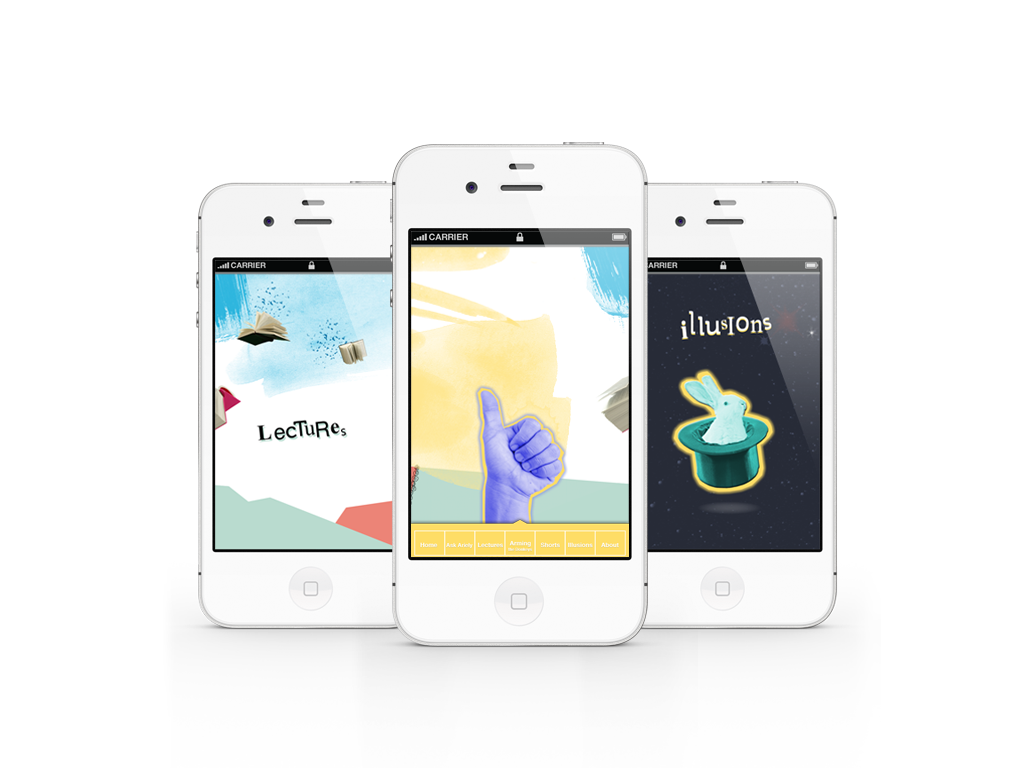
Download now on your iPhone, iPad, and Android devices!
And check out the talented team of developers that made this app at mezzolab.com
 Tweet
Tweet  Like
Like Addressing Inequality with Behavioral Economics
Tomorrow (Tuesday, October 15 from 6-7pm), the Center for Advanced Hindsight will host a discussion on behavioral economics and applications in financial services. We are seeking partnerships with local financial services organizations that are interested in using behavioral-based strategies to help them better serve their mission. The attached Request for Proposals provides a summary of our proposed program. We will also be discussing the RFP on Tuesday and answering questions about the program.
The event is RSVP only. If you are interested in attending, please email rebecca.kelley@duke.edu

Ask Ariely: On Tesla, To-Do Lists, and Knowing the News
Here’s my Q&A column from the WSJ this week — and if you have any questions for me, you can tweet them to @danariely with the hashtag #askariely, post a comment on my Ask Ariely Facebook page, or email them to AskAriely@wsj.com.
______________________________________________________
Dear Dan,
I was thinking about buying a Tesla electric car, and I was very excited about it, but given the recent news, I am not sure this is a wise decision. Is it too risky?
—Karl
Indeed, earlier this month a Tesla Model S drove over a large metal object, and the object punched a hole through the plate protecting the battery, and the battery pack caught on fire. But this is only one part of the story. In August, the model S received five stars in all test categories—an unusually high rating—by the National Highway Traffic Safety Administration. In the two days after we all learned about the crash test ratings, the stock of the company went up by 2%.
We now need to add one more data point to this body of evidence: The fire happened on Oct. 1. The share price fell by 10% over the next two days. By the way, this means that the effect of one small piece of bad news can be four times more effective than good news based on much more data. (A rare downgrade of the stock by the R.W. Baird brokerage from “outperform” to “neutral” probably also contributed to the drop.)
Elon Musk, Tesla’s CEO, pointed out in a statement Oct. 4 that no one was hurt, that the car warned the driver to pull over, and that gas cars are in no way safer. After the statement, the stock price increased by 3%, making the overall losses 6.2% from the day before the accident.
From a psychological perspective, this overreaction to one very salient (and very sad) accident is nothing new. It is a consistent way that we react to salient news, and it is perfectly irrational.
And after all of this, my suggestion to you? If you had decided to buy a Tesla before this accident, get one now—because the event didn’t add much to the information you used to make your original decision. In fact, given that other people might have an irrational fear of buying a Tesla, maybe the prices will go down a bit.
______________________________________________________
Dear Dan,
Why do people love to write to-do lists?
—Joe
I suspect there are rational and irrational reasons for the very large amount of list-making activity we see around us. On the rational side, lists help us with faulty memory and allow us to share tasks with other people simply and efficiently. On the irrational side, making lists and checking items off these lists give us the false sense that we are actually making progress. The term for this by the way is “structured procrastination.” It’s an attempt to capture the momentary feeling that we are progressing—whereas in fact when we look back at the end of the day on what we achieved, we realize that we did not get much done. I also suspect that all the apps that help us make lists and then make it fun for us to check things off are reducing our collective productivity, by replacing real work and focus with structured productivity.
______________________________________________________
Dear Dan,
I am always upset by bad news online when I turn on my computer. But negative news is pervasive, so what can I do to make myself feel better and get down to work immediately?
—Liz
One approach is to start each day with the most depressing set of news around for about five minutes and then move to the regular news. The idea here is that contrast between the highly depressing and the regular will make you feel good in comparison.
See the original article in the Wall Street Journal here.
Are dogs really people?

A few friends, well aware of how completely obsessed I am with all things dog-related, have been sending me this recent New York Times op-ed about whether or not dogs are people. The answer that Emory neuroeconomist, Gregory Berns, gives is “yes.” At least the kind of limited personhood we might grant to small children. I was hoping to love this piece but instead felt frustrated that the findings seem to rely more on—to borrow a phrase—the seductive appeal of neuroscience, rather than any empirical basis.
Berns begins by noting limitations in understanding animal emotion, disparaging the “behaviorism” in animal research. He tries to get around these restraints by putting dogs in an fMRI machine. After some trial and error (that’s adorable to visualize), Berns explored activation in the caudate nucleus—a brain region associated with reward, memory, and learning—focusing specifically on the caudate’s role in anticipating things that we enjoy, as well as its functional and structural similarity across dogs and humans. He writes in the critical two paragraphs:
In dogs, we found that activity in the caudate increased in response to hand signals indicating food. The caudate also activated to the smells of familiar humans. And in preliminary tests, it activated to the return of an owner who had momentarily stepped out of view. Do these findings prove that dogs love us? Not quite. But many of the same things that activate the human caudate, which are associated with positive emotions, also activate the dog caudate. Neuroscientists call this a functional homology, and it may be an indication of canine emotions.
The ability to experience positive emotions, like love and attachment, would mean that dogs have a level of sentience comparable to that of a human child. And this ability suggests a rethinking of how we treat dogs.
First, it seems an empirical and philosophical stretch to consider “experiences positive emotions” as a coherent and plausible criterion for personhood. I’m also unconvinced that caudate activity is solid enough ground to infer sentience, since rats have a functioning caudate that responds to rewards.
Second, it’s not at all clear to me why neuroscience is required to make this conclusion. If we want to give personhood to animals that experience positive emotions, then why go through the trouble and expense of putting dogs in an fMRI machine? It’s pretty obvious to me when my dog is happy. He perks up, he wags his tail, he grins, he looks at me lovingly when I scratch his ears, he sighs contentedly when he chews on bones and other things, and so on. I don’t need to examine activation in his caudate to realize that he’s experiencing positive emotions.
It could be argued that we can’t actually observe the positive experiences in dogs—we can only make inferences from behavioral similarities. And in that case we’d want to look deeper into the subjective experience that dogs might have. Neuroscience is a tempting alternative, but it’s a shallow one—it only feels more scientific without providing much payoff.
What fMRI scans tell us is that certain regions of the brain receive more blood at certain times during a task. So if we see more blood flow to the caudate when dogs look at their owners or see a hand signal associated with food, we infer that the caudate is more active. But how is caudate activation enough to infer something about what dogs experience?
We still haven’t observed any emotion, but rather brain activation. You could appeal to structural or functional homology, as Bern’s does (i.e. “dogs and humans both have caudates that respond to similar things, so they must feel similarly, too”), but notice we’re no better off than where we started. We’ve simply replaced one assumption with another. If the first (“dogs and people both smile, so dogs feel like people do when they smile”) is unjustifiable, so must be the neural one. We’ve learned nothing new about what dogs experience, but rather that dogs show activity in reward regions when they see things they enjoy (which, like, duh?). We’ve only bought the sexy feeling that the science we’ve done is somehow more legitimate.
Which leads me to my last pet peeve (hah) about the OpEd—the constant suggestion that neuroscience has triumphed over the constraints of behaviorism, while ignoring that psychology has been looking beyond behavior just fine for a long time. Animal psychology has been no exception, here. I know of and have been involved in a lot of comparative cognition research with animals (the operative word being “cognition,” not “behavior”). I have good friends who work with Brian Hare at Duke, the co-director of the Canine Cognition Center at Duke and author of The Genius of Dogs, and my undergraduate advisor is currently diving into dog cognition, herself. There is a lot of great research that explores how canines think, not just behave. All without the aid of fMRI’s.
fMRI is a great tool, no doubt. But it’s not the only way to learn about the mind, and it certainly has it’s limits. These limits do not go away, however, when looking at other animals. So even though I love my dog (a lot), he’s probably not a person (though I might treat him like one, sometimes). If he is, though, it’s going to take more evidence than this study to convince me.
This piece was originally published on the author’s personal blog, which he encourages you to follow.
Looking for a Full Stack Developer
Project Description
We are currently seeking a Full Stack Developer to join our team to develop and support a growing collection of software for collecting and analyzing internal research, as well as developing software that will be marketed and released to a public audience.
This position will help build and maintain a suite of fun and innovative web and mobile apps to help people make better moral, financial, and health decisions. This suite includes user-facing mobile apps, admin-facing web applications, and backends for interaction between the two. Among the projects currently in motion is an internal iPad app that helps the Center and its collaborators around the world run experiments on the go. Another app, (Sample) Size Matters, is publicly available and currently being used to collect data from participants all over the globe who download the app. Developing this app is one of the Center’s main priorities, and we are excited to improve it so that it ultimately becomes the best method for data collection worldwide.
While some applications will only be used internally (and the programming focus will be on functionality), others will be distributed to the public and will therefore require a greater focus on interface design and consumer usability.
Overall, the position will be responsible for programming and maintenance of apps, including:
- data collection instrument design
- survey implementation across multiple mobile platforms (e.g., Android and iOS, phones and tablets)
- field-based direct data collection and quality control
- secure device and cloud server storage (Heroku/Mongolab)
- secure transmission of data using mobile platforms
Specific Responsibilities
- Build Software/Apps for Internal Research Purposes. Serve as the technical lead with a team of researchers to identify innovative approaches for collecting, storing and synthesizing data captured through mobile devices. Develop innovative ways of using mobile platforms for the deployment of study materials. Design, develop, implement and document research software tools. Manage cloud-based web/application servers, configure server software and manage the technology to ensure secure transmission, storage and data sharing.
- Build Software/Apps for Public Consumption. Oversee the development of commercial applications with a focus on well-designed, attractive, user-friendly applications. The software/apps for public consumption will be designed to teach consumers about behavioral economics. The primary aim of these applications is to educate and nudge people toward making better decisions, helping people in moral, financial, and health domains.
- Maintain Legacy Software/Apps for Internal and External Use. Support the suite of applications currently in use by the CAH (for both research purposes and public consumption). Maintain pre-existing apps, as well as update software when necessary. Work collaboratively with the original developers to understand the important features of the apps and revise the software appropriately.
- Optional: Specialize in user interface, human-computer interaction, and design. Preferences include experience with 1) design software such as Photoshop, Sketch, Illustrator and 2) video editing software such as FCPX, Motion. While this is not a necessary skill for the position, applicants with experience in this domain will have an edge on others.
Perform other related duties incidental to the work described herein.
Skills/Experience/Knowledge
Technical (required):
- Python (with webframe work experience)
- Javascript (with jQuery)
- iOS (Objective C)/
- Web development (HTML5, CSS3, web APIs)
- Experience with databases (preferably NoSQL MongoDB)
Preferred:
- Android (Java)
- VPS Services (Heroku)
Other:
- Curiosity and a passion for inquiry
- Experience working in a research environment
- Ability to adjust rapidly to evolving needs of multiple researchers and projects
- Strong interpersonal and communication skills
- Ability to communicate effectively with people of varied technical backgrounds
- Demonstrated ability to work independently, as well as manage multiple collaborations and research projects at once
- Ability to meet strict deadlines and work in a timely manner, keeping researchers up to date with progress being made on the applications
- Experience preparing and maintaining form and procedure manuals to effect implementation and the continuing operation of apps
- Knowledge of data security and prior experience acting as an administrator for networked file systems
The above statements describe the general nature and level of work being performed by individuals assigned to this classification. This is not intended to be an exhaustive list of all responsibilities and duties required of personnel so classified.
Minimum Qualifications
Education
Work requires a Bachelor’s degree in mathematics or computer-related field, or equivalent coursework or technical training.
Experience
Work requires one year of programming or analytical experience with knowledge of several computer languages, programs or systems OR AN EQUIVALENT COMBINATION OF RELEVANT EDUCATION AND/OR EXPERIENCE.
What is the Center for Advanced Hindsight?
The Center for Advanced Hindsight is Dan Ariely’s behavioral economics lab at Duke University. We are interested in how and why people make a wide range of decisions, and how certain forces influence our thoughts and behavior. Our research focuses on the faulty assumptions of rational decision making, and strives to unveil how people make decisions in the real world – all kinds of decisions, from what inspires us to work those extra hours, to how much we are willing to spend on black pearls, to what we choose to eat for lunch.
Broadly, our primary research interests include:
- Moral decisions
- Health decisions
- Financial decisions
- Social and environmental influences on behavior
What About Duke?
Duke has been named as a best place to work by several publications and organizations, including Carolina Parent, Computerworld, The Scientist, and the American Association of Retired Persons, among others. The organizations recognizing Duke represent a diverse range of interests, from family-friendly and preventive health to the needs of IT professionals and academic researchers.
Duke’s comprehensive benefits package includes paid time-off (vacation, holidays, sick leave), health, dental, vision, disability and life insurance, retirement, educational assistance, and support for professional development and training. As an employee of Duke University you would also enjoy numerous discounted services such as health club memberships, movie tickets, dining, and entertainment.
Environment
The CAH is a unique working environment, and has acquired a reputation for hosting activities like spontaneous pancake parties, snow cone shindigs, or a lab-wide Color Run. The space is filled with color and hanging chairs, a “Thinking and Dreaming” room, and the occasional art exhibit as a part of our Artistically Irrational series that bridges the gap between the worlds of Art and Science. The lab boasts an airborne remote-control shark, mini hydroponic garden, and the occasional pet sea creature. Not to mention onsite espresso and an ever-changing selection of scrumptious snacks. The work environment is flexible, always evolving, and moves at a pace that even the most highfalutin startups have a hard time keeping up with, and we embrace the momentum with an impassioned sort of grace. It’s not the lifestyle for everyone, but if this sounds appealing, then the CAH might just be the perfect place for you.
Our lab members are as diverse as our daytime activities, with backgrounds ranging from academia to advertising and business to software development. Our work is highly creative and collaborative, and we don’t hesitate to ask for help or to help our peers. And yes, we do walk around in our personalized lab coats that function purely as fashion accessories.
To apply for the position, visit http://www.hr.duke.edu/jobs/apply/ and view Requisition # 400770209 or click here to get to the post directly.
Ask Ariely: On Wasted Time, Framing Failure, and Matrimonial Gambling
Here’s my Q&A column from the WSJ this week — and if you have any questions for me, you can tweet them to @danariely with the hashtag #askariely, post a comment on my Ask Ariely Facebook page, or email them to AskAriely@wsj.com.
______________________________________________________
Dear Dan,
Often when I meet with a group of my closest friends, the discussion goes something like this: “Where do you want to go?” “Not sure.” “Where do you want to go?” “Not sure.” Etc. These discussions are frustrating and waste time. Any advice on how to move them forward and get to a decision faster?
—Matthew
When someone asks “What do you want to do tonight?” what they often are saying implicitly is: “What is the most exciting thing we can do tonight, given all the options and all the people involved?”
The problem is that figuring out the best solution is very difficult. First, we need to bring to mind all the alternatives, next our preferences and the preferences of the people in the group. Then we have to find the one activity that will maximize this set of constraints and preferences.
The basic problem here is that, in your search for the optimal activity, you are not taking the cost of time into account, so you waste your precious time asking “What do you want to do?”—which is probably the worst way to spend your time.
To overcome this problem, I would set up a rule that limits the amount of time that you are allowed to spend searching for a solution, and I would set up a default in case you fail to come up with a better option. For example, take a common good activity (going to drink at X, playing basketball at Y) and announce to your friends that, unless someone else comes up with a better alternative, in 10 minutes you are all heading out to X (or Y).
I would also set up a timer on your phone to make it clear that you mean business and to make sure that the time limit is kept. Once the buzzer sounds, just start heading out to X (or Y), asking who wants to come with you and telling everyone else that you will meet them there. After doing this a few times, your friends will get used to it and perhaps bring an end to this wasteful habit.
______________________________________________________
Dear Dan,
I’d like to understand something I see in my own life and in billion-dollar companies: the switch from aiming to succeed to aiming not to fail. You see this in companies such as Microsoft, but even the National Aeronautics and Space Administration went from the ambitious 1960s-’80s era to its current conservative program. What can we do to overcome this problem?
—Alex
Assuming this is indeed a generalized pattern (and it would be interesting to collect data on the question), it might be a simple outcome of the endowment effect: basically, once we own something, we get used to it and are very reluctant to see it go away. When you are just starting out, you have nothing, so you look at potential gains and losses to some degree on an equal footing. But once you experience some success, you start thinking more carefully about what you have, and you don’t want to give it up, so you become much more conservative. In the process, you give up the things that made you successful from the get-go. Nor are companies alone in this: I suspect that the tendency to switch to a do-nothing defensive posture is just as common in the behavior of our public officials and governments.
______________________________________________________
Dear Dan,
Someone once said to me that marriage is like betting someone half of everything you own that you’d love him or her forever. Do you agree?
—Shane
From the perspective of an outside observer, there are some things in life that can be described as a bet or a gamble—while for the people directly involved, looking at it that way will be a very bad idea. Marriage is one of these cases. It might be fun and interesting to think about other peoples’ marriages in such terms, but don’t be tempted to think about your own relationship this way. And certainly don’t mention these odds to your significant other.
See the original article in the Wall Street Journal here.
Conversations on Google+
Today, Dan will talk to some lucky google+ers about the psychology of money.
To participate, join the Psychology Community on Google+ and post your thoughts about this topic. Dan will select the most insightful contributors to join him in a Hangout On Air on 9/26 at 2 PM ET.
UPDATE: Here is the conversation.
A New Model for Bonuses: Shift that bonus from self to others!

(All the rights of this illustration belong to our talented lab member M.R.Trower)
Before writing personal bonus checks to your employees this December, have a look at our paper — hot off the press! If you are hoping that a bonus would allow them to buy whatever they wish and as a result be happier at work and more productive, we have a better idea! Rather than giving your employees more personal bonuses, make a minor adjustment and offer them prosocial bonuses, a novel type of bonus to be spent on others.
Across three field experiments, we tested the efficacy of prosocial bonuses against the standard model of personal bonuses. We found that when companies gave their employees money to spend on charities or on their colleagues (as opposed to themselves), employees 1) reported increased job satisfaction and 2) performed notably better.
In one experiment, an Australian Bank gave some of their employees a charity voucher and encouraged them to spend it on a cause they personally cared about. Compared to their coworkers who didn’t receive a charity vouchers, bankers who redeemed the prosocial bonuses reported increased job satisfaction and were happier overall.
Next, we examined whether prosocial bonuses were still effective if they were spent on others people personally knew rather than on charities. We ran experiments in two very different settings – one with recreational dodge ball teams in Canada and another one with pharmaceutical sales teams in Belgium – where we encouraged spending on co-workers and teammates. In both cases, we gave cash to some members of each team to either spend on themselves (personal bonuses) or spend on their teammates (prosocial bonuses). We found that teams that received prosocial bonuses performed better than teams that received money to spend on themselves.
It is difficult to measure the return on investment of corporate social responsibility. With prosocial bonuses, however, we were able to measure the dollar impact on the bottom line. On sports teams, every $10 spent prosocially led to an 11% increase in winning percentage, whereas it led to a 2% decrease in winning when team members received personal bonuses. For the sales teams, every $10 spent prosocially earned an extra $52 for the firm.
Our results come at an important time. Job satisfaction is at a 20-year low in the U.S., and people are spending more and more time at work. If you do what you have always done, you will get what you have always gotten. So, we suggest that you try something new this year: Shift the focus of the bonuses from the self to others and create a more altruistic, satisfying and productive workplace!
P.S. If you are interested in testing prosocial bonuses, please feel free to send a gift to lalin.anik@duke.edu
What a $1 sub is really worth

As you leave our lab and take a narrow walkway down to one of the main streets in Durham, you pass through a small parking lot and a few chain restaurants. Yesterday afternoon, that parking lot was packed tightly with a long line of patrons waiting to buy a $1 sub for Jimmy John’s “Customer Appreciation Day.”
If the crowd was any indication, the promotion was a success (although it’s hard to tell how “appreciated” the customers felt without distributing some surveys—maybe next time…). It was clear, however, that they were willing to wait an incredibly long time to get a cheap sub. And that might very well change where they get lunch in the future.
In standard economics, the way we decide to spend our money reflects how useful or enjoyable we expect a product or service to be. We pay five dollars for a sub because we expect to get five dollars of value from eating it, and so on. But findings in psychology and behavioral economics suggest that the choices we make can do more than simply reveal our preferences—they shape them, too.
One classic study by Leon Festinger and James Carlsmith showed the effect that actions can have on our preferences. Participants in their experiment performed a mind-numbing task and were asked to describe it to another person while pretending to have enjoyed it. But there was one crucial difference between two groups: They were paid either a low or high amount of money to do this. Compared to those who were well compensated, the participants who were paid a small amount of money enjoyed the experiment more and reported a higher likelihood of returning to perform a similar experiment.
Festinger and Carlsmith concluded that their low-paid participants experienced a dissonance between the amount of money they were paid and their own willingness to perform the task. And since they couldn’t take back their efforts, they justified their behavior by increasing their enjoyment of the task. Here, we could say quite a bit about what Festinger and Carlsmith called “cognitive dissonance,” but let’s instead focus on how this affected their participants’ later behavior.
When we look back on our past actions, we tend to ignore situational factors and assume instead that we made that decision for good reasons. This actually changes how we feel about those decisions later, and that can change our future behavior. This process, where we look to our past behaviors to guide our future decisions, is called self-herding. To provide a simple example, imagine that you got a particularly flattering evaluation last Friday at work. You were feeling pretty happy about this and decided to celebrate by inviting some co-workers to a bar for a drink. The next Friday, as you’re considering what to do that evening, you might look back on your past excursion and decide to do it again. You look to the past behavior (going out for drinks) rather than the situational factors (the glowing report) that led you to the behavior.
So the people waiting in a long line for a cheap sub that everyone seems excited about might look back tomorrow and like Jimmy John’s more than they otherwise would have. Though they might look herded to one another, standing in a line that stretches out the door and into the parking lot, it’s how they’re herded to themselves that matters in the long run.
~Vlad Chituc~
Read more:
Chapter 2 in Predictably Irrational and Chapter 10 in the Upside of Irrationality
Dan Ariely and Michael Norton (2007), “How Actions Create—Not Just Reveal—Preferences.” TRENDS in Cognitive Sciences. Vol. 12, No. 1: 13 – 16.
More than Friendship: The Importance of Student Peers

Time and time again, you hear students talk about how lonely graduate school can be. To fight the loneliness, graduate students often befriend each other, play board games together, go to trivia nights together, or yes even party together—only on weekends and always responsibly of course. Even though this makes graduate school less lonely, the research itself may remain a lonely enterprise.
Yet it doesn’t have to be: future professors, inventors, and intellectual powerhouses are residing on the desk across from you, why not take advantage of that?
On day one of graduate school I wished someone would have told me so many things (e.g. difference between theory-application, how run certain models) but most of all I wish someone would simply have told me: “Student peers are fundamentally important to your academic life.”
Of course, everyone knows you want to befriend and get along with the students in your department. However, unlike during your undergraduate studies where friendship is the ultimate goal, in graduate school so much more can occur. Graduate students are not just potential friends, they are potential colleagues, co-authors, discussion partners, support networks, and walking encyclopaedias of various literatures. Fellow students are the one of the biggest and most powerful resources in graduate school, yet we often overlook this fact.
No matter who your advisor is, he or she will not be around as much as your fellow students who are almost always there. They hear your ideas in class and lab, attend your conference presentations, talk at length with you over coffee and lunches, and see your ideas develop from day one. In many ways your peers often know your ideas, thought processes, passions, and weaknesses better than anyone else. This is especially true for students working with multiple advisors or switching between advisors.
Yet, often we simply don’t take advantage of our friendly fellow students. We don’t follow the example of the Psych Your Mind students who spend one lunch a week talking about ideas just amongst themselves. We don’t take the time to kick ideas back and forth, or just be someone’s sounding board. Instead, we stumble into advisor meetings will ill-prepared pitches, when a pre-conversation with a peer could have drastically improved them.
Recently, a group of students at a conference agreed to start a purposefully small and private online message board group, so they could communicate about important topics and questions. With this message board system, these students can get insight on complicated questions, methods, cites, and theories within an hour. A network of graduate students supporting each other can be at times more powerful than any individual meeting with a faculty member.
Lastly, even if we talk together or form networks, we don’t tend to co-author with each other. Remember last time you just couldn’t figure out the right stimuli, couldn’t handle the stress of a revision, and got writers block? Or remember that time you needed feedback from your advisor, but the advisor was in a conference in Spain? That’s when a student co-author would have saved you.
Professor Gavan Fitzsimons at Duke University often gets praised for one interesting talent: he’s good at putting graduate students together and building research teams. He knows how powerful a network of graduate students, senior professors, and often also young professors can be and his CV is a testimony of that.
There’s a belief in Improv Comedy that when two performers get on stage and make up a scene together, the performers create something that is greater than either performer would have created own their own. Improv performers believe that putting two passionate people together creates true greatness as they positively build upon one another’s ideas. Whether it is as co-authors, giving feedback on manuscripts, or just chatting about research over lunch, togetherness is a path to greater things.
~Troy Campbell~
Originally posted on InDecision Blog.