They say money can’t buy happiness. That might be true, but a new study suggests money holds more benefits in store than just the obvious ones. A clever set of experiments by Xinyue Zhou, Kathleen D. Vohs and Roy F. Baumeister suggest that simply handling money can dull physical and emotional pain.
Previous research has shown that social exclusion and physical pain share common underlying mechanisms. This is due to the way we evolved as social animals. In fact, a 2003 study (Eisenberger et al.) showed that the brain produces similar responses to social rejection as to physical pain. Other work (Vohs et al., 2006) revealed that thoughts of money convey feelings of self-sufficiency, thus soothing the uneasiness of social exclusion. Putting these findings together, Zhou et al. propose that money and physical pain are linked to one another, and they set out to examine this connection as well as the connection money has to social distress.
Three pairs of experiments were carried out on university students, looking to see if:
a. social exclusion and physical pain increase the desire for money
b. money can appease this pain, both physical and emotional
c. losing money intensifies these sensations. As it turns out from the study, the answer to all of these hypotheses is yes.
Since I liked the design of the study I’ll describe it succinctly as I introduce the findings. The impatient reader can skip the part in blue.
The first pair of experiments explored if the desire for money increases with social rejection and physical pain. Researchers let groups of four get acquainted with each other, and then split them to individual rooms. The subjects were then told that they were not picked by any of the others as partners for a dyad task, to stem feelings of social rejection (subjects in the control group were told everyone chose them). After this semi-cruel manipulation, the subjects’ desire for money was measured in three different measures (e.g. the sum they were willing to donate to an orphanage) and in all three the participants in the rejected condition expressed higher desire for money, compared to their ‘popular’ counterparts.
In the second experiment, half the subjects were primed to the idea of physical pain with word-completion tasks, while the other half was exposed to neutral concepts. Simply priming the notion of pain also increased the desire for money.
The next pair of experiments investigated if money can sooth pain. Subjects in the one condition were asked to count eighty $100 bills, in order to invoke the feeling of obtaining money, while the other subjects counted 80 pieces of paper (all this under the pretence of a finger-dexterity task). Then, one experiment had subject play ‘Cyberball’ – a computerized ball-tossing game with other players. The participants were lead to believe the players were human but in fact were a simple computer program. Subjects in the exclusion condition weren’t passed the ball and were effectively left out of the game by the other ‘players’. How tragic it must have been for some of them – it’s the grade school playground all over again. After the game ended participants were questioned about their experience, and – as you might have guessed it – those who counted money beforehand felt less social distress over being left out of the game, and maintained higher self-esteem than those who counted paper.
The other experiment of the pair is possibly the most interesting in the bunch. After that same money/paper counting exercise, the poor participants had to undergo a pain-sensitivity task (and all they got in return was partial course credit!). Zhou et al. used another approach – they put subjects’ hands in an immobilizing contraption and then poured hot water on their fingers. After this ‘pleasantness’, subjects rated how painful was this experience. The results indicate that simply counting money significantly reduced feelings of pain in the high-pain condition, and that it made participants feel stronger than those who counted paper.
The last pair of experiments used similar measures to show that thinking about losing money actually intensifies the sting of social rejection (Cyberball) and exacerbate physical pain (hot water again). Subjects in the money-losing condition indeed reported higher vulnerability in both cases.
To sum up, these experiments suggest that having financial resources diminishes pain, both physical pain and emotional pain caused by social rejection. Possibly the most interesting thing to pinpoint is that the method these findings were obtained indicates a general perception of money as a mean to alleviate pain and suffering. This is because money by itself had no value in the experiments as it could not “buy” any passes of the ball nor a release out of the hand constraints. It is also interesting to notice that merely thinking about having or losing money, without any actual change in resources, had the described effects since the experimenters didn’t award (or take) the subjects any money (neither as a part of the experiments nor for their participation).
This study springs several implications to mind. As for me, I wonder if there will ever come a day that a dentist appointment will kick off with a brief game of monopoly (one where the patient always accumulates great wealth) prior to the actual treatment. It just might alleviate the pain.
 Tweet
Tweet  Like
Like One of the things that always amazed me about rational economists is that they don’t update their opinions.
In economics there is a very clear way in which all people are supposed to observe new information and based on it update (what is called Bayesian Updating) their understanding of the world. And while Bayesian Updating is a big part of economic theory, economists themselves don’t seem to do any of this Updating based on data about real economic behavior of people.
Of course, no experiment is ever perfect, and there are always more questions and alternative possible interpretations – but that rational economists would not update at all? This is just too odd. Or maybe it is the real proof that we are all somewhat irrational?
Here is what Asimov had to say about believing in data…
“Don’t you believe in flying saucers, they ask me? Don’t you believe in telepathy? – in ancient astronauts? – in the Bermuda triangle? – in life after death?
No, I reply. No, no, no, no, and again no.
One person recently, goaded into desperation by the litany of unrelieved negation, burst out ‘Don’t you believe in anything?’
‘Yes,’ I said. ‘I believe in evidence. I believe in observation, measurement, and reasoning, confirmed by independent observers. I’ll believe anything, no matter how wild and ridiculous, if there is evidence for it. The wilder and more ridiculous something is, however, the firmer and more solid the evidence will have to be.”
Isaac Asimov, The Roving Mind (1997), 43
Before the financial crisis of 2008, it was rather difficult to convince people that we all might have irrational tendencies.
For example, after I gave a presentation at a conference, a fellow I’ll call Mr. Logic (a composite of many people I have debated with over the years) buttonholed me. “I enjoy hearing about all the different kinds of small-scale irrationalities that you demonstrate in your experiments,” he told me, handing me his card. “They’re quite interesting-great stories for cocktail parties.” He paused. “But you don’t understand how things work in the real world. Clearly, when it comes to making important decisions, all of these irrationalities disappear, because when it truly matters, people think carefully about their options before they act. And certainly when it comes to the stock market, where the decisions are critically important, all these irrationalities go away and rationality prevails.”
Given these kinds of responses, I was often left scratching my head, wondering why so many smart people are convinced that irrationality disappears when it comes to important decisions about money. Why do they assume that institutions, competition, and market mechanisms can inoculate us against mistakes? If competition was sufficient to overcome irrationality, wouldn’t that eliminate brawls in sporting competitions, or the irrational self-destructive behaviors of professional athletes? What is it about circumstances involving money and competition that might make people more rational? Do the defenders of rationality believe that we have different brain mechanisms for making small versus large decisions and yet another yet another for dealing with the stock market? Or do they simply have a bone-deep belief that the invisible hand and the wisdom of the markets guarantee optimal behavior under all conditions?
As a social scientist, I’m not sure which model describing human behavior in markets-rational economics, behavioral economics, or something else-is best, and I wish we could set up a series of experiments to figure this out. Unfortunately, since it is basically impossible to do any real experiments with the stock market, I’ve been left befuddled by the deep conviction in the rationality of the market. And I’ve wondered if we really want to build our financial institutions, our legal system, and our policies on such a foundation.
As I was asking myself these questions, something very big happened. Soon after Predictably Irrational was published, in early 2008, the financial world blew to smithereens, like something in a science fiction movie. Alan Greenspan, the formerly much-worshipped chairman of the Federal Reserve, told Congress in October 2008 that he was “shocked” (shocked!) that the markets did not work as anticipated, or automatically self-correct as they were supposed to. He said he made a mistake in assuming that the self-interest of organizations, specifically banks and others, was such that they were capable of protecting their own shareholders. For my part, I was shocked that Greenspan, one of the tireless advocates of deregulation and a true believer in letting market forces have their way, would publicly admit that his assumptions about the rationality of markets were wrong. A few months before this confession, I could never have imagined that Greenspan would utter such a statement. Aside from feeling vindicated, I also felt that Greenspan’s confession was an important step forward. After all, they say that the first step toward recovery is admitting you have a problem.
Still, the terrible loss of homes and jobs has been a very high price to pay for learning that we might not be as rational as Greenspan and other traditional economists had thought. What we’ve learned is that relying on standard economic theory alone as a guiding principle for building markets and institutions might, in fact, be dangerous. It has become tragically clear that the mistakes we all make are not at all random, but part and parcel of the human condition. Worse, our mistakes of judgment can aggregate in the market, sparking a scenario in which, much like an earthquake, no one has any idea what is happening. All of a sudden, it looked as if some people were beginning to understand that the study of small-scale mistakes was not just a source for amusing dinner-table anecdotes. I felt both exonerated and relieved.
While this is a very depressing time for the economy as a whole, and for all of us individually, the turnabout on Greenspan’s part has created new opportunities for behavioral economics, and for those willing to learn and alter the way they think and behave. From crisis comes opportunity, and perhaps this tragedy will cause us to finally accommodate new ideas, and-I hope-begin to rebuild.
2008 was a very interesting and important year for Behavioral Economics.
For many years, the common reaction to the experimental evidence showing different types of irrationality was that these irrationalities will “go away” when dealing with professional people, dealing with a lot of money, and of course acting within the competitive environment of the market.
While I never understood the intensity of beliefs in these arguments, it was not really possible to test these assertions — so this remained an academic debate.
In 2008 when the markets failed is such a miserable way, it became clear that rationality was not just playing a role in “regular” peoples’ lives, and that it was also a part of professional sector and our institutions. Now irrationality became much more interesting to the general audience, business, and even policy makers.
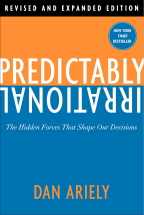
Predictably Irrational was first published in February 2008, and given the relative ease of modifying books these days, I decided to add some of my reflections on the stock market crisis — and create an expanded edition of Predictably Irrational. Once I decided to add some material, I also realized that I have learned some new things in the last two years about some of the original chapters in Predictably Irrational, so I added some material about these topics as well.
The expanded edition will come out on May 19th, with a somewhat different cover (see below), more material, and also with a more aggressive stand against rational economics.
I am looking forward to the reactions to this version, and in particular to the criticisms from rational economists.
 Order from Amazon
 Recently I wrote a short summary of Christakis’s research for Time magazine 100 people of 2009. Here is my summary of the research:
Social scientists used to have a straightforward, if tongue-in-cheek, answer to the question of how to become happy: Surround yourself with people who are uglier, poorer and shorter than you are – and who are unhappily married and have annoying kids. You will compare yourself with these people, and the contrast will cheer you up.
Nicholas Christakis, 47, a physician and sociologist at Harvard University, challenges this idea. Using data from a study that tracked about 5,000 people over 20 years, he suggests that happiness, like the flu, can spread from person to person. When people who are close to us, both in terms of social ties (friends or relatives) and physical proximity, become happier, we do too. For example, when a person who lives within a mile of a good friend becomes happier, the probability that this person’s good friend will also become happier increases 15%. More surprising is that the effect can transcend direct links and reach a third degree of separation: when a friend of a friend becomes happier, we become happier, even when we don’t know that third person directly.
This means that surrounding ourselves with happier people will make us happier, make the people close to us happier – and make the people close to them happier. But social networks don’t transmit only the good things in life.
Christakis found that smoking and obesity can be socially infectious too. If his thesis proves out, then the saying that you can judge a person by his or her friends might carry more weight than we thought.
A few people have been asking me if there is a good way to self diagnose the swine flu.
Luckily there is a highly accurate test (with accuracy above 99.9%).
Step 1: ask yourself: do I have the swine flu?
Step 2: scroll to the bottom of this screen
Congratulations! You don’t have the swine flu
What is amazing to me is how little evidence we have to support any side of this debate and yet how certain each person is in his position.
Maybe what we need is research directed at the beliefs that drive our political system and convictions.
Here are the first two question of the exam I just gave:
1) My parents and grandparents would be most proud of me if:
a. I did not cheat on this exam and got the score I deserve
b. I cheated on this exam and got a score higher than the score I deserve
2) While taking this exam, I intend to:
a. cheat (e.g., by looking at other people’s answers, or showing my answers to others)
b. not cheat
I think it was effective..
It’s hard to displace a global economic crisis from headlining the news, but the pigs did it. A n variant of the H1N1 flu virus, associated in our lore with the 1918 flu pandemic, has jumped species and infected humans. There are reported deaths (though numbers and details vary wildly) and cases appear to have spread globally.
The media jumped on this new new new crisis, the politicians around the world thanked Providence for something to distract voters from their ethical lapses and the opportunity to pad their budgets, pharmaceutical stocks rallied, airline stocks tanked, and the conspiracy theories are running wild. The Russians stopped importing pork, even though you don’t get the flu from eating pork.
On the positive side, a few more people started washing their hands. This is a rational response; hygiene is an innovation that works. (Purell and other hand disinfectants work in a pinch, but washing your hands for at least one minute, with a long rinse in running warm water is better.)
Three of our predictable irrationalities give the swine flu story much more impact than it should have — and in this case, it would be better if we were more rational.
One: Unlike the agents in economic models, we have limited memory and limited thinking capacity; to manage it we shift our attention depending on outside information. Or, in non-academese, we pay attention to what’s happening now: things that are recent and things that are repeated often get more attention, even if they are not that important. Because the news focus on the negative (it’s their business model) we keep hearing about the cases discovered, and not about the millions of people who were exposed and didn’t get sick. Which gets us to point two:
Two: We overweigh new risks relative to comparable risks we are accustomed to. Around 100 people per day died in US roads in 2008, an enormous improvement over previous years but still. People obsessing about spending 5 minutes in elevators with others (an infinitesimal chance of contagion) will blithely cross the street against the light to have a artery-clogging triple cheeseburger with fries and then smoke a pack of cigarettes. These things have much higher risks, but because we have grown accustomed to them, we don’t think of the risks. They are not, in the technical term, salient; but they are much more dangerous. Still, their dangers are dry statistics and people are not good with statistics, which gets us to point three:
Three: Brains are wired to work well with stories. And there are many stories one can make from the news reports: pandemics amplified by airport air recycling and global travel; mass extinction followed by anarchy and mayhem; terrorism taking advantage of the burden on the health system; the flu as prelude to alien invasion from Alpha Centauri. Ok, the last one only works around the MIT Media Lab. But we love stories, and forget that the plural of anecdote is not data. Statistics, dry as they may be, give a lot more information than stories.
It is not that this problem is not real and important, I just don’t think that relative to our other problems, it is as big as we are making it to be.
What can we do: as the British said during the Blitz, keep calm and carry on. Take appropriate precautions, wash your hands, and if you’re sick get help and keep out of crowds.