 Tweet
Tweet  Like
Like Call for Artists to respond to research on inequality
Hosted by Dan Ariely and the Center for Advanced Hindsight
Artists from around the world are invited to attend a discussion on social and economic inequality (from the lab that hosted the “Creative Dishonesty” project), on Wednesday, February 22nd at 7 PM EST. (Artists who do not live within driving distance of Durham, NC will watch the forum streaming live online.)
Interested artists are to RSVP to the curator, Catherine Howard, at creativedishonesty@gmail.com by Tuesday, February 21st at 9 PM.
After the forum, artists interested in creating artwork in response to the research will complete an online application, including a 1-page explanation of the artist’s creative process and 2-3 digital images of past work. To be considered, applications must be submitted by Monday, February 27th at 9 PM.
Artists will be notified if they are selected to participate by February 29th and will receive a $100 stipend to complete their piece. There is no limitation to the style or media of pieces created for “PoorQuality,” but all work must be completed by May 5th.
Artwork created for “PoorQuality” will be on display at the Center for Advanced Hindsight from June 1st to August 31st with a reception on June 22nd. An exhibit catalog, including responses and reflections by the artists and the researchers, will be published. Each artist will receive a copy.
Artists will retain all rights to their piece. Works will be returned to artists after the exhibit by September 15th, 2012. If the piece is purchased, the $100 stipend will be deducted from the purchase price.
Important Deadlines
Feb 22, 7 PM – “PoorQuality: Inequality” forum at the Center for Advanced Hindsight
Feb 27, 9 PM – Deadline to apply for participation
Feb 29, 9 AM – Selected artists will be notified
May 5, 9 PM – Drop-off deadline
Jun 22, 6 PM – 10 PM – Opening reception at the Center for Advanced Hindsight
For more information about the “PoorQuality” project, contact curator Catherine Howard at creativedishonesty@gmail.com
 Call for Artists to respond to research on inequality
Hosted by Dan Ariely and the Center for Advanced Hindsight
Artists from around the world are invited to attend a discussion on social and economic inequality (from the lab that hosted the “Creative Dishonesty” project), on Wednesday, February 22nd at 7 PM EST. (Artists who do not live within driving distance of Durham, NC will watch the forum streaming live online.)
Interested artists are to RSVP to the curator, Catherine Howard, at creativedishonesty@gmail.com by Tuesday, February 21st at 9 PM EST
After the forum, artists interested in creating artwork in response to the research will complete an online application, including a 1-page explanation of the artist’s creative process and 2-3 digital images of past work. To be considered, applications must be submitted by Monday, February 27th at 9 PM.
Artists will be notified if they are selected to participate by February 29th and will receive a $100 stipend to complete their piece. There is no limitation to the style or media of pieces created for “PoorQuality” but all work must be completed by May 5th.
Artwork created for “PoorQuality” will be on display at the Center for Advanced Hindsight from June 1st to August 31st with a reception on June 22nd. An exhibit catalogue, including responses and reflections by the artists and the researchers, will be published. Each artist will receive a copy.
Artists will retain all rights to their piece. Works will be returned to artists after the exhibit by September 15th, 2012. If the piece is purchased, the $100 stipend will be deducted from the purchase price.
Important Deadlines
Feb 22, 7 PM – “PoorQuality: Inequality” forum at the Center for Advanced Hindsight
Feb 27, 9 PM – Deadline to apply for participation
Feb 29, 9 AM – Selected artists will be notified
May 5, 9 PM – Drop-off deadline
Jun 22, 6 PM – 10 PM – Opening reception at the Center for Advanced Hindsight
For more information about the “PoorQuality” project, contact curator Catherine Howard at creativedishonesty@gmail.com.
Learn more about this research at danariely.com
UPDATE: We have a new website fully devoted to our “Artistically Irrational” art series.
Check it out here: http://artisticallyirrational.ssri.duke.edu/
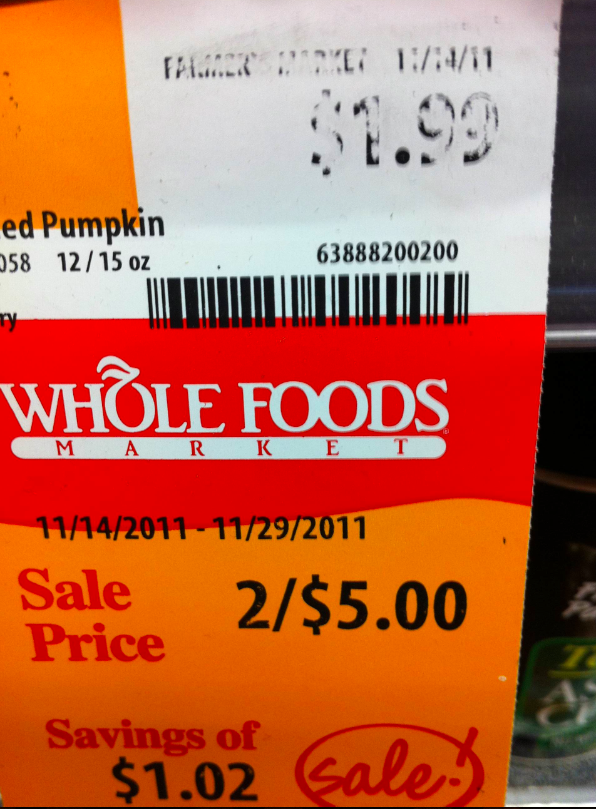
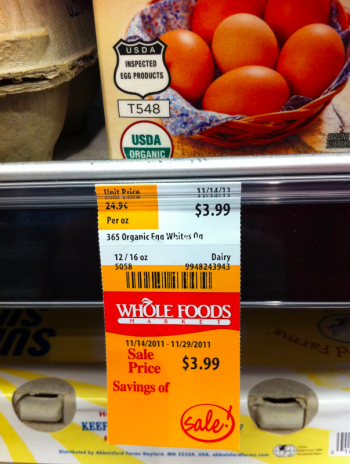
Jared Wolfe, one of the students working with me, took the following pictures at Whole Foods a few days ago. They illustrate amazing creativity in defining what the term “a deal” means.
1) Regular price is $1.99 and the Sale price is? Two of the same item for $5 — which according to Whole Foods’ quick calculation is a savings of $1.02. Amazing.
2) Regular price is $3.99 and the Sale price is? $3.99 — thankfully this time they did not add any amount to the savings.
What I am wondering is how many people just look for the orange tags and the Sale signs without even looking at the details. I suspect that this is very common, particularly in a busy and hectic grocery store and particularly when we buy many items that each of them by itself is not very expensive.
I got this picture this week. What is interesting about this price menu is that the “Fuel and Service,” priced at $9.29, is so off the scale (and so outrageous) that perhaps it makes the pre-paid option of $3.65 look attractive. After all it is about 1/3 the price of the Fuel and Service.

I came across a funny cartoon the other day that captures an interesting aspect of our purchasing behavior. We are perfectly willing to spend $4 on coffee (for some of us this is a daily purchase), or $500 on devices that you can argue we don’t really need. However, when it comes to buying digital items, such as apps, most of which are priced at $1, we suddenly get really cheap. Why?
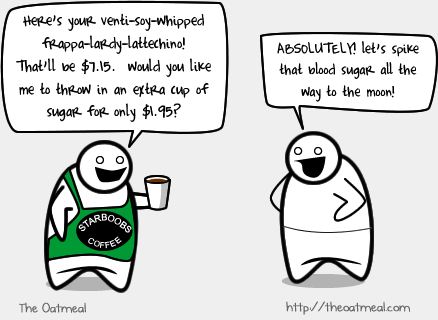
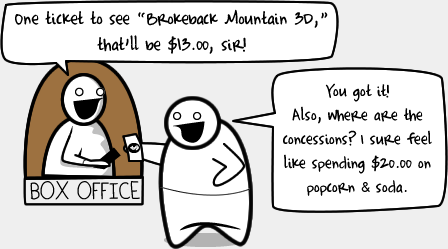
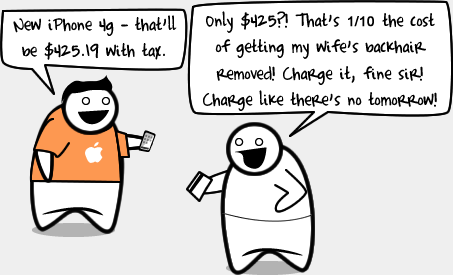
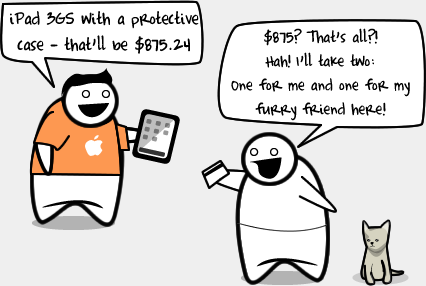
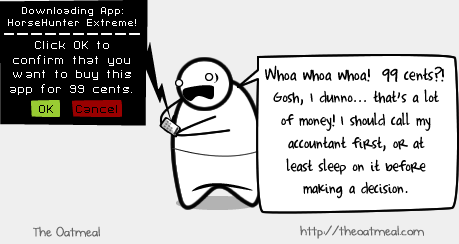
http://theoatmeal.com/blog/apps
Here are some reasons. The first is that we are anchored by the price of categories, so when we think about lattes, we compare only across beverages. When we think about apps, we only compare across digital downloads. Thus, when we think about buying a $1 app, it doesn’t occur to us to ask ourselves what the pleasure that we are likely to get from this $1 app — or even what is the relative pleasure that we are likely to get from this app compared with a $4 latte. In our minds, those two decisions are separate.
So now the question becomes, why is the price anchor for apps so low? I think the answer to this is that we have been trained with the expectation that apps should be free. Having lots of free apps on the App Store is clearly advantageous for Apple, because it makes their devices more attractive. However, because FREE! is such a special, exciting price level, it makes the thought of paying even $1 for an app into an agonizing decision.
I think this could have been avoided. Imagine if instead of offering free apps on day one, Apple instead created a really low minimum price–say $0.15. Lots of people would still go for Apps at this price, but instead of being anchored to the idea that apps should be free, we would be anchored to the idea that apps should cost something. Then paying more (maybe even $2) for an app would be a simpler step, maybe one that we could take as easily as paying $4 for a latte.
One of my long time friends just wrote me earlier today. Not seeing her for a long time I was looking forward to seeing her, and I invited her to join us for dinner on Friday night.
She was very happy to accept the invitation, and asked what she could bring. I asked her not to bring anything and just come. She wrote back insisting that she wants to bring something.
Here is my email to her ……
————————————————————————–
————————————————————————–
Many of my economist friends have a problem with gift-giving. They view the holidays not as an occasion for joy but as a festival of irrationality, an orgy of wealth-destruction.
Rational economists fixate on a situation in which, say, your Aunt Bertha spends $50 on a shirt for you, and you end up wearing it just once (when she visits). Her hard-earned cash has evaporated, and you don’t even like the present! One much-cited study estimated that as much as a third of the money spent on Christmas is wasted, because recipients assign a value lower than the retail price to the gifts they receive. Rational economists thus make a simple suggestion: Give cash or give nothing.
But behavioral economics, which draws on psychology as well as on economic theory, is much more appreciative of gift giving. Behavioral economics better understands why people (rightly, in my view) don’t want to give up the mystery, excitement and joy of gift giving. In this view, gifts aren’t irrational. It’s just that rational economists have failed to account for their genuine social utility. So let’s examine the rational and irrational reasons to give gifts.
Some gifts, of course, are basically straightforward economic exchanges. This is the case when we buy a nephew a package of socks because his mother says he needs them. It is the least exciting kind of gift but also the one that any economist can understand.
A second important kind of gift is one that tries to create or strengthen a social connection. The classic example is when somebody invites us for dinner and we bring something for the host. It’s not about economic efficiency. It’s a way to express our gratitude and to create a social bond with the host.
Another category of gift, which I like a lot, is what I call “paternalistic” gifts—things you think somebody else should have. I like a certain Green Day album or Julian Barnes novel or the book “Predictably Irrational,” and I think that you should like it, too. Or I think that singing lessons or yoga classes will expand your horizons—and so I buy them for you.
A paternalistic gift ignores the preferences of the person getting the gift, which tends to drive economists crazy, but it may actually change those preferences for the better. Of course, you might mess up by giving a paternalistic gift that someone hates, but that doesn’t mean you shouldn’t try.
A holiday gift can straddle these categories. Instead of picking a book from your sister’s Amazon wish list, or giving her what you think she should read, go to a bookstore and try to think like her. It’s a serious social investment.
The great challenge lies in making the leap into someone else’s mind. Psychological research affirms that we are all partial prisoners of our own preferences and have a hard time seeing the world from a different perspective. But whether or not your sister likes the book, it may give her joy to think about you thinking of her.
My final category of gift is one that somebody really wants but would feel guilty buying for themselves. This category shouldn’t exist, according to standard economic theory: If you really liked it and could afford it, you’d buy it.
For me, fancy pens meet this description. I don’t use pens that much, but I’d be pleased to get a really nifty one (a Porsche 911 would be OK, too). When my students defend their dissertations, I ask everyone on the Ph.D. committee to sign the required forms with an expensive pen, and then I give the pen to the student. It’s a prototypical good gift, because it’s something that they would probably feel guilty about buying for themselves, plus it has positive associations as a memento of the day.
Behavioral economics has one more lesson for gift givers: If your goal is to maximize a social connection, don’t give a perishable gift like flowers or chocolates. True, people enjoy them, and you don’t want to impose by giving something more permanent. But what are you trying to maximize? Is your goal to avoid imposing on them or for them to remember you?
For a durable impression, better to give a vase or a painting. Even if your friends don’t like it that much, they’ll think about you more often (though maybe not in the most positive terms).
Better yet, give a gift that gets used intermittently. A painting often just fades into the attentional background. An electric mixer, when used, gets noticed.
I like to buy people high-end headphones. They get used intermittently, so I can imagine that every time you put them on, you will think of me. Also, they’re a luxury—the kind of thing that people have a hard time buying for themselves. Best of all perhaps, they’re intimate: When I give someone headphones, I can think of myself whispering in their ears.
And maybe, when they use the headphones, they’ll remember you whispering to them or even kissing their ears. Has anyone ever thought of a kiss after you hand them cash?
Happy holidays — Dan
—-
This post first appeared on WSJ.com
I just posted a new study that should take you about 5 minutes to complete. If you would like to take the survey (and I would appreciate it very much), please look to the right sidebar under “Participate” and click on the “Take a quick anonymous survey” link. Thanks in advance for your help.
Irrationally Yours
Dan