Carreker Happens
 Did you know that free checking works by exploiting the everyday cash shortages of the poorest in our country? There is a company that dresses it up and sells it to banks.
I recently moved to Durham from Boston, and as it goes I had to set up new accounts to establish services for my loft. Part of this task involved deciding on a bank to take my deposits and facilitate payments. I set up a simple matrix to help me decide on a bank that included two simple categories: proximity and fees. There were plenty of banks within a reasonable distance to me, but where my matrix failed was in the fee category.
Apparently, “free” checking accounts are now ubiquitous. Sounds good, right? Not for me. I work in behavioral economics. Free checking looks to me like Winnie the Pooh walking out of a XXX movie theater. In other words, innocence doesn’t have sweat on its sneaky brow. There is no such thing as free, it’s just hiding. Cost can be intangible, but this is not the case with free checking. So, who pays for free checking for all of us? Consumers with illiquidity issues, and these are the people who need their money the most. There cannot be a worse target. What used to be called a penalty fee for overdrafting an account is now called a convenience fee or value added service. How appealing. These fees add up and happen frequently enough to offer free checking.
I had to ask, from whom are all of these banks getting this bright idea? I found that banks of all sizes offer free checking, so this tells me that there must be a third party facilitator. I searched for B2B bank products under the granddaddy of all bank facilitators, Fiserv, and smiling at me like Miss America with AIDS was none other than Carreker.
Carreker calls it Revenue Enhancement and it is a very attractive service for any bank that puts money before fairness to consumers. Carreker enables a bank to collect on penalty fees and clear transactions in real time, which is how Carreker can boast that the bank will see immediate results. It is not because they have done something truly beneficial for the customer. Most of all, Carreker actually controls the overdraft decisions. They have their hand on the penalty revenue throttle. As a customer’s account goes negative, they can allow the customer to overdraft not once but for several transactions, thus incurring high fees. Senior Vice President and Managing Director of Carreker Revenue Enhancement, Jeff Burton, claims that the “fee income market is fine” provided that you [the bank] position yourself with Carreker to share in the wealth.
Aggressive revenue seeking has changed the manner of normal operations into more of a production model. Banks now call overdraft penalties by a new name: exception revenue. Furthermore, they want you to see it as if they are doing you a favor and that it is okay, in fact perfectly fine as you now know, if you need to overdraft your account. The negative connotation has been replaced by the notion that your bank is forgiving and would never prevent you from making that gratifying purchase. It is not right to allow customers to pay an average of 9 X $30 if they miscalculate their account balance. Alas, Carreker does not stop with their exception revenue system.
Burton states that they have gone as far as to create a special framework for one of their clients to allow them to profit from payday loans. This is what they call their approach to increase overall revenue and customer utilization. I’m not sure about you, but I am not here to be “utilized.” Carreker will continue to innovate new ways to capitalize on the hardships of consumers. Most frighteningly, they are not just an idea firm because they actually provide the framework, algorithms, and integration to allow the bank to carry on these evil deeds.
For what’s it’s worth, I changed my decision matrix to seek a bank that had all around low fees, so I can avoid living off of the money of people who desperately need it. I’m still looking.
~Myles Leighton~
 Tweet
Tweet  Like
Like Upside of Irrationality: Chapter 10
Here I discuss Chapter 10 from Upside of Irrationality, The Long-Term Effects of Short-Term Emotion: Why We Shouldn’t Act on Our Negative Feelings.
Upside of Irrationality: Chapter 9
Here I discuss Chapter 9 from Upside of Irrationality, On Empathy and Emotion: Why We Respond to One Person Who Needs Help but Not to Many.
Upside of Irrationality: Chapter 8
Here I discuss Chapter 8 from Upside of Irrationality, When a Market Fails: An Example from Online Dating.
Upside of Irrationality: Chapter 7
Here I discuss Chapter 7 from Upside of Irrationality, Hot or Not? Adaptation, Assortative Mating, and the Beauty Market.
Upside of Irrationality: Chapter 6
Here I discuss Chapter 6 from Upside of Irrationality, On Adaptation: Why We Get Used to Things (but Not All Things, and Not Always).
If the video is not working — www.youtube.com/watch?v=9pzB3NXr7ys
FREE! in Swedish Medicine
I recently learned of an interesting innovation in medical pricing coming from Sweden. This pamphlet from the healthcare authority states (translated): “If you have a respiratory problem and you don’t take antibiotics for it during your first visit to the doctor, you have the right to a second visit within five days free of charge”.
This approach is using the power of FREE! in an attempt to get people to reduce their use of antibiotics. But, I wonder if this approach might be too powerful, such that it will get people who do need antibiotics not to get them. And I also wonder whether this approach will be particularly effective on people who have less money — which might not be ideal.
Better (and more) Social Bonuses
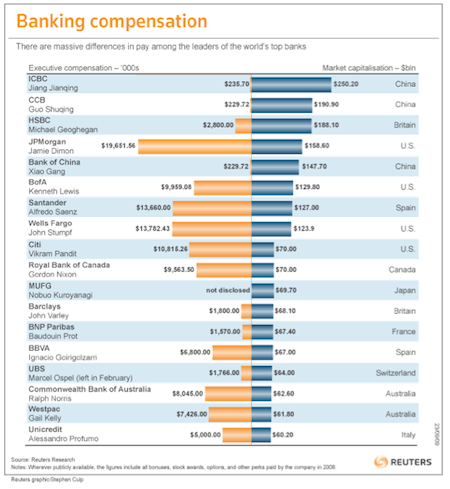
Over the last few years, many individuals (myself included) have been feeling tremendous anger about the level of executive compensation in the US, an anger that is particularly strong against those in the financial sector. As you can see in the chart below, there is an incredible gap between CEO compensation in the US compared to most other countries. Bankers are paying themselves exorbitant wads of cash, seen in both in their salaries and bonuses. And in their defense, the bankers in question claim that such extravagant wages are essential to properly motivate them, and that without such motivation they would just go and find a job somewhere else (they never exactly specify which jobs they will get and who will pay them more, but this is another matter).
Inordinate compensation levels aside, it is important to try and figure out more generally how payment translates into motivation and performance. There is a general assumption that more money is more motivating and that we can improve job performance by simply paying people more either in terms of a base salary, or even better as a performance-based incentive – which are of course bonuses. But, is this an efficient way to compensate people and drive them to be the best that they can be?
A new paper* by Mike Norton and his collaborators sheds a very interesting light on the ways that organizations should use money to motivate their employees, boost morale and improve performance – benefiting both employees and their organizations. The researchers looks at a few ways that money can be spent and how that affects outcomes such as employee wellbeing, job satisfaction and actual job performance. Specifically, they examine the effect of prosocial incentives, where people spend money on others rather than themselves, and they find that there are many benefits to spending money on others (think about the inherent joy of gift-giving).
In the first experiment, the researchers gave charity vouchers worth $25 or $50 to Australian bank employees and asked them to donate the money to a charity of their choice. Compared to people who did not receive the charity vouchers, those who donated $50 (but not $25) claimed to be happier and more satisfied with their jobs.
The second experiment took the concept of prosocial incentives a step further by directly comparing people who were asked to spend money on themselves (a personal incentive) with those who were asked to purchase a gift for a teammate (a prosocial incentive). This experiment took place in two different settings — with sales and sports teams — and looked at a broader range of outcomes. It not only examined employee satisfaction, but also the other side – benefits to the organization in terms of employee performance and return on investment. While neither sales nor sports teams improved when people were given money to spend on themselves, Norton and his colleagues found vast improvements for those who engaged in prosocial spending. While they were purchasing a gift for a teammate, they also became more interested in their teammate and were happier to help them further in multiple other ways.
If we compare these experiments, we can also see that while a gift of $25 did not make a difference when it was donated to a faceless and impersonal charity, a gift of $20 provided numerous positive outcomes when it was given in the form of helping out a teammate. Thus, it appears that we can reap the greatest benefits when we spend money on others, and even more when we spend money on close others.
Taken together, these results also suggest that our intuitions are leading us down the wrong path when we assume that we will be happiest and most motivated when we earn money to spend on ourselves. The findings from this paper can be extended to recommendations for current business practices, particularly in cases where compensation is very high. In fact, Credit Suisse has gotten a head start on adopting the idea of prosocial spending, as it has recently implemented a program requiring its employees to donate at least 2.5% of their bonuses to charity. Now, is this just a PR trick to try and diffuse some of the anger that people feel these days about bankers, or is this a real effort to increase and improve motivation? I don’t know. But what is clear to me is that prosocial incentives, either in the form of charitable donations or team expenditures, can be an effective means of encouraging more positive behavior for the individual, their teammate and for society.
* Norton MI, Anik L, Aknin LB, Dunn EW & Quoidbach J (manuscript under review). Prosocial Incentives Increase Employee Satisfaction and Team Performance.
Upside of Irrationality: Chapter 5
Here I discuss Chapter 5 from Upside of Irrationality, The Case for Revenge: What Makes Us Seek Justice?.
Big City, Small Robot
 Several years ago, I began to make human-dependent cardboard robots and place them on the streets of New York City. These little robots, which came to be known as Tweenbots (a combination of the words “between” and “robot”), roll at a constant speed, in a straight line, and have a flag that says that they are trying to get to a certain destination (e.g., the southwest corner of Washington Square Park). The flag asks for people to aim the Tweenbot in the right direction to reach its goal.
New York City is a large and bustling place – and if one ascribes to the stereotypes about New Yorkers’ helpfulness, the outlook did not appear promising for these little cardboard robots.
On the other hand, the Tweenbots are irresistibly cute. They have a cheerful posture and move along at a bumbling pace. As you look down at them, the first thing you see is an iconic smiley face made of two large circles for eyes and a line for a mouth.
Scott McCloud, who writes about the theory of cartoons in his book Understanding Comics, explains the deeply embedded mental processes that compel us to interpret everything in our own image; we can’t help but transform two dots and a line into a face. For McCloud, the less realistic –the more abstract and iconic– a character’s features, the more easily we fill in the details based on our own perspective and imagination, “assigning identities and emotions where none exist.” We project ourselves onto characters so that we not only identify with them, we inhabit and become them.
Over the course of a few months, as I observed people interacting with the Tweenbots, I came to realize just how powerful their anthropomorphic and emotive qualities were. At first, I started to perceive this through people’s use of simple gestures that are commonplace in our everyday social interactions; when a pedestrian looked down at a Tweenbot’s smiling face, they couldn’t resist smiling back. This automatic mimicry is a sort of emotional contagion, and goes beyond unconsciously mirroring another’s expression – it also implies that you can “catch” or feel the emotions of another. I saw this automatic response over and over again, and hoped that by smiling in response to the Tweenbots, people were actually feeling happier. I also came to recognize that people were experiencing deeper emotional connections when, moments after they characterized the Tweenbot as happy and non-threatening, they seemed to consider the Tweenbot’s presence in the context of the big city and respond empathetically to their plight.
Empathy is being able to walk a mile in someone’s shoes, to vicariously experience and understand what another is going through. As I watched some people bend down and gently orient the Tweenbot in the right direction, it occurred to me that the Tweenbots were inviting people to extend beyond themselves to experience the city from the perspective of a tiny and tragically cheerful cardboard robot. With their improbable presence on city streets, Tweenbots are the quintessence of vulnerability, of being lost, and of having intention without the means of achieving their goal alone. We all know –or can imagine– what it feels like to be lost or helpless in the face if the city’s massive network of streets, subways and crowds. But this overwhelming milieu may also be the reason that we ignore others who may need help as we go about our daily routines. The unexpected appearance of the Tweenbot, along with their disarming appearance, disrupted the self-focused navigation of the city, inviting people to stop and interact. New York brought the Tweenbots to life when people projected their own feelings onto the simple forms of the Tweenbots, and in a small way for just an instant, they perhaps saw themselves looking up from the sidewalk as a helpless cardboard form.
It seemed entirely possible that this empathetic connection was what motivated so many people to help the Tweenbots. Every time a Tweenbot got stuck in a pothole or started to grind futilely against a curb, someone would come to its rescue. Strangers, who seconds before would have no reason to talk to one another, came together to help. People talked to the Tweenbots, and asked for directions on the Tweenbot’s behalf when they did not know which direction to aim it. Of all the amazing interactions, my favorite was when one man turned a Tweenbot back in the direction it had just come, saying out loud to it “you can’t go that way, it’s toward the road.”
~Kacie Kinzer~
To learn more about the Tweenbots, you can check out the website here.
Tweenbots from kacie kinzer on Vimeo.