Draw a Bicycle
My guess is that you feel that you know how a bicycle works. You’ve seen them all your life. You may have seen one this morning. If I asked you to rate, on a scale of one to ten, how well you understand a bicycle, you would probably say eight or nine. Basically, you would feel that you understand how bicycles look and how they work.
But, what if I asked you to take a piece of paper, and draw a bicycle? My guess is that if you started drawing a bike, the wheels, the pedals, the chain, the frame, you would realize that your confidence in your knowledge is somewhat misplaced.
In 2006, a psychologist at the University of Liverpool named Rebecca Lawson ran a version of this experiment. She gave participants a partial drawing of a bicycle that had the wheels and the handlebars, and she asked them to fill in the frame, the pedals, and the chain. Beforehand, the participants rated how well they understood how a bicycle works. They rated themselves high. After they drew the bicycle, almost none of them could draw a working one. Pedals attached to the front wheel. Chain that ran through the front fork. Frames with bars in the wrong places. Some of the bicycles were so wrong that they could not have been ridden. After the drawing exercise, when participants were asked to rate their understanding again, the average rating dropped by nearly half.
The low knowledge but high confidence when it comes to bicycles is not an unusual case. Lawson’s study was inspired by an earlier, broader piece of research by Leonid Rozenblit and Frank Keil at Yale, called “The Misunderstood Limits of Folk Science.” Rozenblit and Keil asked participants to rate their understanding of a long list of common objects and processes: how a flush toilet works, how a helicopter takes off, how a sewing machine sews, how a zipper closes, how a presidential election decides anything. People rated themselves confidently on most items. Then the researchers asked them to write a step-by-step explanation of how each item worked. The explanations were thin. After writing them, participants dropped their confidence ratings sharply, and the drop persisted even after they read accurate explanations from experts.
Rozenblit and Keil called the gap between what we feel we understand and what we understand “The Illusion of Explanatory Depth.” And it is an illusion that we carry it with us almost everywhere we go. The reason we carry this illusion is straightforward. We see a bicycle work. We see a flush toilet work. We see a zipper work. We see a medication reducing fever. The thing we observe is the surface. The mechanism is hidden. Our brain mistakes the smoothness of the surface for an understanding of the mechanism, because the smoothness is what we directly experience. Pull the covers off, and we realize that the mechanism is very different than what we imagined it to be.
The good news is that the illusion of explanatory depth is one of the most repaired-by-experience cognitive biases I know of. The repair is simple. Try to explain. Try to draw. Try to teach. The moment we try to clearly express our understanding, our true understanding becomes calibrated to some degree, and closer to our actual level of knowledge.
This last part is what I find most hopeful in this research. if the illusion can be punctured by a single attempt to truly explain what we understand, there is hope. So, here is an exercise I prepared for you. Follow this link and explore one thing that is both important and that you believe in very strongly. Something that you believe and other people don’t. The link below would help you do the kind of bicycle exercise for your belief.
I truly encourage you to try it.
https://decisionaids.danariely.com/belief-audit/
Draw a Bicycle
(The Short version: Adapted from Misbelief)
My guess is that you feel that you know how a bicycle works. You’ve seen them all your life. You may have seen one this morning. If I asked you to rate, on a scale of one to ten, how well you understand a bicycle, you would probably say eight or nine. Basically, you would feel that you understand how bicycles look and how they work.
But, do you?
There is a research stream called “The Misunderstood Limits of Folk Science.” In this kind of research participants are asked to rate their understanding of a long list of common objects and processes: how a flush toilet works, how a helicopter takes off, how a sewing machine sews, how a zipper closes, how a presidential election decides anything. People rated themselves confidently on most items. Then the researchers ask them to write a step-by-step explanation of how each item worked. The explanations come out thin. And the good news? After trying to explain what they thought they understood, participants dropped their confidence ratings sharply, and the drop persisted even after they read accurate explanations from experts.
This is truly fantastic news because it tells us that the illusion of explanatory depth is one of the most repaired-by-experience cognitive biases I know of. The repair is simple. Try to explain. Try to draw. Try to teach. The moment we try to clearly express our understanding, our true understanding becomes calibrated to some degree, and closer to our actual level of knowledge.
This last part is what I find most hopeful in this research. if the illusion can be punctured by a single attempt to truly explain what we understand, there is hope. So, here is an exercise I prepared for you. Follow this link and explore one thing that is both important and that you believe in very strongly. Something that you believe and other people don’t. The link below would help you do the kind of bicycle exercise for your belief.
I truly encourage you to try it.
 Tweet
Tweet  Like
Like The Shredder Problem
A few years ago, my university introduced a new procedure: every research center would submit a quarterly report. I knew what this was. Anyone who has spent time inside a large institution knows what this is. It was a document that would exist so that someone could say a document existed.
But I decided to treat it differently. I gathered the whole lab and made the case that if we had to write this thing anyway, we might as well write it well, and that describing everything we were doing, with real depth, might teach us something about ourselves as a lab. People bought in. We worked hard. The report was long, well reasoned, carefully documented, and submitted on time.
What came back, almost six months later, was a note about serial numbers. Someone had checked each of our research protocols against another list and found that a few numbers didn’t match. That was the only focus of the review process. Nothing about what we were studying, or why, or what we had found.
I want to be precise about what happened, because it isn’t quite the usual story. Our report wasn’t thrown away, and it wasn’t ignored. Somebody read it. They just read it for the one thing that didn’t matter and passed over everything that did. I remember the feeling in the lab afterward: not anger, exactly, but deflation, and a quiet collective decision that next quarter we would not try so hard.
That feeling is the subject of this essay. How much does it cost when the work we do disappears into a drawer or a shredder? And how little would it take to prevent it?
Legos
In 2008, Emir Kamenica, Drazen Prelec and I tried to put a number on this. We paid people to build Lego Bionicle figures. The pay started at two dollars and dropped by a few cents with each figure, so that at some point everyone would decide the next one wasn’t worth it and stop.
The only difference between our two conditions was what happened to the figures afterward. In one, each finished Bionicle went under the table, to be taken apart at the end of the session. In the other, the experimenter dismantled it right in front of the participant, while they were starting the next one, and put the pieces back in the box to be rebuilt. We called this the Sisyphean condition.
Same pay, same task, same Legos. People in the first condition built about eleven figures. People in the Sisyphean condition built about seven. And a smaller finding that I still think about: in the first condition, people who loved Legos built more, as you’d expect. In the Sisyphean condition, that relationship vanished. Watching your work get destroyed severed the link between enjoying something and doing it.
We then ran a version with a task nobody could love: finding pairs of identical adjacent letters on sheets of random text, again for declining pay. In one condition the experimenter glanced at each finished sheet, nodded, and put it on a pile. In another, the sheet went on the pile unread. In the third, it went into a shredder. The acknowledged group kept working until the pay dropped to about fifteen cents a sheet. The shredded group quit at about twenty-nine cents. The ignored group quit at about twenty-eight.
Hold on to that. Being ignored was as bad as being shredded, and a glance and a nod were worth almost half the pay. When we asked a separate group to predict these results, they got the direction right and the size badly wrong. They assumed meaning would matter a little. It mattered a lot. We titled the paper, with a wink at Viktor Frankl (1959), “Man’s Search for Meaning: The Case of Legos” (Ariely, Kamenica & Prelec, 2008).
What we didn’t know
The study had limits. Our participants were adults in a single session, and meaning took one form: your work survives for an hour. Three questions stayed open. How small a dose of meaning is enough? Is this need something we absorb from years of jobs and performance reviews, or is it there earlier? And does meaning change what people choose to do, not just how long they persist?
The traditional view in developmental psychology was that the need for significance arrives in adolescence or later (Damon, Menon & Bronk, 2003). Erikson (1968) placed concerns about legacy in mid-life; Maslow (1971) put meaning near the top of his pyramid, a mark of the self-actualized. On that view, a four-year-old shouldn’t care whether her drawing gets kept.
Meaning at age four
This summer, Yilin Liu and Fan Yang (2026) published a paper in Psychological Science that adapted our task for children between four and nine, with adults tested alongside them. The setup was even more minimal than ours. Children could build a heart out of puzzle pieces, and the heart would either go in a box or be taken apart. Nothing was said about how long the box would be kept, whether they’d see the heart again, or what it was for. It would simply exist, or not.
About eighty percent of the children chose the box game, and said building the heart mattered more there. So did about eighty percent of the adults. Then the researchers asked whether people would pay for this. One game cost a sticker, the other was free. When both games saved the heart, eighty-five percent of the children took the free one. When only the costly game saved the heart, half of them gave up the sticker. And this happened only when they had made the heart themselves; when the choice was about watching pieces move on their own and be saved or not, nobody paid. We don’t want objects to survive. We want our own work to survive.
The third study is the closest to our Legos. Participants were offered an easier option: skip the heart and just move the pieces into the box. When the heart would be saved, eighty-three percent of adults built it anyway. When it would be taken apart, only thirty-four percent did. Among the children, the older they were, the more likely they were to take the easy way out when their work was doomed. Somewhere between four and nine, we learn that if it’s going to be destroyed, don’t bother.
Finally, the researchers tried the obvious fix and told one group that the point of the game was to have fun. It helped, but it did not close the gap. Enjoyment compensates for missing meaning partially, not fully.
Two things follow. The dose of meaning required is tiny: a box, with no promise attached. And the need is there before anyone has explained to us what impact or legacy is supposed to mean.
Not a lab curiosity
If this were only Legos and puzzle hearts, you could dismiss it. Adam Grant (2008) had university fundraisers spend five minutes with a student whose scholarship their calls had funded; in the following month they raised far more than colleagues who hadn’t. Dana Chandler and Adam Kapelner (2013) paid crowdworkers to label medical images; those told the images were tumor cells for cancer research labeled more of them, and more carefully, for identical pay. Economists now write review articles about work as a source of meaning (Cassar & Meier, 2018), and people reliably say they’d accept lower salaries for work that matters (Hu & Hirsh, 2017). Meaning is not a soft benefit. It behaves like a wage.
Why organizations shred without noticing
Nobody at my university set out to demoralize a lab. That is exactly the problem. Three things make shredding invisible to the people doing it.
The first is the prediction failure from our third experiment: managers know meaning matters and underestimate by how much, so they never budget for it. The second is that shredding is usually a side effect of tidiness. Reorganizations, cancelled projects, dashboards that count outputs, compliance checks on serial numbers: each is sensible housekeeping, and each quietly tells someone that the part of their work they cared about was not the part anyone looked at. The third is speed. Liu and Yang (2026) end their paper worrying about fragmented, transient engagement, and I’d extend the worry to how we now work with AI: drafts generated and discarded in seconds, nothing looked at twice. We are building environments that are very good at making things and very bad at keeping them.
The cheapest intervention in management
The lesson is not “make work meaningful,” which sounds expensive and vague. It’s narrower. Find where you are shredding, and stop. Find where you are ignoring, and look, and nod. A glance was worth almost half the pay in 2008. A box was enough for a four-year-old in 2026.
When the serial-number memo arrived, all it would have taken was one sentence at the top: “We read this; the work on X looks interesting.” It would have cost nothing. Instead my lab learned what the nine-year-olds learned: if it’s going to be shredded, don’t bother. Meaning is cheap to give and expensive to withhold, and we are remarkably bad at noticing when we withhold it.
References
Ariely, D., Kamenica, E., & Prelec, D. (2008). Man’s search for meaning: The case of Legos. Journal of Economic Behavior & Organization, 67(3–4), 671–677.
Liu, Y., & Yang, F. (2026). Moved by the lightest touch of meaning: Even minimal significance matters for motivation from childhood. Psychological Science, 37(8). https://doi.org/10.1177/09567976261462874
Grant, A. M. (2008). The significance of task significance: Job performance effects, relational mechanisms, and boundary conditions. Journal of Applied Psychology, 93(1), 108–124.
Chandler, D., & Kapelner, A. (2013). Breaking monotony with meaning: Motivation in crowdsourcing markets. Journal of Economic Behavior & Organization, 90, 123–133.
Cassar, L., & Meier, S. (2018). Nonmonetary incentives and the implications of work as a source of meaning. Journal of Economic Perspectives, 32(3), 215–238.
Hu, J., & Hirsh, J. B. (2017). Accepting lower salaries for meaningful work. Frontiers in Psychology, 8, 1649.
Damon, W., Menon, J., & Bronk, K. C. (2003). The development of purpose during adolescence. Applied Developmental Science, 7(3), 119–128.
Erikson, E. H. (1968). Identity: Youth and Crisis. W. W. Norton.
Maslow, A. H. (1971). The Farther Reaches of Human Nature. Viking.
Frankl, V. E. (1959). Man’s Search for Meaning. Beacon Press.
Structured Procrastination in the Era of AI
We have always found ways to feel productive while avoiding the hard work of thinking. AI agents just gave us the best one yet.
There’s a term in behavioral economics that I think helps organize the world in a very interesting way. There are many such terms, but this is one I particularly love: structured procrastination.
The idea is that we want two things at the same time, and they pull in opposite directions. We want to feel that we are making progress. But we also want to procrastinate — not to put in hard effort right now. The hard effort we happily assign to some future version of ourselves; the present version prefers to do things that are easy and fun. Structured procrastination is a kind of compromise we strike between these two desires: activity that delivers the feeling of progress without demanding the effort.
In the old days, we had two main ways of managing this balance.
The first was tidying. We organized our desks. We wrote to-do lists — and if we were really good at this, the first item on the to-do list was “write a to-do list,” so that we could cross something off within seconds. We got the sensation of achievement without investing any real energy.
The second was paperwork. Whenever something difficult and complex was waiting for us, we could escape into it: forms, procedures, all the tasks that don’t require much thought but give us the feeling that we are moving forward. After all, at some point this paperwork has to be done. Why not now?
The third version
I think a third version of structured procrastination — and surely the most interesting one — is emerging now, in the era of AI, and in particular of AI agents. This one is more seductive than its predecessors, because it lets us feel that we are making progress while avoiding the hardest work of all: actual thinking.
Imagine you have a real task in front of you. One path is to think, think, think, plan, plan, plan — and then execute. This is difficult, and not only because thinking is effortful. It’s difficult because as you think and plan, you might discover that you got things wrong. That your idea is not at the quality you expected. That there are parts you can’t yet solve. Thinking is where our ideas get confronted, and confrontation is uncomfortable.
The other path is to take a half-baked thought and send your agent to start working on it.
Here is what makes this genuinely new. Until the era of AI, structured procrastination was a choice between tasks. We could pick something that required deep thinking, or we could pick something shallow — the to-do list, the emails, the bureaucracy. Now the choice lives inside a single task. Let’s say I need to accomplish something for work. Within that very same task, I can decide to spend a lot of mental energy — be deliberate, be thoughtful, make a plan — or I can simply say to my agent: “Hey, I have this half-baked idea. Start working.”
Tokens are the new to-do list
Remember that structured procrastination is a balance: we don’t want to spend the effort of thinking, but we still want to feel that we’re getting somewhere. So where does the feeling of progress come from in this new version?
It comes, in magnificent form, from watching our AI agent burn tokens.
In the past, you would write a to-do list and cross things off, and every crossed-off line gave you a small hit of progress. Now you can watch the agent work. You can see the output streaming, the tasks being spawned, the tokens being consumed — and that gives you exactly the same feeling. Something is happening. Things are moving. I am making progress. Not only that, but it’s burning millions of tokens. What a great feeling of progress. So much hard work is being invested — and there is a counter to prove it.
So what I would like to argue is that we have entered a new era of structured procrastination. It is no longer just about the choice between tasks; we can now procrastinate inside a task. And the feedback we get in the form of tokens consumed is a bottomless supply of exactly the satisfaction that structured procrastination demands from us. The to-do list eventually ran out of items. The token counter never runs out.
What doesn’t change
The uncomfortable part is that the thinking still has to happen. The question is only when. If we do it before we hit “run,” we discover the holes in our idea cheaply, while they are still just thoughts. If we skip it and let the agent run, we discover many of the same holes later — after the tokens have been spent, and after we have grown attached to output that looks finished.
So here is a small test I’m trying on myself. Before I send an agent off to work, I ask: have I done enough of the difficult thinking? If the honest answer is no, then what I’m about to do isn’t delegation. It’s structured procrastination with a very convincing progress bar.
I’d be curious to hear your version. What is your “hey agent, start working” moment — and what did it let you avoid?
The Surprisingly Low Price of Treason
Why Iranian handlers pay their spies so little — and what it teaches us about how we all negotiate with our own conscience
A friend recently shared with me a quote from the Times of Israel’s daily podcast, on an episode about Israelis who spy for Iran. It’s the kind of quote that anyone should read twice:
“…if the Iranian handlers offered lots of money, then the soldiers or the civilians or whoever it is involved would feel like they are actually carrying out treason if it’s in exchange for lots of money. But when it’s a small amount of money? They feel less bad about it.”
Stop and notice how strange this sounds. Standard economics says that if you want someone to do something costly and risky — and betraying your country is about as costly and risky as it gets — you should pay them more. Bigger incentive, more takers. And yet here are the handlers, professionals in the business of getting people to cross lines, deliberately paying less. Not because they’re cheap. Because small payments work better.They have, in effect, rediscovered something we found in the lab almost twenty years ago.
In our research on dishonesty, Nina Mazar, On Amir and I gave people a simple math task and paid them per correct answer, with an easy opportunity to cheat. The standard economic prediction is that people would cheat as much as they could get away with. That’s not what happened. People cheated — but just a little. A few questions here and there, well below what they could have safely claimed. We called the force behind this the “fudge factor”: the idea is that we want the benefits of cheating, but we also want to keep seeing ourselves as good, honest people, and we resolve this tension by cheating exactly up to the point where our self-image starts to complain. Small transgressions slip through our moral accounting unrecorded. Big ones get flagged.
And here is the detail that connects directly to the Iranian spies: in our experiments, raising the payoff for cheating did not increase cheating. If anything, when the amounts got large, people cheated less. Taking ten dollars you didn’t earn makes you “someone who rounded up.” Taking a hundred makes you a thief — and that label is precisely what the fudge factor cannot digest.
The Iranian handlers understand this accounting perfectly. I don’t think they have read our research or my book, but I think they have learned the same lesson from their own experience over time. The payment isn’t really compensation; it’s a categorization device. Nobody can accept a million dollars to photograph a secret military installation and still tell themselves a story in which they’re not a spy. The money itself would scream the truth. But a few hundred dollars to take a picture of a street corner? That’s not treason, that’s a gig. “It’s just to cover expenses.” The small price tag keeps the act filed in the mental drawer of small favors, right next to inflating an expense report — and that is the drawer our conscience never audits.
But this is just the first act of the journey down the slippery slope of doing things we wouldn’t have imagined we would do. There’s a second act to this playbook. Once someone has taken the small payment and done the small task, they’re no longer a person who would never work for Iran — that line is already behind them. The next request can be slightly bigger, and refusing it now means admitting that the previous one was wrong too. One small, cheaply-priced step at a time, people walk into places they would never have agreed to jump to.
I don’t expect many of my readers to be approached by foreign handlers. But all of us run the same accounting system, and all of us are surrounded by people who price things to keep them feeling small — and by our own inner handler doing exactly the same (“it’s just one invoice,” “everyone rounds up a little”). The espionage cases are just the extreme edge of a very ordinary machinery: the really dangerous transgressions rarely arrive looking big. They arrive priced small, precisely so our conscience will wave them through.
So here is the lesson, and it’s one worth teaching our kids and our organizations: when you’re deciding whether something is right, judge the act, not the price tag. And if someone ever offers you suspiciously little money for something that feels a bit off — understand that the smallness of the offer is not reassuring. It is the most alarming thing about it.
Source: The Times of Israel Daily Briefing, “As both sides keep striking, is there still a Lebanon ceasefire?”, April 26, 2026.
Mazar, N., Amir, O., & Ariely, D. (2008). The dishonesty of honest people: A theory of self-concept maintenance. Journal of Marketing Research, 45(6), 633–644.
Ariely, D. (2012). The (Honest) Truth About Dishonesty: How We Lie to Everyone—Especially Ourselves. New York: Harper.
Where On the Funnel Are You?
We picture a change in beliefs in other people as a switch. Someone was fine, and then one day they were not, and somewhere in between there was a video with some misinformation. It is a comforting picture, because it implies a fix. Find the bad video, replace it with a better one and all is well.
The problem is that this view is wrong.
Nobody falls into misbelief. People slide, slowly, pulled by four psychological forces. Every one of those forces is part of the standard human equipment. You are running all four right now. So am I.
Why do I use the term funnel
A funnel is wide at the top and narrow at the bottom. Many people enter it, fewer continue down, and the further down you go the harder it becomes to climb back out. Not because the arguments get better. Because near the bottom, the walls are no longer made of arguments at all. They are made of relationships, identity, and the price of admitting that the last two years were a mistake.
The four forces
Emotional. This is the force at the top, and it starts with stress, particularly the unpredictable kind you cannot plan around. Stress makes us want a villain. Run that backwards and the appeal of a conspiracy becomes obvious. A story with a villain in it is a story where somebody is at the wheel. That is easier to live with than random harm that can attack again at any point.
Cognitive. This is what happens to the search once you are motivated to find something specific. You do not weigh evidence, you go looking for it, and the internet always has the answers you were looking for. And the cognitive elements do not end there. They include a few other components, including our tendency for little knowledge but overconfidence.
Personality. This is about who slides faster, and it is the uncomfortable section. Higher patternicity, which means seeing signal in noise, the sense of control, intellectual humility and narcissism, are all elements that fit the personality part of the funnel.
Social. This is what makes the whole thing permanent, and it is the force almost everyone underestimates. It is the main event. Once you are inside, leaving costs you every relationship you have left. Extremity stops being about the belief and starts being a way of belonging.
So I built a set of questions that walks you through it
You can use it to diagnose someone else, or yourself.
Each answer visibly moves one of four thermometers, with a short explanation of why it moved
https://decisionaids.danariely.com/funnel/
One more, for the force you most likely think does not apply to you
The cognitive force is the one nearly everybody exempts themselves from. Rather than argue with you about that, here is something additional that you can do to yourself in five minutes.
Rate how well you understand something you deeply believe in. Then explain how it actually works, step by step. Then rate yourself again. One belief, no score at the end. It asks what you can explain, not what you can defend, and the gap between the first rating and the second one is the entire point.
When Is It OK to Decide for Other People?
Four conditions that make me more comfortable with paternalism
Let’s talk about paternalism. Paternalism and behavioral economics are deeply intertwined, and here is why. If you believe that people are perfectly rational, the conclusion is simple: let them make whatever decisions they want. After all, every one of their decisions is rational, so who are we to interfere? But the moment you start saying that we are irrational — that we are not designed to think long-term, that we are easily tempted, that computing compound interest is not something our brains do well — you have opened a different door. If people are predictably irrational, then maybe we also need to help improve their decisions. Maybe, sometimes, we need to limit their options.
And of course, in many areas of life we already accept paternalism without blinking. We accept traffic laws; you can’t just drive wherever you want, at whatever speed you want. You want to use heroin? No, you can’t do that either. And yet you can invest your money almost anywhere you want, in almost anything, with almost no one standing in your way. So the interesting question is not whether paternalism is good or bad in general. The interesting question is: when do we feel more comfortable being paternalistic, and when should we insist on leaving people alone?
After thinking about this question for a while, here are the conditions that, for me, make paternalism more acceptable.
Condition one: the decision is big and consequential. Think about retirement savings. A mistake there is not a bad lunch; it’s a mistake that shapes decades of your life.
Condition two: the decision is hard to reverse. This is connected to size, but it’s not the same thing. If you get your retirement wrong, you discover it at age 65, and there is no version of “oops, let’s start over.” Some mistakes come with an undo button, and some don’t. The ones that don’t deserve more protection.
Condition three: it is hard to learn from experience. If you ask me whether I prefer broccoli to cabbage, I don’t need anyone’s help — I can try both, and over time I’ll figure it out. Trial and error works beautifully for vegetables. But there are domains where we simply don’t get a good learning process. Much of medicine is like this: as individuals, we don’t get enough tries, the feedback is slow and noisy, and by the time we’ve “learned,” the lesson may have cost us dearly. Where learning is impossible, the case for letting everyone learn on their own collapses.
Condition four: there is a large information gap. I’m buying a house; the person selling it knows a great deal about it, and I know very little. I walk into a doctor’s office; my doctor knows a lot, and I know almost nothing. When one side of a decision holds most of the cards, “let the individual decide freely” is a nicer-sounding arrangement than it is a fair one.
Put these four together — a big decision, hard to reverse, resistant to learning, with deep information asymmetry — and under those conditions I feel much more comfortable saying: let’s not make everyone figure this out alone. Let’s do the work collectively, figure out what is good for most people, and make that the standard. Not a prison, a standard.
What is the right path for retirement savings? Should every person work it out for themselves, or should we say: big decision, impossible to learn from experience — let’s set sensible defaults? What should we do with people who got injured and are trying to make their way back to work? Should each of them navigate that maze alone, or are there some things we should do together?
Notice that the same four conditions also tell us when to keep our hands off. Small decision? Reversible? Easy to learn from? Both sides equally informed? Then leave people alone — that is exactly the territory where freedom to make our own mistakes is how we learn, and where paternalism has no business.
Now it’s your turn. If you have other conditions that you think should be on this list, I want to hear them. And if you think there are behaviors where I’m wrong — where we should be less paternalistic even though they rank high on all four conditions — let me know.
The Chapter I Could Not Write
After I finish a lecture there is usually a line, and most of the people standing in it want a book signed. But someone always waits until the line is gone. They stand off to the side while the room empties out, and then they ask me the question I have now been asked in something like a dozen countries.
It is never “why do people believe this stuff.”
It is almost always “my brother.” Or “my mother.” Or “my closest friend since we were nine.” And then, more quietly: what do I do.
They are not asking for an explanation. They want instructions for what they could do next with people that they love.
What I say about this in Misbelief?
Misbelief is not stupidity. That is the first thing to say and the hardest thing for people to accept. Stupidity is a very comfortable explanation that allows us to ignore the person and the problem. It is also very incorrect. What I found instead was a funnel that takes people and changes them over time. It starts with stress that pushes people to look for anything that would explain to them what is going on. It is not any kind of stress that pushes us to find an answer, it is, especially the unpredictable kind of stress. The kind of stress that makes us wonder about what is really going on. After stress, our cognitive gets to work and after that personality joins in. Finally, the social forces of acceptance and belonging, echoing beliefs and becoming more extreme, cement the misbelief, and it makes leaving the group of misbelievers very expensive
I did not choose this subject. It chose me in 2020, when I started appearing in other people’s videos as an Illuminati henchman, complete with a speech I never gave.
The chapter I could not write
When I started working on Misbelief, I assumed I knew how the book would end. There would be a final chapter, and that chapter would tell you how to get your brother back.
I planned for it. I read for it. I spent two years interviewing for it.
I did not find it.
The trouble is that once people enter the funnel the forces to maintain them there are just too powerful. It also became clear that the standard responses of simply giving people more information or giving them some facts is not going to do much to change anyone’s opinion.
So, instead of one solutions chapter, the book grew small boxes scattered through it,wherever the research actually supported doing something. I called them “Hopefully Helpful.”
That name is not modesty. It is an accurate description of my confidence. Some of them will help some people some of the time, and I cannot tell you in advance which ones. There are 25, spread across chapters 3 through 11.
One is called “How to Have a Nondebate,” which is about removing the scoreboard from a conversation so that neither of you is playing to win. Another is “The Three Razors,” which hands you Occam’s razor, Hitchens’ razor, and a gentler version of Hanlon’s, offered as hygiene for your own thinking rather than as weapons for somebody else’s.
All 25, in one place
Enough people wrote asking me for specific pieces of advice that I finally pulled all 25 out of the book and put them into a single document. It is here for you to read.
https://misbeliefbook.com/pdfs/Hopefully-Helpful-Boxes.pdf
I also realized that 25 pieces of advice might be too much to go through. Maybe it is Thursday. You are about to have a conversation on Sunday. You are already upset, and you are not going to read a booklet and work out which four paragraphs apply to you.
So the boxes became a tool. It asks up to three questions about the conversation you are actually about to have, and then hands you three of the 25. Not all of them. Three.
https://decisionaids.danariely.com/conversations/
I did not stop there and I created a second tool. This is not a tool to plan a conversation, it is a tool that was created to try and fix something about a conversation that maybe did not go the way you planned for it to go. It is a post-mortem you run the same evening, while it is still fresh. Thirteen questions, about three minutes.
The design of this tool, and what I think makes it worth while is that it asks what you did, not what you meant. From the inside, those two feel like the same thing. They are not, and the distance between them is where most of these conversations quietly go wrong.
https://decisionaids.danariely.com/went-badly/
What I had to give up
Writing this book cost me a belief of my own. It was the belief that there is an answer that could make a person take a U-turn and come back. There isn’t such simple answer. What is left is smaller, and it is about aiming for small steps over time.
And here again are all the links. Hopefully, you will make good use of them.
The 25 boxes, free: https://misbeliefbook.com/pdfs/Hopefully-Helpful-Boxes.pdf
Before the conversation: https://decisionaids.danariely.com/conversations/
After the conversation: https://decisionaids.danariely.com/went-badly/
Which Country Would You Choose, If You Didn’t Know Who You’d Be Born As?
Before we argue for the perspective of a particular political party, it’s worth pausing for a question an American philosopher posed more than fifty years ago. When I asked thousands of people to answer it honestly, I discovered something surprising: our disagreements are far smaller than we think.
Imagine the following exercise: tomorrow morning, you are born again. You don’t know which family you’ll arrive into. Maybe a wealthy home, maybe a poor one. Maybe a big city in the center of the country, maybe a remote town. Maybe you’ll be born healthy, maybe with a serious illness. You know nothing about the particular situation you’ll be born into. Now ask yourself: what would you want that country to look like? How would you want it to treat its citizens?
This exercise was proposed in 1971 by the American philosopher John Rawls, in a book — “A Theory of Justice” — that is considered to this day one of the cornerstones of thinking about justice. Rawls called the idea “the veil of ignorance,” and his claim was simple and profound: a just society is one you would be willing to enter it in a random position.
A just society is a society we would be willing to enter first and only then learn that we have been born into a particular economic setting, a medical condition, a gender, and ethnicity.
Under normal circumstances, when we are asked whether our country is a just one, we answer partly from the perspective of justice — but we can’t help but to also answer from the perspective of our own narrow, particular interests. The rich tend to think high taxes are a bad idea; the poor tend to think the opposite. And these narrow interests shape our sense of justice in every domain of life.
But behind the veil of ignorance, when we don’t know whether we will end up at the top or at the bottom, only the question of justice itself remains. What, really, is a just country?
For years, the veil of ignorance served as an important exercise in philosophy seminars. Then my colleagues and I decided to see what happens when you hand it to real people. We asked them to design a country that would be, in their eyes, just — from behind the veil of ignorance. We surveyed a representative sample of more than five thousand Americans: rich and poor, Republicans and Democrats.
What we learned from the results was that Americans thought a just country would be even more equal than Sweden. And, of course, they thought that the actual distribution of wealth in the United States is very far from just.
What was even more interesting: the agreement. Rich and poor, Republicans and Democrat voters (in the 2004 election), men and women — all of them drew remarkably similar ideal distributions. In the noisy political debate, they seem like they are serious enemies. Behind the veil of ignorance, the distance between them nearly disappears.
As our own elections approach, it’s worth running this exercise on our own political beliefs. Ask yourself honestly: would you be willing to enter today’s United States of America in a random position? And if the answer is no — what USA would you design from behind the veil of ignorance?
My guess, based on what we saw in the study, is that if we think in veil-of-ignorance terms, we will discover that we want a very different country from the one we have — and also, mainly, that we agree on much more than we think.
If you find this topic interesting, I’m attaching below two links, one for a very wonderful YouTube video that somebody did about our research, and another one for a short TED lecture I gave on the same topic.
https://www.youtube.com/watch?v=QPKKQnijnsM
https://www.ted.com/talks/dan_ariely_how_equal_do_we_want_the_world_to_be_you_d_be_surprised
Advanced Review of My New Book: MISBELIEF
David Pitt reviews my new book in this month’s edition of Booklist.
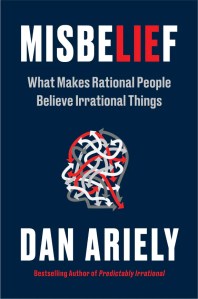
Misbelief: What Makes Rational People Believe Irrational Things.
By Dan Ariely.
Sept. 2023. 320p. Harper, $32 (9780063280427). 300.Social scientist Ariely (Irrationally Yours, 2015; Dollars and Sense, 2017) has spent years focusing on the way we often embrace ideas that are irrational, and here he turns his at- tention to misinformation specifically. Based in part on the author’s own experiences as the target of deliberate disinformation—with seemingly rational people believing lies about him—the book is an insightful examination of the underlying psychological factors that bolster misinformation’s appeal. It covers our natural tendency to accept ideas that reinforce our own beliefs (and to dismiss those that contradict them), and the way the spread of misinformation is reshaping our society. Ariely is a persuasive writer, offering plenty of anec- dotal examples to bolster his arguments and show how misinformation alters people’s lives. It’s a rigorous but also deeply compassionate book: Ariely’s goal isn’t to condemn people who fall for misinformation, but to show the reader how easy it is to believe the irrational. The book asks us to foreground empathy to reexamine some of our own beliefs. For some readers, the results could be eye-opening. —David Pitt
Full link to Booklist: https://booklist.booklistonline.com/html5/reader/production/default.aspx?pubname=&edid=6d2991a4-9d82-4321-9c01-8a678a578755
My new book MISBELIEF will be out on September 19th! You can pre-order it here https://misbeliefbook.com.
Ask Ariely: On Perfection Premiums and Digital Devices
Here’s my Q&A column from the WSJ this week — and if you have any questions for me, you can tweet them to @danariely with the hashtag #askariely, post a comment on my Ask Ariely Facebook page, or email them to AskAriely@wsj.com.
___________________________________________________
Dear Dan,
Every time my sister hosts a dinner party, she insists that every last tidbit of food she serves be homemade. This high standard is wearing on her. To make her life easier, I proposed buying a few items, but she balked at the idea. Why is she so invested in making everything from scratch, despite the stress?
—Roxanne
Your sister might be experiencing a “perfection premium,” which is the tendency to overrate something because it’s perfect—and in her case, 100% homemade.
The perfection premium was demonstrated in a study about socks. Researchers asked some people how much more they would pay for socks that were 100% Merino wool compared with socks that were 98% Merino wool. They asked others about their willingness to pay for socks that were 96% Merino wool compared with socks that were 94%Merino. In both cases, the question was about the value they placed on an additional 2% wool—but in the first case, that 2% made the socks a perfect 100% wool, while in the second case, it was just an increase of 2% more Merino wool. The participants were willing to pay much more for the 2% increase when it brought the total to a perfect 100% compared to when it was just a 2% increase.
These findings show that people place a premium on perfection, perhaps because we put things that are perfect in a different mental category than those that are near-perfect. For your sister, making 95% of a meal from scratch rather than 100% may have the benefit of saving time, but it would cost her with the loss of the perfection premium. With this in mind, Instead of interfering with her pride in a perfectly home-cooked meal, you could try to work with it—for example, by suggesting that she purchase desserts from a baker at a local farmer’s market. These items aren’t technically ‘homemade,” but you might be able to help her think about them as such.
___________________________________________________
Dear Dan,
My teenage kids spend a lot of time on their phones, especially on social media. I’m worried about what all this screen time does to their mental health. Should I put strict limits on their screen time?
—Yasmin
How your kids use their devices matters much more than for how long they use them —especially during times when face-to-face interactions are limited, such as school vacations or during COVID-19.
Over a period of six weeks during Peru’s most stringent COVID-19 lockdown, researchers in Peru surveyed teenagers about screen time. They asked about their subjects’ experiences online: their feelings of loneliness or of wellbeing and their sources of social support. The study found that chatting with friends and family or joining multiplayer video games had a positive effect on the teenagers and left them feeling less lonely and with higher well-being. Passive engagements, on the other hand—such as enviously scrolling through retouched Instagram selfies—took a toll on teens’ loneliness and wellbeing.
Given that forming friendships and interacting with people outside of the family is especially important to teenagers, spending more time online during COVID could be positive, provided that the time online is used to actively engage with others and not to passively engage with the digital world.
See the original article in the Wall Street Journal.