Ask Ariely: On A Midlife Cliché
Here’s the missing Q&A from my Ask Ariely column yesterday…
______________________________________________________
Dear Dan,
I am a middle-aged guy who’s doing OK financially, and I’m thinking about buying myself a sports car—perhaps a Porsche 911. But I’m also a bit disturbed by the obvious midlife cliché. What would you do?
—Craig
Tesla designs cars for people with your exact conflict. The Tesla is a sports car, but it has an environmental image, and those who buy it can look at themselves as green, not gray.
______________________________________________________
See the original article in the Wall Street Journal here.
 Tweet
Tweet  Like
Like Ask Ariely: On Superstitious Toasts and Exploring the Unknown
Here’s my Q&A column from the WSJ this week — and if you have any questions for me, you can tweet them to @danariely with the hashtag #askariely, post a comment on my Ask Ariely Facebook page, or email them to AskAriely@wsj.com.
______________________________________________________
Dear Dan,
At a dinner party a few years ago, we were raising our glasses to our hosts’ health. The person on my right said that every time you make a toast, you need to look straight into the eyes of the person you’re toasting as your glasses touch—and that failure to do so inevitably results in five years of bad sex. I don’t think anyone around the table believed in that superstition, but we found it very amusing and, for the rest of the night, looked into each other’s eyes while toasting. I don’t think of myself as superstitious, but since that dinner party, I find myself looking very intently into peoples’ eyes whenever I toast. I know I am being irrational, so why can’t I shake this superstition?
—Kathleen
If you were going to design a superstition, this one is as close to perfect as you’re likely to get. For starters, the cost of the ritual (looking into each other’s eyes) is low, and in fact pleasurable. On the other hand, the cost of ignoring the ritual is very high (years of rotten sex). It’s certainly not worth risking such a large consequence for such a small act. And like all good superstitions, the outcome in question occurs far into the future and is difficult to evaluate objectively.
The only thing I might add would be a method to make things right after a missed opportunity. Perhaps if someone forgets to make eye contact, they should have to close their eyes and have the person next to them hold a glass to their lips and help them drink? With this addition, you would have a perfect ritual and superstition to make any party a bit more fun.
Incidentally, I told a friend about this five-year deal, and his response was, “Only five years?”
______________________________________________________
Dear Dan,
As summer finally gets closer, we are starting to plan our family vacation. The past few years, we have gone to Florida for two weeks. Should we stick to this familiar plan or try something different?
—Michael
In general, sticking with something well-known is psychologically appealing. Our attraction to the sure thing explains why, for example, we often frequent the same chain restaurants when we travel—and even order the same familiar dishes. Sure, we might enjoy something new more than the sure thing, but we also might not. And given the psychological principle of loss-aversion (whereby we dislike losses more than we enjoy gains), the fear of loss looms heavy, and we decide not to risk trying anything new.
That’s a mistake, for three key reasons. First, if you think about a long time horizon (say, 20 more years of vacations and eating out), it is certainly worth exploring what else may be out there before settling into a limited set of options. Second, variety really is one of the most important spices of life. Finally, vacations are not just about the two weeks you are away from work; they’re also about the time you spend anticipating and imagining your trip, as well as the time after you are back home when you replay special moments from your vacation in your mind. Among these three types of ways to consume the vacation—anticipation, the trip itself and consuming the memories afterward—the shortest amount of time is spent on the vacation itself.
Given all this, the short answer is: try something new.
______________________________________________________
See the original article in the Wall Street Journal here.
Cross-Coursera Dishonesty Debate
Today, at 7:30pm Eastern time, watch the legendary moral philosopher Peter Singer, the distinguished psychologist Paul Bloom, and the expert behavioral economist Dan Ariely (me) as we join hands to discuss our views and research on dishonesty, morality, and ethics. This is our attempt to bring our respective disciplines (and coursera classes) together on topics that we all find very interesting.
Watch the recording below.
Ask Ariely: On Late-night Raids, Home Improvement, and the Magic of Memory
Here’s my Q&A column from the WSJ this week — and if you have any questions for me, you can tweet them to @danariely with the hashtag #askariely, post a comment on my Ask Ariely Facebook page, or email them to AskAriely@wsj.com.
______________________________________________________
Dear Dan,
Whenever I work the night shift, I wind up raiding the fridge—and ruining my diets one after the other. During the day, I manage to resist the temptation, but at night, my self-control seems to stop working. What should I do?
—Meni
What you describe is a well-known phenomenon called “depletion.” All day long, we face small temptations and do our best to resist them. We maintain control over ourselves so as to be productive, responsible people and stop ourselves from caving in to our urges to shop, procrastinate, watch that latest cat video on YouTube and so forth. But our ability to resist urges is like a muscle: The more we use it, the more tired we become—until at night, it just becomes too weak to stop us. (This is one reason the temptation industry—bars, strip clubs—operates mostly at night.) One way to overcome this problem is based on the story of Odysseus and the sirens. In this story Odysseus told his sailors to tie him to the mast as they sailed near the island of the sirens and not to untie the ropes under any circumstances so he couldn’t be tempted to jump into the water and swim toward the sirens’ seductive voices. The modern equivalent of this tactic? Keep all tempting things out of your house. You can hope that your future self will be able to resist temptation, buy the chocolate cake and eat just a sliver of it every other day. But the safer bet is not to keep chocolate cake in the fridge in the first place.
______________________________________________________
Dear Dan,
At work, I have no problems giving my subordinates feedback about their performances and suggesting improvements. But it is harder for me to give feedback to the woman who cleans my home. So I’ve adopted an indirect approach: Instead of giving her pointers in person, I leave her a note. Is there a better way?
—Galia
Leaving notes isn’t ideal. Would you leave notes for your kids on how they fell short on their chores? Would you give your husband written feedback on his performance in bed? In general, when results matter, communicating while the task is being performed (or immediately after) is the way to go, and communicating face to face makes quick communication much more natural. It may not always be fun, but it makes clear to the person performing the task what the feedback is about—and offers a greater chance for learning. The second part of your question involves the different ways you treat people at work and your cleaning lady. I suspect this difference comes from your general discomfort about having someone else cleaning your house (maybe it is something you may feel you should be doing yourself). But you’re not really helping your cleaning lady by withholding timely feedback. My suggestion: tidy the house up a bit before she shows up (as many people do), leave a generous tip but also start be more diligent about pointing out the dust bunnies she missed.
______________________________________________________
Dear Dan,
My 10-year-old daughter wonders: If a child has been really mean to her best friend (for example, by tattling on her) and their friendship falls apart, how do they manage to become best friends again after only a couple of days?
—Aviel
That is the wonder of bad memory. We enjoy this benefit when we’re young and then again when we’re old. In between, we’re unhappy and vengeful.
See the original article in the Wall Street Journal here.
Ask Ariely: On God’s Image and Marriage Money
Here’s my Q&A column from the WSJ this week — and if you have any questions for me, you can tweet them to @danariely with the hashtag #askariely, post a comment on my Ask Ariely Facebook page, or email them to AskAriely@wsj.com.
______________________________________________________
Dear Dan,
Why are there so many religions, all of which suggest that God is on their side and holds the same values that they do?
—Moshe
One answer comes from a 2009 study by Nick Epley and some of his colleagues from the University of Chicago, which asked religious Americans to state their positions on abortion, the death punishment and the war in Iraq. (This study is described in Dr. Epley’s recent book, “Mindwise: How We Understand What Others Think, Believe, Feel, and Want.”) Participants were then asked to predict the opinions of a few well-known individuals (such as Bill Gates), President Bush, the “average American,” and—and uniquely to this study—God on these issues.
Interestingly, the respondents were rather objective about predicting the opinions held by their fellow humans, but they tended to believe that God had similar opinions to their own. Conservatives believed God was very conservative; liberal believers were certain that God was more lenient.
To find out why we can view God so flexibly, a follow-up experiment asked another group of participants to take the position on the death penalty diametrically opposed to their own and argue this viewpoint in front of a camera. A large body of research on cognitive dissonance has shown that people who are forced to argue for an opinion opposite to their actual one feel so uncomfortable with the conflict that they’re likely to change their original opinion. After giving their on-camera speech, participants were again asked to express the views on these hot-button issues of the study’s famous individuals, President Bush, the “average American” and God.
The results? After expressing the opinion opposite their original one, individuals became more moderate. Those who disliked the death penalty became less opposed, and those who were for it became less so. But there was no such shift in participants’ predictions of the opinions of the well-known individuals, President Bush or the “average American.” And what about their predictions about God’s views? Participants tended to attribute the same position as their own new, more moderate viewpoint to God.
God, apparently, is something of a clean slate on which we can more easily project whatever we wish. We subscribe to the religious group that supports our beliefs, and then interpret Scripture in a way that supports our opinions. So if there is a God, I believe—no, I’m sure—that that (s)he thinks the way I do.
______________________________________________________
Dear Dan,
My partner and I will soon be married, and in honor of the event, his parents have promised us some money. Now my parents have offered us double that amount. How can I tell my partner without making him feel uncomfortable?
—Nikki
Congratulations—I hope you’ll have a lovely wedding and a good life together.
As for your question, the problem is not just that your future husband and his parents will feel uncomfortable; it is also that your dynamics as a newlywed couple will proceed from an uneven starting point. I am not suggesting that every time that the two of you fight, you will remind your husband that it was your family’s money that let you buy a new house. But even small inequalities at the start of a marriage can have long-term effects.
If I were in your shoes, I would ask your parents to give you the same amount now that your fiancé’s parents are giving—then give you the second amount in a year, once the marriage is more established. (If you’re not sure you will stay together, maybe ask them to wait five years.)
Incidentally, since weddings are irrational in so many ways, I recently obtained a license to perform weddings through some online site—and now I’m waiting for the first couple to ask me to conduct their nuptials (hint hint).
See the original article in the Wall Street Journal here.
A Documentary about (Dis)Honesty
It is my greatest pleasure to announce a documentary that I have been working on with Yael Melamede of Salty Features.

Today, we launch a Kickstarter campaign that will help us finish the film and build its presence in the world.
[protected-iframe id=”0c35872a2195114e20aa1c3cbc1f5c0b-1285065-1348005″ info=”https://www.kickstarter.com/projects/1501481976/dishonesty-a-documentary-feature-film/widget/video.html” width=”480″ height=”360″ frameborder=”0″ scrolling=”no”]
Please visit our Kickstarter Page to learn more about (Dis)Honesty and to become part of this special project.
Then, share the project with all your family members, closest friends, acquaintances, the cashier at your local grocery store, that guy you bumped into on the way to work, the lady whose wallet you found on the street and returned…everyone!
Thank you for your support, and I look forward to working with you along the way.
(Dis)honestly Yours,
Dan Ariely
P.S. Like The Dishonesty Project on Facebook!
And follow on Twitter: https://twitter.com/dishonestyproj
Sign up for “Irrational Behavior”
Behavioral economics is the study of humans and their (occasionally irrational) interactions with the world. Starting on March 11th, I will teach “A Beginner’s Guide to Irrational Behavior,” a glance at the peculiar mechanics of the mind. Join me for the most riveting 8 weeks of your life, and you never know — you may just end up the next CEO of the world.
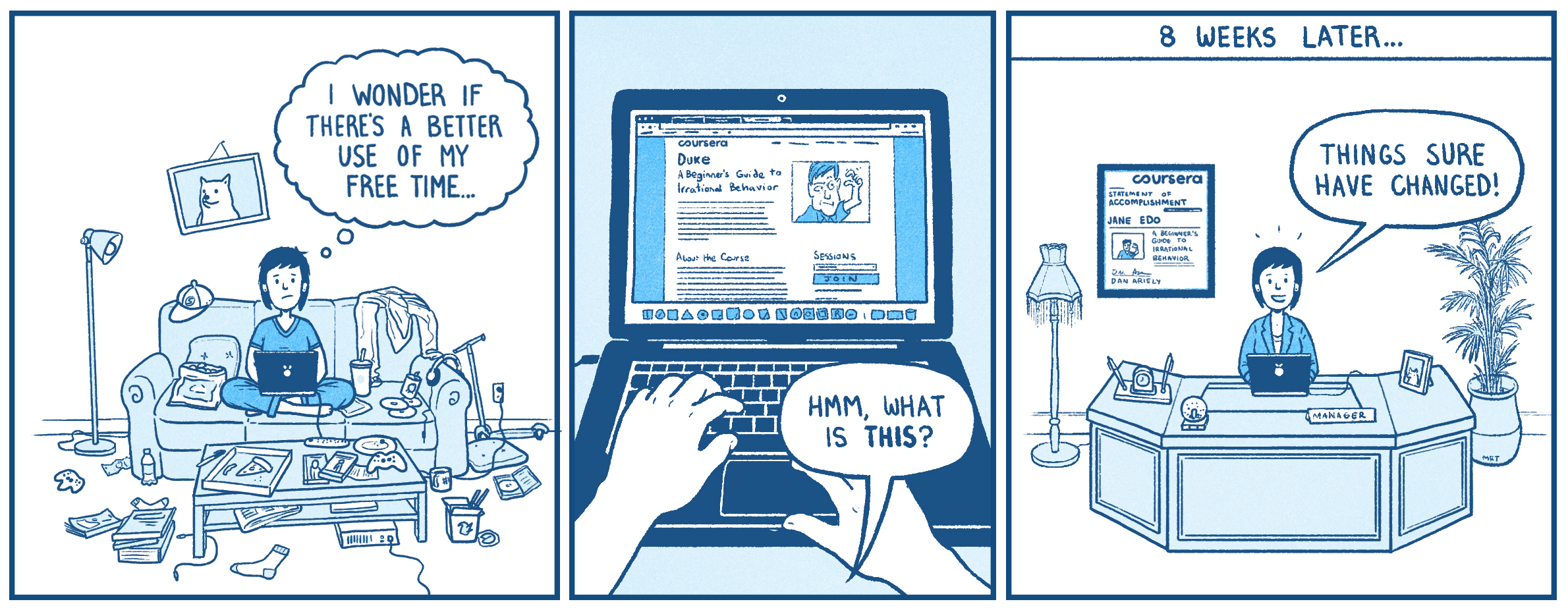
Sign up here!
Ask Ariely: On Weather Delays, Time Delays, and Garlic Cologne
Here’s my Q&A column from the WSJ this week — and if you have any questions for me, you can tweet them to @danariely with the hashtag #askariely, post a comment on my Ask Ariely Facebook page, or email them to AskAriely@wsj.com.
______________________________________________________
Dear Dan,
I was recently stuck overnight in a strange city due to a canceled flight. Because the airline blamed the cancellation on “weather,” no one helped me find a place to stay or pay for it. Meanwhile, I saw other flights leaving the same airport. Is “weather” just a term airlines use when they try to consolidate flights, not compensate their customers and avoid blame?
—Kelly
I am sure that sometimes the weather really is at fault, but I have no idea whether the airlines use the weather excuse promiscuously when it’s to their financial advantage. It would be difficult to make such a judgment call (should we call the reason for the delay the weather or technical issues?) while completely ignoring the economic incentives involved. And blaming all kinds of things on the weather is a very useful strategy for the airlines because trapped fliers don’t directly blame the airlines for it.
But let’s be honest here: Many of us also sometimes blame our own tardiness on traffic or the weather. And I suspect many of us would blame the weather even more frequently for all sorts of lapses if we just had the opportunity.
To my mind, the weather excuse (as the airlines use it) has one major problem. The airlines’ logic is that bad weather is an act of God, which releases the airline from responsibility. But isn’t the airlines’ behavior probably the reason God is angry to begin with?
______________________________________________________
Dear Dan,
How can I enjoy life more? Every year, time seems to go by faster; months rush by, and years just seem to disappear. Is there a reason for this, or is the memory of time passing more slowly when we were children just an illusion?
—Gal
Time does go by (or, more accurately, it feels as if time is going by) more quickly the older we get. In the first few years of our lives, anything we sense or do is brand-new, and a lot of our experiences are unique, so they remain firmly in our memories. But as the years go by, we encounter fewer and fewer new experiences—both because we have already accomplished a lot and because we become slaves to our daily routines. For example, try to remember what happened to you every day last week. Chances are that nothing extraordinary happened, so you will be hard-pressed to recall the specific things you did on Monday, Tuesday etc.
What can we do about this? Maybe we need some new app that will encourage us to try out new experiences, point out things we’ve never done, recommend dishes we’ve never tasted and suggest places we’ve never been. Such an app could make our lives more varied, prod us to try new things, slow down the passage of time and increase our happiness. Until such an app arrives, try to do at least one new thing every week.
______________________________________________________
Dear Dan,
My daughter recently persuaded me to start eating two cloves of garlic every day. I feel more energetic and less stressed. Is it the garlic, or is it a placebo?
—Yoram
I am not sure, but have you considered the possibility that the reason you feel so much better is that people are now leaving you alone?
See the original article in the Wall Street Journal here.
“A Beginner’s Guide to Irrational Behavior,” Take 2
You make decisions all the time. What should you eat for breakfast? Which route should you take to work? How much are you willing to pay for local, pasture-raised beef over factory farmed, corn-fed meat? Should you go for a run, jog, walk, or finish watching the last season of Breaking Bad?
Some of these decisions might be great, while others … not so much. For example, take the mind-boggling case of someone winning a chess championship one minute and texting while driving the next. Playing chess (competently, at least) requires thinking many steps ahead, considering multiple scenarios and outcomes — whereas texting while driving is a complete and utter failure of the same kind of forward-thinking. The gap between how amazing we are in some respects and completely inept in others just highlights the invaluable nature of studying how humans think and interact with the world.
So, when do we make good decisions, and when and why do we fail? Fortunately, behavioral economics does have some answers. In “A Beginner’s Guide to Irrational Behavior,” you will learn about some of the many ways in which we behave in less than rational ways, and how we might overcome some of our shortcomings. You’ll also find cases where our irrationalities work in our favor, and how we can harness these tendencies to make better decisions.
You will explore topics such as our “irrational” patterns of thinking about money and investments, how expectations shape perception, economic and psychological analyses of dishonesty by honest people, how social and financial incentives work together (or against each other) in labor, how self-control comes into play with decision making, and how emotion (rather than cognition) can have a large impact on economic decisions.
All of this, packed into just 8 weeks! Join our modern crusade to improve decision making, and hopefully learn some things on the way. Sign up now (class starts on March 11th): https://www.coursera.org/course/behavioralecon
Irrationally Yours,
Dan Ariely
Small Savings, Big Difference
What’s the best way to help low-income families improve their financial lives? One approach is “microsavings,” which are small deposit accounts that can be an incentive to save more for future goals. Research shows that these small, long-term accounts not only build assets but also promote the social and intellectual development of low-income children. In this podcast, I talk with Professor Michael Sherraden of Washington University in St. Louis about another concept of savings accounts called Individual Development Accounts (IDAs), and their potential impact on poverty in the U.S.
Listen to the podcast here.