Tag: Predictably Irrational

The paperback version of PI is out…

Apr 27

As of today the paperback version of PI is out.

I took out the parts about the stock market, and added 2 new chapters: one about the effects of social norms, and one about the cycle distrust in marketers and markets.

Sadly I cannot distribute these digitally, but if you are every in a book store or a library (or if you think that this worth $10) ….

Irrationally yours

Dan

Announcing My New Book!
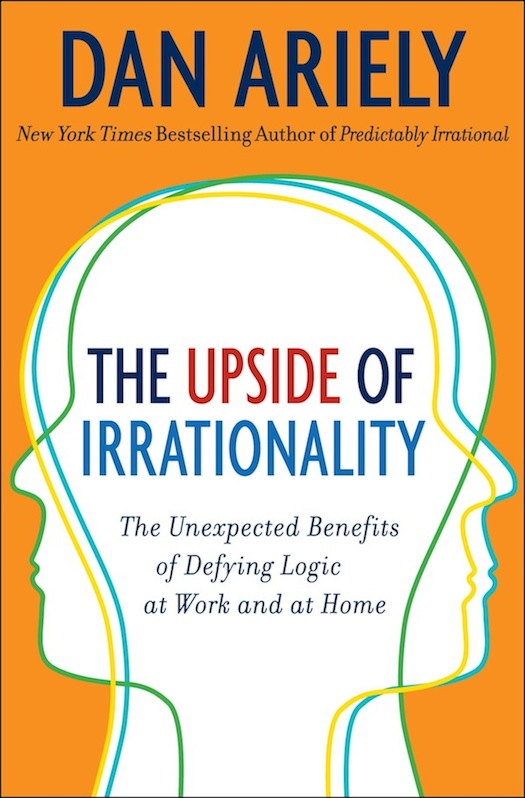
Mar 10

Here is the cover of my new book. Look for it June 1, 2010!

Predictably Irrational — 2 years

Feb 19

Predictably Irrational was published two years ago today

Mazal Tov

It has been an amazing two years

Dan

Attention Predictably Irrational Fashionistas!

Jan 15

One of our readers, Ms. Justine Chiu, has sent me two fantastic pictures of her Predictably Irrational outfit. If anybody else has fun ideas for how to dress Irrationally, please email them to me and I’ll put some more pictures up on my blog.

justinechiu_predictablyirrational_01 08-39-10-1justinechiu_predictablyirrational_02 08-39-10

Help find a name

Oct 30

I recently started working on my next book.

It is generally going to be more stories about my research and the plan is to have 3 parts

Part 1: Personal life, happiness, adaptation, dating, and online dating
Part 2: business life: motivation at work, the role of bonuses, mistrust, and revenge
Part 3: cheating: the effects of observing other people cheat, group based cheating, the effect of one dishonest act on others etc.

The current title is:

Living irrationally: the way we work, date and cheat.

If you have any other suggestions for a title, please email me at dan at predictablyirrational dot com

Many thanks

Dan

The Nuances of the FREE! Experiment

Aug 10

The New York Times and Time Magazine have recently posted interesting articles about two new books that discuss consumer behavior: Chris Anderson’s Free and Ellen Ruppel Shell’s Cheap (see links in The New York Times and Time Magazine).

Both books reference our Hershey’s Kiss experiment that is described in Chapter 3 of Predictably Irrational. If you recall, in one trial of one study we offered students a Lindt Truffle for 26 cents and a Hershey’s Kiss for 1 cent and observed the buying behavior: 40 percent went with the truffle and 40 percent with the Kiss. When we dropped the price of both chocolates by just 1 cent, we observed that suddenly 90 percent of participants opted for the free Kiss, even though the relative price between the two was the same. We concluded that FREE! is indeed a very powerful force.

It’s important to note that we have carried out lots and lots of studies on the effect of FREE!, many of which are detailed in Predictably Irrational. Describing them all, however, would be too much for those who are trying to make just one point abut this effect, so naturally we see authors making choices about which experiments to describe and which ones to leave in footnotes, or not to mention at all. But, some  kinds of omissions are made as well — ones that are important for understanding the complexity of the effect.

For example, in one study of FREE!, we tried lowering the price from 2 cents to one cent on the Kiss to see if we observed that same level of increase in demand in the Kiss. We didn’t. In another study we also tried seeing what would happen if we lowered the price from FREE! to negative one cent, and we also didn’t see a difference in behavior. We also tried the experiment on a broad demographic–not just college students, but also on children and older adults.
Personally, I think it is perfectly fine for people to take the main point from some experiments and build on it, but as readers (and writers) we should realize that often there is more complexity to the picture and that before criticizing particular findings, or citing them as supporting evidence, we should keep in mind the nuances.

Email me the expanded edition of PI!

Jun 30

A few people purchased the original version of Predictably Irrational since it came out in February 2008.

Now that the expanded edition is out, it seemed to me that the right thing would be to get the extra material to those who have purchased the book already.  After discussing this idea with HarperCollins, my publisher, we decided to try an honor system for distributing the extra material.

So — if you purchased the original version of Predictably Irrational and you want the extra material, please email  piexpanded@gmail.com and we will email you back the added information in 3 PDFs (a new introduction, added material about the original chapters, and reflections about the financial markets).

Irrationally yours

Dan

Context effect in Britain’s Got Talent?

Jun 13

I got this suggestion from Thomas Aedy in Eton College in the UK:
Dear Dan,

The final for Britain’s Got Talent was on Saturday June 30th and this final was very interesting because it involved 3 choices, 2 of which were very similar, and 1 of which was different. In our show, viewers have to vote in by telephone on the night of the show for a winner to be decided, and there was some shock when the favorite (Susan Boyle – a singer) didn’t win, and lost out to one of two dance groups (Diversity were the winners, Flawless were the other dance group) – whilst the dance group were very good, most people thought that the singer would edge win.

I think this is a case of relativism:

Option A – Singer – Susan Boyle who was generally regarded (before the final) as the favorite contender for the win

Option B – Dance group – Diverstiy

*   Probably the better of the two dance groups – more creativity and flair, and possibly more entertaining
*   That is largely my view, although their victory in the competition would suggest that they were the better of the two dance groups

Option B’ – Dance group – Flawless

*   Also a very talented dance group, but more straightforward dancing – not very many surprises from them
*   We could view them as the ‘dud’ choice of the two (although this is somewhat harsh)

General points

*   Frankly impossible to judge who were the best of all three – all of them were very talented, but it is impossible for most viewers to try and think whether Option B was better than Option A (comparing singing and dancing)
*   However, on the night, it is fair to say that Option B was better than Option B’
*   Thus whilst most found it impossible to establish who was better of A and B – it was clear that B was better than B’, and this made it easier to select an overall winner (which would be Option B)

In my mind this could be seen as an example of relativism

Very best wishes,

Thomas Aedy

PS: YouTube videos of the 3 acts if you’re interested.

Option A (singer) : http://www.youtube.com/watch?v=b2xiAQCTy2E

Option B (dance) : http://www.youtube.com/watch?v=KJIz8BgRQc0


Option B’ (dance) : http://www.youtube.com/watch?v=NY9I6pxnVpM

————-

I did not watch this show — but I find the idea plausible and interesting.

Dan

2008 was a good year for behavioral economics

May 20

Before the financial crisis of 2008, it was rather difficult to convince people that we all might have irrational tendencies.

For example, after I gave a presentation at a conference, a fellow I’ll call Mr. Logic (a composite of many people I have debated with over the years) buttonholed me. “I enjoy hearing about all the different kinds of small-scale irrationalities that you demonstrate in your experiments,” he told me, handing me his card. “They’re quite interesting-great stories for cocktail parties.” He paused. “But you don’t understand how things work in the real world. Clearly, when it comes to making important decisions, all of these irrationalities disappear, because when it truly matters, people think carefully about their options before they act. And certainly when it comes to the stock market, where the decisions are critically important, all these irrationalities go away and rationality prevails.”

Given these kinds of responses, I was often left scratching my head, wondering why so many smart people are convinced that irrationality disappears when it comes to important decisions about money. Why do they assume that institutions, competition, and market mechanisms can inoculate us against mistakes? If competition was sufficient to overcome irrationality, wouldn’t that eliminate brawls in sporting competitions, or the irrational self-destructive behaviors of professional athletes? What is it about circumstances involving money and competition that might make people more rational? Do the defenders of rationality believe that we have different brain mechanisms for making small versus large decisions and yet another yet another for dealing with the stock market? Or do they simply have a bone-deep belief that the invisible hand and the wisdom of the markets guarantee optimal behavior under all conditions?

As a social scientist, I’m not sure which model describing human behavior in markets-rational economics, behavioral economics, or something else-is best, and I wish we could set up a series of experiments to figure this out. Unfortunately, since it is basically impossible to do any real experiments with the stock market, I’ve been left befuddled by the deep conviction in the rationality of the market. And I’ve wondered if we really want to build our financial institutions, our legal system, and our policies on such a foundation.

As I was asking myself these questions, something very big happened. Soon after Predictably Irrational was published, in early 2008, the financial world blew to smithereens, like something in a science fiction movie. Alan Greenspan, the formerly much-worshipped chairman of the Federal Reserve, told Congress in October 2008 that he was “shocked” (shocked!) that the markets did not work as anticipated, or automatically self-correct as they were supposed to. He said he made a mistake in assuming that the self-interest of organizations, specifically banks and others, was such that they were capable of protecting their own shareholders. For my part, I was shocked that Greenspan, one of the tireless advocates of deregulation and a true believer in letting market forces have their way, would publicly admit that his assumptions about the rationality of markets were wrong. A few months before this confession, I could never have imagined that Greenspan would utter such a statement. Aside from feeling vindicated, I also felt that Greenspan’s confession was an important step forward. After all, they say that the first step toward recovery is admitting you have a problem.

Still, the terrible loss of homes and jobs has been a very high price to pay for learning that we might not be as rational as Greenspan and other traditional economists had thought. What we’ve learned is that relying on standard economic theory alone as a guiding principle for building markets and institutions might, in fact, be dangerous. It has become tragically clear that the mistakes we all make are not at all random, but part and parcel of the human condition. Worse, our mistakes of judgment can aggregate in the market, sparking a scenario in which, much like an earthquake, no one has any idea what is happening. All of a sudden, it looked as if some people were beginning to understand that the study of small-scale mistakes was not just a source for amusing dinner-table anecdotes. I felt both exonerated and relieved.

While this is a very depressing time for the economy as a whole, and for all of us individually, the turnabout on Greenspan’s part has created new opportunities for behavioral economics, and for those willing to learn and alter the way they think and behave. From crisis comes opportunity, and perhaps this tragedy will cause us to finally accommodate new ideas, and-I hope-begin to rebuild.

The Expanded edition is out on May 19th

May 17

2008 was a very interesting and important year for Behavioral Economics.

For many years, the common reaction to the experimental evidence showing different types of irrationality was that these irrationalities will “go away” when dealing with professional people, dealing with a lot of money, and of course acting within the competitive environment of the market.

While I never understood the intensity of beliefs in these arguments, it was not really possible to test these assertions — so this remained an academic debate.

In 2008 when the markets failed is such a miserable way, it became clear that rationality was not just playing a role in “regular” peoples’ lives, and that it was also a part of professional sector and our institutions.  Now irrationality became much more interesting to the general audience, business, and even policy makers.

Predictably Irrational was first published in February 2008, and given the relative ease of modifying books these days, I decided to add some of my reflections on the stock market crisis — and create an expanded edition of Predictably Irrational.  Once I decided to add some material, I also realized that I have learned some new things in the last two years about some of the original chapters in Predictably Irrational, so I added some material about these topics as well.

The expanded edition will come out on May 19th, with a somewhat different cover (see below), more material, and also with a more aggressive stand against rational economics.

I am looking forward to the reactions to this version, and in particular to the criticisms from rational economists.

newpicover_small.jpg Order from Amazon

« Older Entries