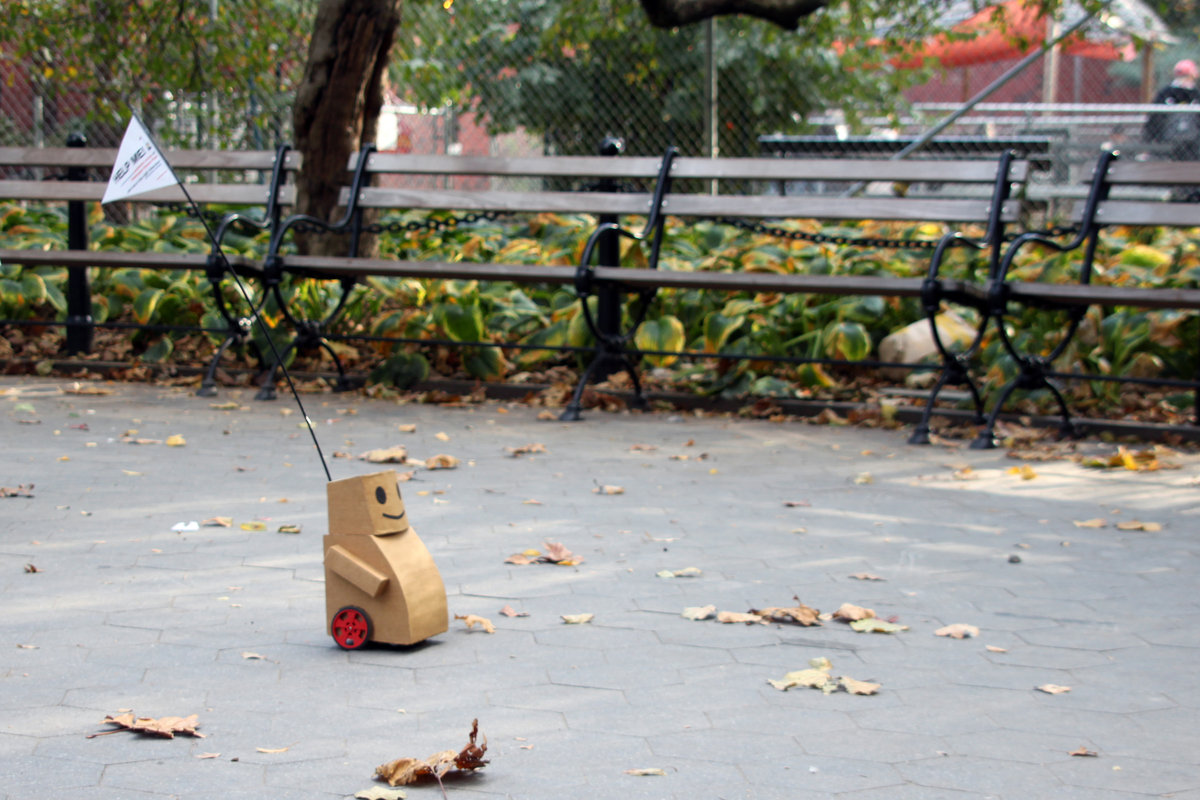
 Several years ago, I began to make human-dependent cardboard robots and place them on the streets of New York City. These little robots, which came to be known as Tweenbots (a combination of the words “between” and “robot”), roll at a constant speed, in a straight line, and have a flag that says that they are trying to get to a certain destination (e.g., the southwest corner of Washington Square Park). The flag asks for people to aim the Tweenbot in the right direction to reach its goal.
New York City is a large and bustling place – and if one ascribes to the stereotypes about New Yorkers’ helpfulness, the outlook did not appear promising for these little cardboard robots.
On the other hand, the Tweenbots are irresistibly cute. They have a cheerful posture and move along at a bumbling pace. As you look down at them, the first thing you see is an iconic smiley face made of two large circles for eyes and a line for a mouth.
Scott McCloud, who writes about the theory of cartoons in his book Understanding Comics, explains the deeply embedded mental processes that compel us to interpret everything in our own image; we can’t help but transform two dots and a line into a face. For McCloud, the less realistic –the more abstract and iconic– a character’s features, the more easily we fill in the details based on our own perspective and imagination, “assigning identities and emotions where none exist.” We project ourselves onto characters so that we not only identify with them, we inhabit and become them.
Over the course of a few months, as I observed people interacting with the Tweenbots, I came to realize just how powerful their anthropomorphic and emotive qualities were. At first, I started to perceive this through people’s use of simple gestures that are commonplace in our everyday social interactions; when a pedestrian looked down at a Tweenbot’s smiling face, they couldn’t resist smiling back. This automatic mimicry is a sort of emotional contagion, and goes beyond unconsciously mirroring another’s expression – it also implies that you can “catch” or feel the emotions of another. I saw this automatic response over and over again, and hoped that by smiling in response to the Tweenbots, people were actually feeling happier. I also came to recognize that people were experiencing deeper emotional connections when, moments after they characterized the Tweenbot as happy and non-threatening, they seemed to consider the Tweenbot’s presence in the context of the big city and respond empathetically to their plight.
Empathy is being able to walk a mile in someone’s shoes, to vicariously experience and understand what another is going through. As I watched some people bend down and gently orient the Tweenbot in the right direction, it occurred to me that the Tweenbots were inviting people to extend beyond themselves to experience the city from the perspective of a tiny and tragically cheerful cardboard robot. With their improbable presence on city streets, Tweenbots are the quintessence of vulnerability, of being lost, and of having intention without the means of achieving their goal alone. We all know –or can imagine– what it feels like to be lost or helpless in the face if the city’s massive network of streets, subways and crowds. But this overwhelming milieu may also be the reason that we ignore others who may need help as we go about our daily routines. The unexpected appearance of the Tweenbot, along with their disarming appearance, disrupted the self-focused navigation of the city, inviting people to stop and interact. New York brought the Tweenbots to life when people projected their own feelings onto the simple forms of the Tweenbots, and in a small way for just an instant, they perhaps saw themselves looking up from the sidewalk as a helpless cardboard form.
It seemed entirely possible that this empathetic connection was what motivated so many people to help the Tweenbots. Every time a Tweenbot got stuck in a pothole or started to grind futilely against a curb, someone would come to its rescue. Strangers, who seconds before would have no reason to talk to one another, came together to help. People talked to the Tweenbots, and asked for directions on the Tweenbot’s behalf when they did not know which direction to aim it. Of all the amazing interactions, my favorite was when one man turned a Tweenbot back in the direction it had just come, saying out loud to it “you can’t go that way, it’s toward the road.”
~Kacie Kinzer~
To learn more about the Tweenbots, you can check out the website here.
Tweenbots from kacie kinzer on Vimeo.
 Tweet
Tweet  Like
Like When it comes to sterilization, Denmark has had a rather turbulent history. In 1929, in the midst of rising social concerns regarding an increase in sex crimes and general “degeneracy,” the Danish government passed legislation bordering on eugenics, requiring sterilization in some men and women. Between 1929 and 1967, while the legislation was active, approximately 11,000 people were sterilized – roughly half of them against their will.
Then, the policy was changed so that sterilization was still available, still free, but not involuntary. And as you might expect, the sterilization rate in Denmark dropped down dramatically – and stayed this way until 2010.
Now we come to 2010. In only a few short months, the sterilization rate increased fivefold. No, this was not a regression to the old legislation; it was a result of free choice…
What happened? Last year, the Danish government announced that sterilization, which had been free, would cost at least 7,000 kroner (~$1,300) for men and 13,000 kroner (~$2,500) for women as of January 1st, 2011. Following the announcement, doctors performing sterilizations found that their patient load suddenly surged. People were scrambling to get sterilized while it was still free.
Now, it could be that the people who were already planning on getting sterilized at some point in the future just made their appointments a bit sooner, and conveniently saved some money. But I can also imagine that (much like our research on free tattoos) there were many people who did not really think much about sterilization before the price change, but were so averse to giving up such a good deal that it pushed them to take the offer and undergo a fairly serious procedure.
And although we usually don’t think about sterilization as an impulse purchase, it might just become one when a free deal is about to be snipped.
The recent death of Amy Winehouse should make us pause and consider the question of personal and shared responsibility. Was she solely responsible for her tragic outcome? Or was it somewhat the fault of the people around her? How do we want to think about the state of mind of a drug addict? And what does that say about their ability to make good decisions and hence their responsibility?
I am almost sure that if I were a jury member being presented with a case of a drug addict who committed a crime while in a highly emotional state of drug craving — that I would equate this state of mind to temporary insanity, and would find this to be a mitigating circumstance.
And if being in a state of drug craving can be considered a mitigating circumstance, shouldn’t this tell us that we should not expect too much personal responsibility from people who are in this state of mind? And shouldn’t the people around them (particularly the ones working with / for them) take control? There is a very nice saying that “friends don’t let friends drink and drive,” and I suspect that this rings even truer of drug cravings.
—
P.S. To clarify, my point here is not that Amy Winehouse is not to blame for her decisions, or that her friends are. Rather, I think that we need to back down from our chronic obsession with personal responsibility and realize that there are times when it is necessary to step in to help people who are not in a state to make the right decisions for themselves. Who knows, maybe the next Amy Winehouse’s daddy will try a little harder to keep her in rehab when she won’t go, go, go.
From the Huffington Post:
Would you still pay a dollar for Honest Tea if you could take it for free? On July 19, the company conducted an Honest Cities social experiment—it placed unmanned beverage kiosks in 12 American cities. There was a box for people to slip a dollar in, but there were no consequences if they did not pay.
Turns out, Americans (or at least Americans who like Honest Tea) are pretty gosh darn honest. Chicago was the most honest city, with 99 percent of people still paying a dollar. New York was the least honest city—only 86 percent coughed up the buck.
The full results:
Chicago: 99%
Boston: 97%
Seattle: 97%
Dallas: 97%
Atlanta: 96%
Philadelphia: 96%
Cincinnati: 95%
San Francisco: 93%
Miami: 92%
Washington, DC: 91%
Los Angeles: 88%
New York: 86%Honest Tea is donating all of the money collected, nearly $5,000, to Share Our Strength, City Year and Rails-to-Trails Conservancy. The company is matching the total, bringing the total donated to $10,000.
What kinds of things might have changed this very honest behavior?
Here are some open questions, or maybe future experiments to try:
1) What if the box for paying was not transparent? If it was opaque, then no one could see if the person in front of the box was really paying and there was no evidence that many people have paid before (based on the number of dollars that were there)
2) What if people approached the booth one by one and without being observed by anyone?
3) What if the experiment was conducted at night? What if people were slightly drunk?
4) What if there was an actor who would go by and take a bottle without paying? Would it make the other people be less honest? (I think so)
5) Who is more likely to be dishonest, people who come as individuals, or people who come in groups?
6) When it is sunny and people are happier, are they also more honest?
What is clear is that there are lots of interesting questions here.
Here I discuss Chapter 4 from Upside of Irrationality, The Not-Invented-Here Bias: Why “My” Ideas Are Better than “Yours”.
Here I discuss Chapter 3 from Upside of Irrationality, The IKEA Effect: Why We Overvalue What We Make.
 In the course of our lives, we come across countless opportunities to help others. The occasional homeless person or charity asks for a donation, or the Red Cross is collecting blood across the street. But most of the time, these opportunities present themselves through our social networks — simply because we interact most often with our friends. One important difference between helping friends and helping strangers is that we know our friends can pay us back in the future, whereas strangers can usually only pay it forward. Of course, all people are not able to help others to the same degree; some people have a lot to spare while others get by on a tighter budget.
My friend Sevgi and I wondered whether people are more generous when others have the opportunity to help them back in the future, and whether people reciprocate based on the value of the gift they received. Our main questions were:
1) Do people give more when they know they may get something in return?
2) Do receivers care whether their gift is more valuable in an absolute or relative sense?
To look at these questions, we had people play a simple game as one of two players: lets call them player A and player B. We give $1 to player A and $100 to player B (they both see how much the other gets). Player A can send any amount (of his $1) to player B, and then player B decides how much (of his $100) to send back. In another version of the game, player B cannot give anything back.
Does player A send more money to player B when he knows that B can send money back? How much money does player B send back when player A sends nothing, some of his money, or even his entire dollar?
Looking at the results, we see that people are a) strategic when they offer money initially and b) reciprocating after they have been given money. On average, player A sends more to player B if he knows that B can send something back. And the more that player A sends to player B, the more he receives.
However, the amount sent back by player B does not depend on the absolute value of player A’s initial offer, but on the proportion of player A’s wealth that was offered. What does this mean? If player A has $50 instead of $1 and sends half of it to B ($25), he gets back almost the same amount of money from B as he gets after sending half of $1 (50 cents!).
So, what is the lesson du jour? It turns out that people with limited resources can gain just as much from acting altrustically as those who are well-endowed. Don’t get discouraged by a thin wallet when given the chance to help others — after all, it is your generosity that counts.
~Merve Akbas~
Here I discuss Chapter 2 from Upside of Irrationality, The Meaning of Labor: What Legos Can Teach Us about the Joy of Work.
By Amit and Dan Ariely
For the past few weeks, my 8-year old son Amit and I have been observing birds, paying attention to their individual and particular behavior. We noticed that some of the birds we observed were different in their physical characteristics like color, shape and size, and that these traits varied with their behavior. This made us wonder about the possible evolutionary links between the appearance of the birds on one hand and their respective behavior on the other.
The first difference that stood out to us was between the small and large red birds. Although the larger ones were about twice as big, their ability to fly was about the same — but what was very different about the two kinds was that the larger red birds were much more aggressive and caused more damage when they attacked. Of course, the evolutionary reason for this difference in aggression seems straightforward; as the subtype of birds gets larger, they need more food, and with this increased requirement, aggression becomes an important survival skill.
The yellow subtype of birds were slightly more of a challenge to figure out. Other than being yellow, their general characteristics were similar to the red birds — but Amit and I couldn’t help but notice their tendency to suddenly fly at much higher speeds relative to the red birds. We speculated that the evolutionary reason for this difference must be that the red birds, by virtue of their threatening color, are less appealing to predators, and as a consequence they never needed to develop enhanced speed to escape. In contrast, the yellow birds practically invite predators to dine with their appealing color. With this clear disadvantage the yellow birds are forced to rely on an alternative survival mechanism, in this case the valuable skill of speed.
Another interesting feature of the yellow bird is that it is sharper, perhaps because it is a species connected with the woodpecker family. The yellow birds’ sharpness might also help it further when it needs to break down a structure or cut through wood – which again is most likely connected to their need to compensate for their color disadvantage.
The blue birds were fascinating in their ability to self-replicate, and in all of the cases we observed they produced exactly three offspring. We wondered why the blue birds evolved to produce offspring at such speed and timely consistency, and we determined that the evolutionary reason for this must be that because the blue birds are small and relatively slow, they had to develop a skill for efficient reproduction, thereby hedging their bets and increasing the potential to pass on their genes.
The white birds were even more puzzling. On multiple occasions, we watched them drop their eggs while still in flight, naturally crushing the egg. Initially this seemed to be a counter-evolutionary strategy, but once we inspected the discarded eggs we realized that these eggs were abnormal, and it was probably the white bird’s strategy for dealing with eggs that have a low potential for survival. One additional observation in support of this hypothesis is that the white birds seemed to be much healthier, lighter and happier after the eggs were discarded.
Of course there were many other birds as well, including one particularly interesting black bird, and Amit and I are thinking of continuing to pursue this bird-project for a while. In fact, we are already getting somewhat addicted to it, and we just learned that there are plenty more birds to observe in Rio.
But what really baffles us is this: why are these birds SO angry?
Amit and Dan