Here’s my Q&A column from the WSJ this week — and if you have any questions for me, you can tweet them to @danariely with the hashtag #askariely, post a comment on my Ask Ariely Facebook page, or email them to AskAriely@wsj.com.
______________________________________________________
Dear Dan,
This holiday season had me wondering: Why do people prefer to give and receive gift cards rather than cash, which you can use anywhere for anything?
—Van
Gift cards limit the way we can use money, which means that, from a strictly rational viewpoint, they are inferior to cash. But people prefer gift cards because of an irrational emotion called guilt—or, more accurately, because of our need to alleviate guilt.
When we look around us, we feel guilt over our desire for many different things: fancy chocolates, pens, expensive headsets, electronic gadgets, etc. We want these things, but the guilt caused by our wants is powerful, so it sometimes stops us.
When we get money, we’re likely to feel guilty about spending it on our more self-indulgent desires. But when we get a gift card, the guilt is much reduced and sometimes eliminated.
Interestingly, the particular level of guilt alleviation depends on the type of gift card. For example, if the card is an American Express gift card, it is basically the same thing as money, and it doesn’t ease much guilt. But if the gift card is restricted to Tiffany’s or REI, that money suddenly becomes more valuable. A dollar without guilt is worth more than a regular dollar.
And if you got any gift cards this holiday season, of any type, I suggest using them as if they were meant to be spent only in your favorite store—and enjoy them guilt-free.
______________________________________________________
Dear Dan,
I realize that mixing friendship and business isn’t always the best idea, but I’m starting a business with a friend anyway, and I want to know the best way to mix the monetary bits of the business with the social aspects. Is there a single recipe for this?
—Clara
Going into business with people we know and love is indeed tempting. So long as the venture is going well, working with friends and family can be great: The extra trust and commitment that everyone shares can help both the business side and the social relationship.
The problem is that things frequently go awry. Then the damage done is often not just the professional downside plus the social downside; it can be the professional downside multiplied by the social downside.
So I would prepare yourselves by outsourcing any disagreements. Decide upfront that every time you disagree, even on something small, you will both go to somebody external who isn’t personally involved. Each of you will then describe your side of the argument in five minutes or less and let that person decide for you—and no matter what, you will take their advice and never mention the topic again. This way, you not only have a mechanism for resolving disagreements, but you can do so quickly, before any tension can build up and destroy either your friendship or business.
One more thing: Pick a third party whom you both dislike. Some intriguing research shows that when an arbitrator is nasty, both parties feel more camaraderie, work better together to resolve the issue and, of course, want to end the disagreement as soon as possible.
______________________________________________________
Dear Dan,
A while back, a friend did me a favor with the understanding that I would “return the favor” later. At first, I was eager to reciprocate, but after several months, I’ve become less aggressive about offering to find a way to help her out. Do favors have a shelf life?
—Jen
Only in the minds of the people who owe them.
See the original article in the Wall Street Journal here.
 Tweet
Tweet  Like
Like From the silly to the serious, Troy Campbell, a Ph.D candidate at the center, explains the psychology behind five highlights of 2014 in no particular order.
#1
The Birth of Modern Charity

It dominated Facebook feeds for weeks—everyone from your high school girlfriend to your college roommate to your extended family seemed to join in. The trend swept the nation, yet the question remains: why was the ALS Ice Bucket Challenge so successful?
The ALS Ice Bucket Challenge shows that with successful charity more than just altruism is involved. Social pressure to donate can be extremely motivating and so can self-serving desires to seem clever, cool, or in some cases even sexy on social media.
This viral phenomenon vividly demonstrated how most charities succeed: through a cocktail of altruism, social pressure, and selfishness. Anonymous donors, donors induced by guilt, and donors wooed by the promise of having their name prominently display on a wall have always existed. For the social media inclined, some donors may be tempted to donate or promote in order to have their face posted on Facebook.
So how should we react to the Ice Bucket Challenge’s success? With praise or backlash?
It’s definitely true that the ALS Ice Bucket Challenge was imperfect, as some people did the challenge for the “wrong reasons,” donated disproportionately to one charity, or simply could have given more. But far too often, we let perfect be the enemy of the good (especially when it comes to charity). Moreover, we often expect charity drives to be perfect when humans, as psychological research has consistently demonstrated, are so far from perfect.
As flawed as this phenomenon was, anyone interested in charity or human behavior would be remiss to ignore the lessons the Ice Bucket Challenge has taught us about how to create a viral and powerful, albeit imperfect, charity movement when donors will always be part altruistic givers, part herd-followers, and part narcissists.
#2
The Year of “Happy”
 Pharrell’s summer hit, “Happy,” was the number one song on Spotify this year, and it certainly seems that Americans have started to care more and more about becoming happier.
There were three widely popularized and reported scientific findings this year that helped us understand how to be as happy as Pharrell’s song.
I – Experiences. The mantra of happiness research this year was: If you want to be happy, you shouldn’t spend money on material goods and yourself, but rather, you should spend money on experiences and on those around you. Amit Kumar and others have demonstrated that experiential purchases versus material purchases provide us with more anticipated happiness, higher long term happiness, and better social connections. My own lab mate Lalin Anik, has shown that giving to others not only improves happiness, but also boosts productivity. As recent research has demonstrated, it truly is better to give than to receive.
II – Meaning. Modern research has gone beyond feelings like pleasure or enjoyment to explore deeper issues like finding meaning in life, a sense of purpose, and the values we hold. For instance, having children can be a source of incredible stress, but it has also been shown to make adult life more meaningful. A number of scientific papers this year explored how obtaining happiness and obtaining meaning can sometimes require slightly different paths.
III – Differences. It’s important to remember that what makes you happy does not always make others happy too, something Ed O’Brien, myself, and our colleagues found this year that often people don’t realize. The science community this year poured out examples of how differences vary across people. One vivid example of this came from Amit Bhattacharjee and Cassie Mogilner, who found that younger and older adults crave different types of happiness. Younger adults crave spectacular moments of happiness (e.g. meeting a favorite celebrity) and older adults crave more mundane everyday happiness (e.g. relaxing with relatives). I recently wrote about how I learned this first hand, when my grandpa sweetly explained to me how just mudanely being with his wife made him happier than anything.
#3
The Desire For Authenticity
 Today, people want natural ingredients in all aspects of their lives. People want it in their foods, their local products, and even in their favorite televisions shows. Well-developed characters, flaws and all, are becoming a trademark of primetime cable television. We need look no further than the spectacular success of the drama Breaking Bad or new age sitcoms like Louis CK’s Louie and Lena Dunham’s Girls. These shows demonstrate that there is a new currency of authentic self-expression and honest presentations of one’s flaws. From food to entertainment to beauty there’s a real big push to “be real.”
At psychology conferences, you can already see authenticity is going to be one of the next big topics in consumer science and is going to prove to be a complicated one. For instance, new research looks at how the desire for “authenticity” can lead to some nasty results, like the exclusion of others. Today, many groups have become quite hostile to people who are not “authentic.” Some controversies like #GamerGate and handwringing about “fake gamer girls” shows one of the perils of the pursuit of authenticity when combined with ugly cultural prejudices.
#4
The Album You Had to Buy
 When Taylor Swift removed her music from Spotify, the world responded by purchasing her new album, 1989, en masse. It’s interesting to wonder, though, whether the people who actually bought her album ended up liking it more or less than if they had just streamed it? The answer according to psychological science is almost certainly “yes.”
When people buy things, they experience those products differently due to a process called “effort justification.” People like products and care for them more when they put more effort or money into them.
Taylor Swift also made her album a quasi-symbol of social status, since it became more difficult to acquire. Owning and being able to talk about such a culturally relevant album required actually purchasing it. This way, owners of the album came to feel more like devoted fans or the culturally savvy, since the uninitiated can’t listen for free. As research from this center has previously shown, this feeling of exclusivity and mastery changes (and improves) one’s relationship with the product.
#5
The Role of Science and Protests
 For a long-time now, social scientists have shown there are still damaging systematic racial biases at work in America. The protests that marked the end of 2014 have shown the powers and limitations of social science’s ability to create positive social change.
Social science can be powerful. For instance with the existing social science data, we were able to answer questions like, “Are there racial biases in people’s minds that support the notion that people in power treat people of different races differently?” The unambiguous answer to this question is “yes.” So even if there was ambiguity about the role of race in some of the powder keg incidents behind the protests over the topic of race, the larger data does support the need for systematic changes that address race.
But the protests have also shown the limitations of social science. Science alone rarely leads us to social change. Good science must also be paired with promotion, education, and wide spread communication. Additionally, it depends on social action and the attitudes of the broader culture. It’s not always easy to get people to believe science when the results are inconvenient or cause “solutions aversion.”
#6 (Bonus)
The Problem of Solution Aversion
 This year was full of “solution aversion,” a term my colleague, Aaron Kay, and I coined to describe the act of denying a problem when one doesn’t like the solutions. This research received an abnormal level of media buzz, reaching the top of popular news aggregators like Reddit, we think because it neatly and clearly encapsulates the biases in politics that frustrate so many of us these days.
Particularly, we find that when solutions to problems conflict with people’s political ideologies, people are more likely to deny the problems exist and the scientific evidence behind the problems. One example we used was the problem of climate change. We found experimentally that the more people dislike the proposed political solutions to climate problems, the more likely they were to deny the existence of the climate change problem.
These findings also received and gained a life of their own via blogger-commenters who used our political findings to highlight how solution aversion can also generally be problematic in today’s personal decisions. For marital, health, and career problems, many pointed out the aversive solutions like therapy and dieting can start to warp views about the actual existence of problems.
I now have pages and pages of potential processes of solution aversion to motivate future research. Medical doctors commented about their patients’ solution aversions, business professionals about their own and their employees’ solution aversions, and political persons about different groups’ solution aversions. The comments went on and on. It’s times like these you remember that certain pockets of the Internet can be truly awesome.
Looking Back and Looking Forward
If you have any thoughts on the psychology of 2014 or the future psychology of 2015, let us know. I believe in the promise of crowd sourcing the scientific enterprise and thought whenever possible.
Here’s to a happy, more rational, and more psychologically sound New Year.
 Our local California native Troy Campbell discusses the reason, rational or not, Californians come to love their sunny type of holidays.
As a Southern Californian native, nonnatives always assume I must be sad every time Christmas rolls around and it’s not white. They tell me that I must feel blue because something “essentially Christmas” or “properly winter” is missing.
Yet, nothing could be further from the truth. While the world assumes Californians are sad on Christmas day, many Californians are actually quite happy as we stroll along the beach and enjoy the unique concept of a Southern California Christmas.
As the Southern Californian band Jack’s Mannequin sings: “It’s Christmas in California and it’s hard to ignore that it feels like summer all the time, but I’ll take a West Coast Winter … It’s good to be alive.”

If you moved here you would probably hate this “always summer” vibe. You would probably miss the snow and the cold. But we don’t. We don’t dwell on how we are missing out on the typical winter traditions, because winter does not mean the same things to us that it does to you.
For us, winter means putting on a long-sleeve T-shirt and sharing a peppermint flavored frozen yogurt on a sunny patio; or taking a late-night walk on a decorated pier, possibly after a Christmas Eve service with the people we love; or strolling down Disneyland’s Main Street under the artificial (but quite awesome) snow. Experiences gain value through memories and localized meanings not just global meanings.
If Southern Californians wanted to, we could drive inland and be in the snow in a few hours or less and enjoy the global stereotypes of Christmas. But we don’t all migrate inland for the winter. Why? Because that’s not who we are and that’s not what winter or Christmas means to us.
In the winter season, many Californians often even develop what social scientists call an “oppositional identity.” We choose to swim or surf on Christmas Day and we proudly (and sometimes annoyingly) post photos of how beautiful and completely unmiserable it truly is here. In Southern California and the West Coast at large, we develop traditions in opposition to traditional winter norms.

In general, the world is often jealous of our generally perfect weather. So it is understandable that the world would like to think that for one season or just one Christmas Day, Southern Californians are jealous of others’ weather. But the truth is, were are not jealous. Maybe we’re missing something. Maybe we should be jealous of those enjoying a White Christmas. But because of who we are and the way we have grown up, we will never be convinced that anything is missing from our West Coast Winter.
When West Coasters are on the beach, with a new pair of Rainbow sandals fresh from the San Clemente outlet, a board in their hand, and In-N-Out Burger in their other hand, watching a pelican fly over the Christmas lights on the pier, it doesn’t feel like the moment is missing anything! In fact, for a Southern Californian native, a moment like this could not feel any more complete.
So let me wish everyone everywhere a happy holidays, whether you are somewhere as beautiful as California or as miserable as where you are. Sorry, couldn’t resist. But it is likely that wherever you are, you’ve come to love your type of Christmas or holidays. It’s just how the mind works, and whether that is irrational or not, it is in this case quite fantastic for us all.
By Troy Campbell
Here’s my Q&A column from the WSJ this week — and if you have any questions for me, you can tweet them to @danariely with the hashtag #askariely, post a comment on my Ask Ariely Facebook page, or email them to AskAriely@wsj.com.
______________________________________________________
Dear Dan,
How would you handle a community college student who—bluntly put—just smells absolutely horrendous? My other students are complaining that they can’t focus in the classroom. I think that the student should be made aware of her smell so that she can try to resolve it and avoid jeopardizing her social and professional future—but I’m not sure how to broach the topic.
— Kelly
Sharing this information isn’t going to be easy, but doing so could create many long-term benefits for the student, the community and maybe even yourself—which is why you should definitely tell her.
It might be tempting to convey the information anonymously, which would save you some awkwardness, but it isn’t in the student’s best interest. Some research shows that it is particularly nice to get an anonymous love note because the uncertainty lets us imagine that we are adored by many people. The opposite is likely to be the case with an anonymous note about a negative trait.
My advice: sit the student down and break the news to her. You could start by saying that some people are more sensitive to smell than others and that you suspect her sensitivity is below average. Next, tell her that she has an odor that is noticeable to others and add that you worry that this is making interactions more difficult for her. Finally, offer your ongoing help as she tries to figure out what works for her and what doesn’t.
One last point: A while ago, I decided that every time I see someone with something in their teeth, I would tell them about it. Making this a rule was very helpful for me because now I don’t even need to consider whether to raise this potentially embarrassing point—and 100% of the time, people have thanked me for telling them.
______________________________________________________
Dear Dan,
What’s the best way to give a guest speaker a gift they would truly love and appreciate?
—Wilma
Not long ago, I gave some lectures to a very nice group of people. At the end of the retreat, they held an auction of all kinds of souvenirs, and I bid on a homemade blanket that I particularly liked. Later that night, I discovered, they took the blanket out of the auction after I bid on it and gave it to me as a gift.
This was particularly nice for three reasons. First, I clearly liked the blanket because I bid on it. Second, I assumed that other people also wanted it. And finally, it didn’t have a real market value. All this made it a wonderful, highly appreciated gift without a specific price tag.
If you’re willing to be a bit manipulative, you could take this approach a step further: What if you held a live auction, and when you saw something that the guest speaker was interested in, you got other people to dramatically outbid him or her (offering, say, 10 times more than the speaker would)—and, at the end of the night, gave the item in question to the speaker? This process would make clear that your guest coveted the item, as did other people, and that its value was very high. Clearly an ideal gift.
______________________________________________________
Dear Dan,
Why will many people not stop on the street to pick up a dime but would certainly stop to pick up a dime if it fell out of their pocket? Isn’t the value of 10 cents the same in both cases?
—Baruch
These might seem like the same case, but they aren’t. When we pick up 10 cents, we add to our wealth (just a bit), but when we reclaim a dime that we dropped, we prevent a loss—and preventing a loss is much more important and valuable.
See the original article in the Wall Street Journal here.
Here’s my Q&A column from the WSJ this week — and if you have any questions for me, you can tweet them to @danariely with the hashtag #askariely, post a comment on my Ask Ariely Facebook page, or email them to AskAriely@wsj.com.
______________________________________________________
Dear Dan,
I’ve noticed more people taking selfies. Some are even walking around with specially designed phone holders that help position their phones a bit farther away for taking better selfies. I’m not part of this selfie age group, and I find it all odd and somewhat annoying. Can you help me understand the fascination? Why can’t the new generation take pictures the good old way?
—Ayelet
The selfies phenomenon is complex, but here are some highlights: Its starting point is those moments we want to capture, for our own memories or to share with others. Now, if we were to stop what we’re doing and ask a stranger to take our picture, we would be stepping out of the moment emotionally: We’d have to stand still while smiling artificially, wait for the picture to be snapped, then try to get back to whatever were doing and feeling.
Selfies solve this problem because we don’t step out of the moment. A selfie can even enhance the moment by getting us to stand closer to one another and look at ourselves together on-screen—a sort of celebration of the shared experience.
Another interesting thing about selfies: We always expect them to produce an awkward, low-quality picture. So those of us who always worry about how we look on camera don’t need to fret as much: Everyone looks bad.
Finally, there is an important interplay between language and decision making at work here: Once we gave a name to the activity of huddling together, looking up at a phone from an uncomfortable angle and taking a picture, it became socially acceptable.
______________________________________________________
Dear Dan,
Setting up automatic retirement savings mechanisms (where the default is participation but people can opt out) has been shown to increase savings rates in wealthy countries such as the U.S., Denmark and the Netherlands. But what can be done to raise savings rates in developing countries, where many people work in the informal economy, don’t get regular paychecks and lack access to sophisticated banking services?
—Varun
A recent World Bank report offers some hope. In Kenya, according to the bank, many households report that a lack of cash often holds them back from investing in preventive health products such as insecticide-treated mosquito nets. To help Kenyans save for such needs, researchers provided families with a lockable metal box, a padlock and a place to write the name of the desired item. Simply by making these boxes available, researchers increased the purchase rates of these preventive health products by 66% to 75%, the report said.
The idea behind this approach is that people tend to allocate their funds through a process of “mental accounting” in which they define categories of spending and structure their outlays accordingly. The metal box, the lock and the label all helped people to put money in a separate account dedicated to preventive health products.
More generally, this is an example of the value of labeling for saving and spending—something that each of us can probably use when salting money away for vacations or a rainy-day fund and when grappling with how much to spend on groceries, going out and home renovations.
______________________________________________________
Dear Dan,
Broadly speaking, does the advantage of attractiveness differ across gender? Is it better to be attractive as a woman or as a man?
—Ajit
Some scientists theorize that babies look more like their fathers than their mothers so that nature can prove to the father that the baby is indeed his. Once the father is convinced, the baby can morph to look more like the mother. My own theory is that, since babies are often bald, wrinkled and far from attractive, they tend to look more like their fathers. As for your question: Given the rarity of attractive males, I suspect that the (very) few that fit the bill get a larger advantage.
See the original article in the Wall Street Journal here.
Every day of the year, American shoppers act irrationally. On Black Friday, however, shoppers’ irrationality and wildness climb to dangerously high levels. Why does Black Friday lead shoppers to grab and fight, especially when the stakes are often as low as fifty percent off toasters?
Over the last few decades, social scientists have cataloged the many different factors that lead to irrational consumer behavior, and Black Friday touches on nearly that entire list.
Luckily though, if shoppers stay aware of how Black Friday is designed to make them irrational—and if they take breaks, eat snacks, plan ahead, and keep a clear mind—then they can avoid falling victim to the “holiday.”
Here are seven reasons shoppers become so irrational and committed to deals on Black Friday, as well as a few ways you can protect yourself.
#1
Black Friday is like a hazing ritual
 Black Friday shoppers are dedicated—they sacrifice sleep, football games, and significant others’ approval to make the early bird sales.
When people go through pain and effort to reach a goal, then the goal actually looks more attractive in an attempt to justify the unpleasant struggle. Effects like this are common—think of brutal college hazing rituals, where new members commit more intensely to the group rather than turn away.
A shopper’s first sleepless Black Friday is like a hazing ritual that makes the deals seem that much more attractive—they must be worth it after all that effort.
#2
Shoppers are too “depleted” to be rational

People are vulnerable to irrational tendencies all the time, but they are at their most vulnerable when they’re tired and overwhelmed. Behavioral scientists call this state “depletion.”
In a state of depletion, people just don’t have enough willpower to resist temptation or the cognitive faculties to make complex decisions. Even math whizzes and businesses majors will falter when depleted.
Black Friday shoppers arrive sleep-deprived and stressed from the holidays. For companies, Black Friday can seem like taking candy from a baby. Only here the baby resists even less.
#3
What’s another $10 after the first $500?
 It hurts to spend money. There’s pain in parting with $10 for a flash stick. However, after spending $899 on a TV, the pain one feels parting with a Hamilton for a flash stick is practically gone.
Restraint on Black Friday is even more unlikely because many shoppers tend to begin with the purchase of a large ticket item, like a TV or computer. After the big purchase, every $10 flash stick, $11 dollar t-shirt, or $13 kitchen knife, will not lead to the “pain of paying” that keeps people from buying every random thing on aisle during the other 364 days of the year.
Nobel Prize winners Daniel Kahneman and Amos Tversky explain that people are initially “loss averse”: initially people really do not like losing money. However, once people start losing money, their aversion to losing money starts to go away. Accordingly, cautious spenders can quickly become big spenders.
#4
The shopping momentum phenomenon
 Ever thought your friends turn into entirely different people when they go shopping? Well, scientific research suggests that indeed shopping does change people.
Yale consumer researcher Ravi Dhar and colleagues find we are in a careful “deliberative” mind-set before purchasing an item—carefully weighing the pros and cons. Yet after the first purchase, a floodgate of “shopping momentum” opens up, and we make purchases more readily after.
Fortunately, the phenomenon of “shopping momentum” can be interrupted by a break in shopping. However, on frantic Black Friday breaks rarely occur, so shopping momentum is likely to persist for hours, if not the entire day.
#5
The Halo Effect — Amazing By Association
 One problem for shopper rationality is that the amazing door buster deals on Black Friday may create a “Halo Effect” such that even the bad deals seem amazing by association.
Black Friday shoppers are better off thinking of Black Friday as a day that has both good and some bad deals. Not every sale is a bargain.
#6
Black Friday requires math skills many consumers don’t have
 To distinguish the good from the bad deals, it takes a little bit of math. But research shows many adult Americans lack the basic math skills necessary to evaluate the merits of a deal. For instance, many Americans don’t know that 10 percent of 1,000 is 100 or that 1/4 is larger than 3/20.
Many Americans have what is known as “low numeracy” which means missing questions that national standards say elementary children should know. Are shoppers smarter than a 5th grader? Most often, the answer is no.
If shoppers don’t have the math skills, they are likely to get swept up in Black Friday. Shoppers without strong math skills should feel encouraged to bring along a friend who does, or even utilize smart phone applications that allow for better product evaluation.
#7
There’s no guilt when everybody’s doing it
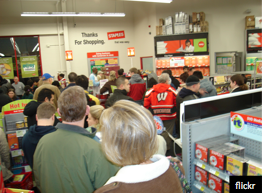 Businesses want Black Friday to be crowded. Not just because they want lots of wallets, but because crowds change people. In the case of Black Friday, crowds can remove all sense of guilt.
Few shoppers feel guilty buying another half-off toaster when the customers next to them have flat screens in their carts. When everybody’s peers are doing it and some peers are “doing it worse,” the painful experience of parting with money becomes a joyous spending spree.
Indeed, research on “social influence” finds that the examples of others can drive people to irrational and even unethical behavior.
Final Reminders
Don’t get too tired. Use a calculator. Decide what you want ahead of time. And don’t get brainwashed. Yes, Black Friday is fun. Yes, Black Friday is a day of great deals. But Black Friday is also a trap that’s very easy to fall into. Happy and responsible shopping everyone!
By Troy Campbell
Originally posted last Black Friday.
Dear Dan,
Thanksgiving is around the corner, including Black Friday, the largest shopping day of the year, when many people spend way too much money. How do we stop this insanity?
—John
People do spend a lot of money on Black Friday, but is that really so irrational? To figure that out, we need to ask which state of the world we should compare this tradition to. If you assume that we could get people to blow less money on Black Friday and decrease overall irresponsible spending, then of course the world would be a better place without Black Friday.
But what if canceling Black Friday just spurred people to start living beyond their means every month of the year? And what if this extra increase in monthly splurging turned out to be larger than the spending increase on Black Friday itself? If all this were true, we would be better off with Black Friday.
Let’s think about dieting as an analogy for shopping. Many diets allow for a “cheat day” because they realize that without the permission to indulge sometimes, people are likely to give up dieting altogether. So the people who design diets have figured out that allowing people to go wild from time to time helps them behave well most of the time. What if Black Friday is the shopping equivalent of the cheat day?
I don’t endorse wasting money, but perhaps we should all figure out how much money we are willing to splurge with, take it in cash and indulge—but only at decent intervals.
Here’s my Q&A column from the WSJ this week — and if you have any questions for me, you can tweet them to @danariely with the hashtag #askariely, post a comment on my Ask Ariely Facebook page, or email them to AskAriely@wsj.com.
______________________________________________________
Dear Dan,
Recently, the German auto maker Daimler gave employees the option of automatically deleting all emails that arrive while they’re on vacation. Senders get a note suggesting that they resend their email later or write to other colleagues who are still in the office. This way, employees don’t have to face overflowing inboxes when they return. Is this a good idea?
—Kathleen
Not having to worry about email while you’re on vacation sounds wonderful, and this policy will probably boost employees’ well-being—though, of course, some will still wonder what they might have missed.
That said, the Daimler approach seems pretty extreme, and it deals with the symptoms rather than the root problem. In my experience, email stresses people out constantly, not just during vacations. We get too much email every day of the year; we spend too much time responding to it and worrying about it. Email correspondence in many corporations is so out of hand that it leaves almost no time for any actual work.
If the bosses at Daimler really care about their employees’ welfare, why not tackle the inefficiencies of this communication channel—and work to reduce their overall email load? How about announcing that no email is allowed between 9 and 11 a.m. and again between 1 and 3 p.m.? Or what if they limited people to just 10 emails a day? (Does anyone really have more than 10 important things to say in a day?)
______________________________________________________
Dear Dan,
I’ve read a lot about the placebo effect. Does that mean it won’t work on me?
—Marco
It turns out that placebos operate to some degree outside of our awareness—which means that even when we know a particular medication is a placebo, we can still benefit from it. So don’t worry about knowing too much. Just take two placebos and call me in the morning.
______________________________________________________
See the original article in the Wall Street Journal here.
Here’s my Q&A column from the WSJ this week — and if you have any questions for me, you can tweet them to @danariely with the hashtag #askariely, post a comment on my Ask Ariely Facebook page, or email them to AskAriely@wsj.com.
______________________________________________________
______________________________________________________
______________________________________________________
See the original article in the Wall Street Journal here.
Here’s my Q&A column from the WSJ this week — and if you have any questions for me, you can tweet them to @danariely with the hashtag #askariely, post a comment on my Ask Ariely Facebook page, or email them to AskAriely@wsj.com.
______________________________________________________
Dear Dan,
I’m about to buy a new laptop—definitely a larger than usual purchase for me. I’ve found that when the base item is expensive, I’m much more likely to indulge in complementary ones, such as a new laptop case or software that I don’t really need but would be fun to play with. Why is it that I think twice about buying good beer on a night out but have no problem spending another $60 on a computer mouse I don’t need?
— Andrew
Here’s another example to help think through your question. Imagine that you’re going to buy a new car for $30,000, and the salesperson tells you that you can get leather seats for $2,000 more. How expensive would those luxurious seats seem to you? And how likely would you be to go for the upgrade?
Now imagine that instead of going to buy a car, you’re buying a new chair for your home office, at a cost of $500—and the furniture store tells you that you can get the chair in leather for $2,000 more. How likely would you be to go for it?
Most people would feel much better about the car upgrade than the chair upgrade. That’s because we think about money in relative terms: Relative to $30,000, that $2,000 doesn’t look that bad, but the same amount feels outrageous relative to $500.
Of course, money isn’t relative, and we should think about it in absolute terms, but this isn’t the natural way we make financial decisions. All this doesn’t make your tendency to shop for items you don’t need after a large purchases any more rational—but it should remind you that it’s very human.
______________________________________________________
Dear Dan,
My husband is incapable of admitting that he is wrong, and it’s driving me crazy. What can I do to get him to acknowledge it when he’s wrong?
— Lisa
I suspect that many of the times that you most want your husband to admit that he’s wrong occur in large and central debates—which could be a mistake on your part.
One of the main problems with admitting error is reputation. Your husband may think that if he admits once that he was wrong, it will indicate that he could be wrong in other cases as well. If this is the case, a better way to fight his denial of wrongness will be to try to get him to admit once to a trivial mistake, maybe even in front of other people—and then hope that with that first step out of the way, the path to admitting other blunders will be more open.
Or here’s a less ambitious approach: give up on having him admit error and focus on just having him say that he’s wrong. For many years, psychologists used to recommend that married couples engage in something called “active listening”—telling the other person that we feel their pain and asking them to describe their annoyance in vivid color and detail. But psychologists have figured out that active listening was actually not very good advice. As it turns out, simply saying “Yes dear” is a much better strategy for a happy marriage. If your husband believes in science, perhaps sharing this sage advice with him will convince him that, despite his difficulty admitting that he’s wrong, agreement is often the best approach.
______________________________________________________
Dear Dan,
When are people most productive? In the morning? At night? Are different people more productive at different times of day?
— Jacob
No question about it: For all kinds of people, the most productive time is tomorrow.
See the original article in the Wall Street Journal here.