Benefits of deadlines
Here is a letter I got a few days ago:
—————————————————————
Dear Dan,
I recently had an experience that I thought you might be able to appreciate and wondered if you had any thoughts on it.
Last fall (early October) I got into a small car accident. It was my fault and I was ticketed for not controlling the speed of my vehicle. As a part of my plea with the courts I agreed to take a defensive driving course. The last time I took one of these, I selected one Saturday that worked for me and met with a teacher in a classroom for 6 hours one day. But in my state (Texas), they don’t have face-to-face courses anymore; they only have online courses. Of course, the court can’t tell you where to go to sign up for these courses, you have to find it on your own. There are LOTS of options. In addition, taking the course basically requires a commitment of 6 hours, but there are no scheduled class times. Instead, you choose whenever you want to begin your course.
I teach at a Community College fresh out of graduate school. I’ve got a family and I’m super busy. Essentially, this means that I never have a block of 6 hours to devote to anything. As a result, I put off this course for longer than I should have and am now in contempt of court and have been summoned to appear in a little over a week. Today, actually, I’m taking the course…
Anyway, I feel like this is a perfect example of how the courts think they’ve made this process easier, when in fact they have shifted a lot of the decision-making burdens on the plaintiffs, making compliance a lot more difficult. I’m not a delinquent, but I feel like the burdens of completing this task have turned me into one. I don’t have access to data, but I’d be willing to bet that delinquencies are much higher under the new system as opposed to the old.
Unfortunately, irrationally, and procrastinatingly yours,
Nathan
—————————————————————
Dear Nathan,
The same basic thing happened a while ago in the scientific community. The organization that funded science in the UK decided that instead of asking people to submit grants by 2 specific dates each year (which is that the US funding agencies do), and get people all stressed over the deadlines — they will let people submit grant at any time and they will review the grants using the same 2 times a year. What happened? Much like your story, fewer grants were submitted and eventually the Brits changed back to the twice a year setup.
All this is to show us how useful deadlines can be.
Irrationally yours
Dan
 Tweet
Tweet  Like
Like Backing Down From Agreements–Results
Imagine that you are shopping for a car, find a seller, and agree to purchase his car in a couple of days. The day before the sale, you find a better deal on a different car. Under what conditions would you renege on your original agreement? Would it be easier if your original agreement was made, so over the phone? Or over coffee?
Last week we put out a survey to find out, and here are the results:
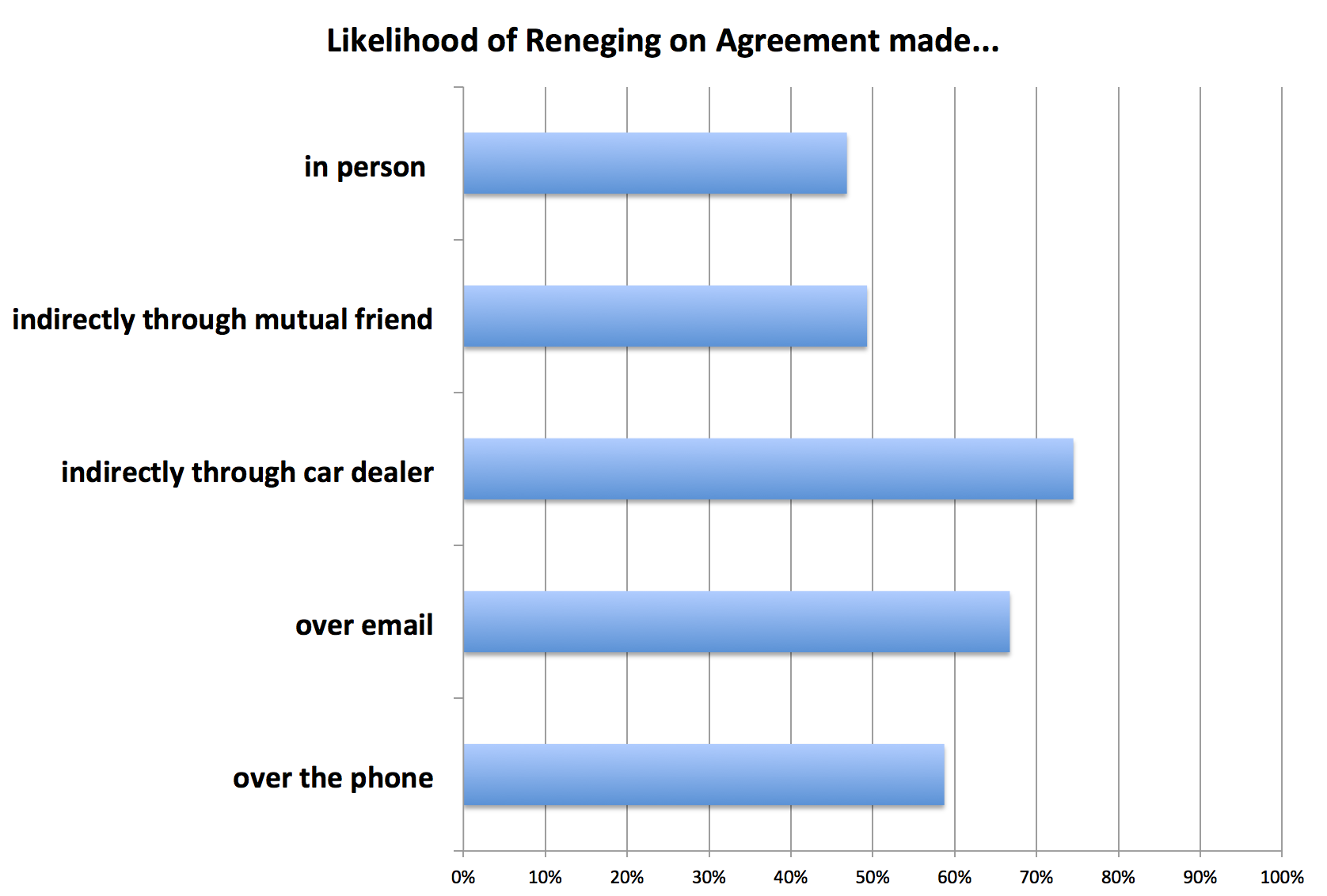
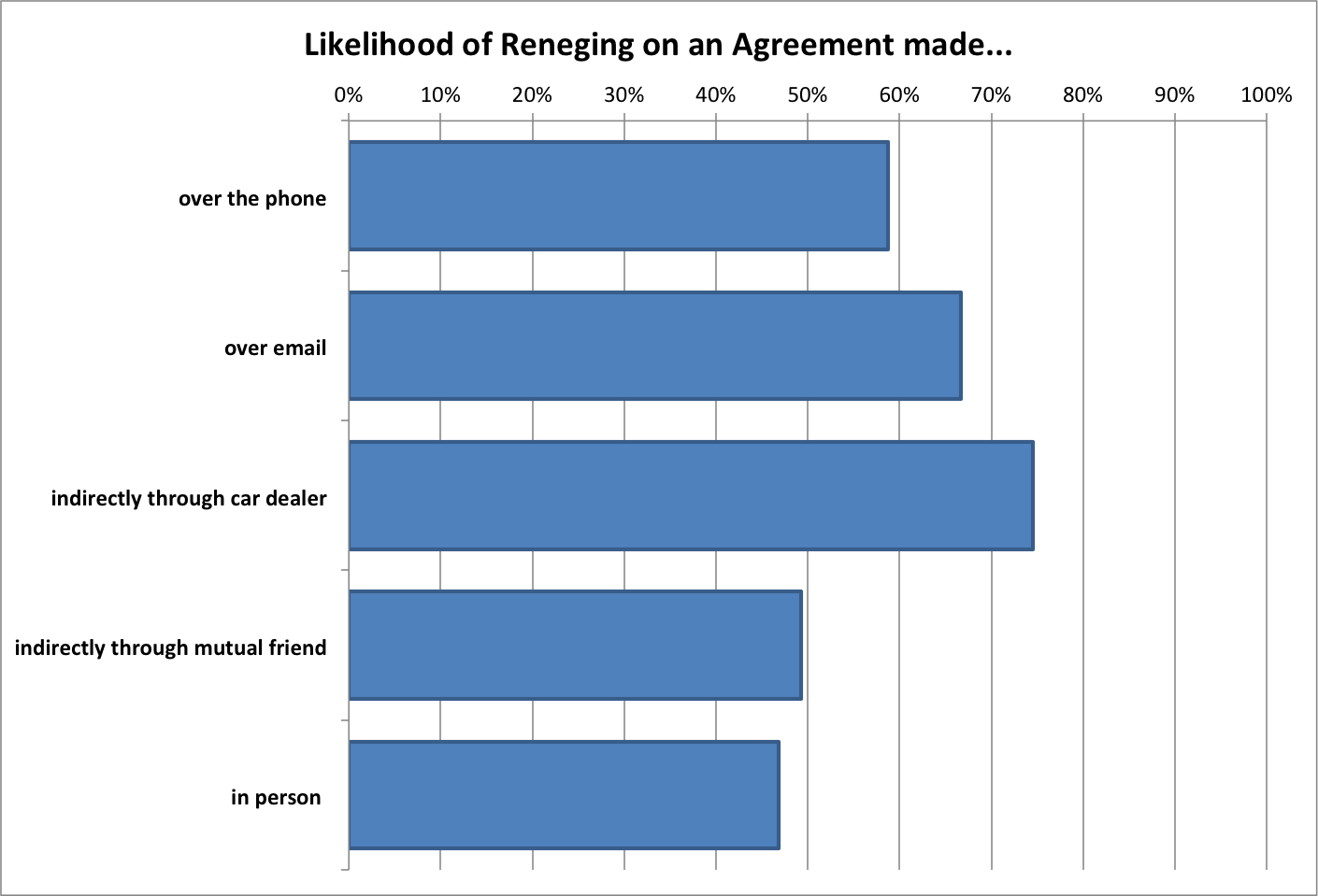
As you can see, people have the hardest time reneging on deals made in person (compared with phone and email), and we have much less of a problem reneging deals made via a car dealer relative to one that was mediated by a mutual friend.
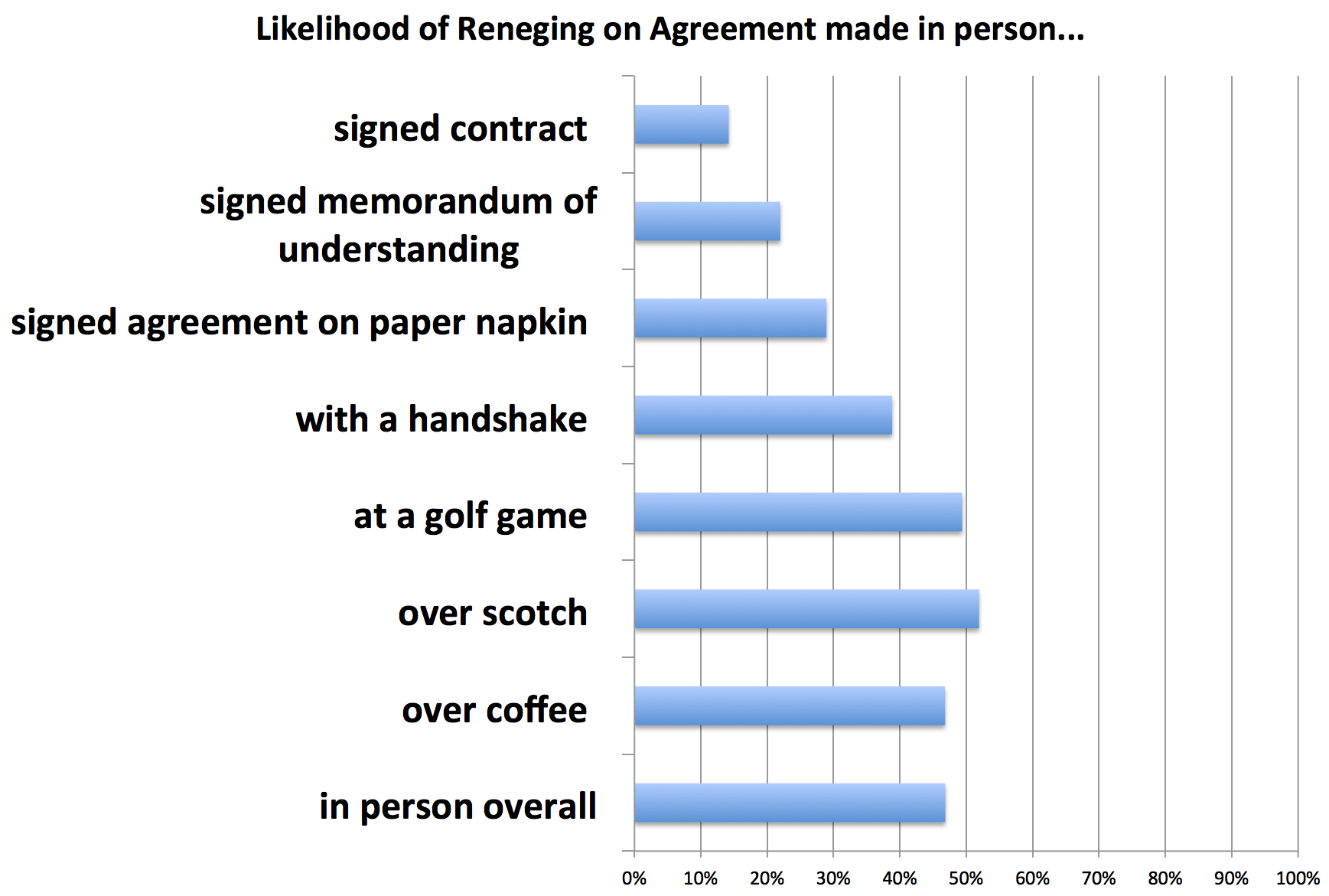
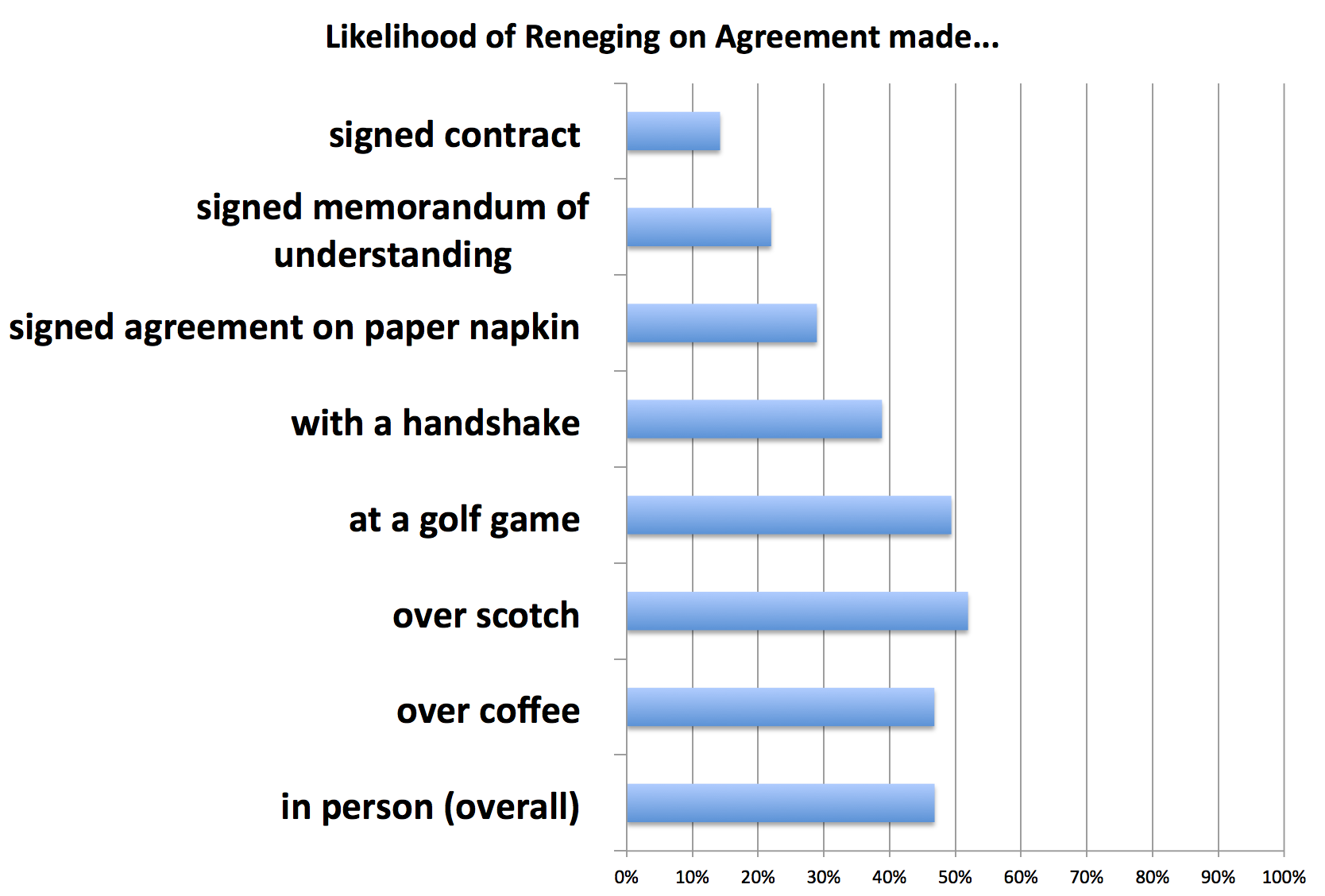
Zooming in on in-person agreements, we see here that agreements made over scotch and golf seem most likely to be reneged on, whereas we see significant improvement over various, even rudimentary, forms of signed contracts (napkin).
So next time you’re out selling a car, make sure at least to bring a napkin and pen with you, and next time you’re out buying a car, don’t sign anything unless you absolutely have to!
p.s here is an interesting academic paper related to this topic
Gold
Cars, iPhones, and Incentives to Work
A few centuries ago little luxuries like iPhones and cars did not exist for the working class to consider buying, so the motivation to work did not extend beyond the desire to feed oneself and one’s family. Now, however, we can imagine that with cars and iPhones within reach, even lower wages in the face of higher taxes are offset by the motivation to acquire these items. The market for such consumer luxuries, in turn, has inspired an incredible wave of motivation and innovation, so let’s be thankful for them.
In Praise of the Handshake
Imagine that you and I meet at a party, and I tell you about my research on behavioral economics. You see opportunities to use the principles to improve your business and think we could work together. You have two options: You can ask me to collaborate, with a handshake promise that if things work out, you’ll make it worth my while. Or you can prepare a contract that details my obligations and compensation, specifies who will own the resulting intellectual property, and so on.
For most of you, the decision is obvious. The second approach, the complete contract, is the way to go. But should it be?
The idea of making a deal with a handshake—what we generally call an incomplete contract—makes most of us uncomfortable. A handshake is fine between friends, but when it comes to vendors, partners, advisers, employees, or customers, we believe that incomplete contracts are a reckless way to do business.
Indeed, firms try to make contracts as airtight as possible—specifying outcomes and contingencies in advance, thus lowering the chances for misunderstanding and uncertainty. But complete contracts have their own flaws, and business’s increasing dependence on (I would say, fetish for) absurdly detailed contracts in every situation comes with its own downside.
All contracts deal with the direct aspects of the expected exchange and with unexpected consequences. Incomplete contracts lay out the general parameters of the exchange (the part that we shake hands over), while the unexpected consequences are covered by social norms governing what is appropriate and what is not. The social norms are what can motivate me to work with you, and what would establish goodwill in resolving problems that might arise.
As for complete contracts, they too specify the parameters of an exchange, but they don’t imply the same adherence to social norms. If something is left out, or if circumstances change, there’s no default to goodwill—it’s happy hunting season for all. When we use complete contracts as a basis for working together, we take away flexibility, reasonableness, and understanding and replace them with a narrow definition of expectations. That can be costly.
A CEO of a large internet company recently told me about one of the worst decisions of his career. He instituted a very specific performance-evaluation matrix that would determine 10% of his employees’ compensation. Before this, the firm, like most, had a general agreement with its employees—they had to work hard, behave well, and were measured on certain goals. In return they were rewarded with salary increases, bonuses, and benefits. This CEO believed he could eliminate the uncertainty of the incomplete contract and better define ideal performance.
The complete-contract approach backfired. Employees became obsessively focused on meeting the specific terms of their contracts, even when it came at the expense of colleagues and the company. Morale sank, as did overall performance.
Even lawyers see the risks of complete contracts. As part of my research, I asked the dean of Duke’s law school, David Levi, if I could take a look at the school’s honor code. Expecting a detailed contract written by lawyers for lawyers, I was shocked to find that the code went something like this: If a student does anything the faculty doesn’t approve of, the student won’t be allowed to take the bar exam. It was, in essence, a handshake agreement!
“Imagine that a student decides to deal drugs and raise chickens in his apartment,” Levi said. “Now suppose that our code of conduct bans many activities but doesn’t address pot or chickens. The student has honored the code. But does Duke really want that student to become a lawyer?”
Complete contracts are inevitably imperfect. So what’s better: a complete contract that mutates goodwill into legal trickery, or an incomplete contract that rests on the understanding we share of appropriate and inappropriate behavior?
This post first appeared on HBR
Three Valentines Day Tips
Tip #1: Go for the chocolate and flowers.
While a rational economist would tell you and your special Valentine to skip the formalities of jewelry, chocolate, and flowers (after all, don’t we all really have better things to spend our money on?), we know that in reality, human relationships are based on more than money.
This video also appeared on my friend Paul Solman’s website
Tip #2: Be careful. Kids are expensive.
Toys, Nintendo, iPads, clothes, birthday parties: kids are expensive. Be careful.
Tip #3: Don’t let your expectations run away.
Our data show that our expectations about people we meet online tend to be overinflated. If we see that somebody is into sports, for example, we tend to mistakenly assume that they like the same sports we do. This bias, as you can imagine, can lead to emotional distress after the date. Keep your expectations modest.
(de)motivating employees
A lesson about (de)motivating employees
A few months ago an ex-student of mine, who was at the time working for a big software company, contacted me and asked me to meet with her and her team later in the summer. My student, together with a large team, had worked very hard for the previous two years on an innovation which they believed was the best new idea in the “computer world,” and the best new direction for their company. They worked very hard on this project and were full of hope and expectations. But, between the time that she originally contacted me and the time that I arrived at their offices for my presentation, the CEO of the company looked at the project and decided to cancel it.
So there I was sitting with a group of highly creative people who were completely deflated. I’ve never seen people in the high-tech industry with a lower level of motivation. So I asked them, “How many of you show up to work later than you did before the project was shut down?” Everybody raised their hand. I next asked them, “And how many of you go home early?” All hands went up. Lastly, I asked them, “How many of you feel that you are now more likely to fudge a bit your expense reports?” In this case, no one answered the question—instead, they smiled in a way that made me think that they had first-hand experience with expense fudge.
Now, it is possible that the project was really not that good, or that it did not fit with the future direction of the company, which would mean that canceling it was the appropriate decision. But even if this were the case, how the CEO could have behaved differently if he was also trying to keep the team members excited and interested in their work? So I posed this question to the team and they came up with a few interesting answers:
1. The CEO could have asked them to present the project to the entire company. The presentation would have included the process that the team followed and the final product specifications. This would allow everyone at the company to understand and (hopefully) appreciate the hard work they had done.
2. The CEO could have asked the team to write about the steps they took in the process of development, and then to use this as a template to help other teams as they developed new products. In this way, their work would not have felt wasted.
3. The CEO could have gone a step further and allowed the team to build a few working prototypes in order to let them experiment with the technology in more depth (which would have also provided a more accurate idea of the usefulness of the technology).
4. The CEO could have asked the team to redirect their efforts toward finding ways to introduce some of their new technology into other products the company was working on.
These were just a few of the team’s ideas, and of course there are many possible approaches that senior management could have taken to boost their morale. Of course, most of these morale-boosters would have required some investment of time and money. The CEO may have thought of these people as rats working in a maze, and therefore seen no reason to motivate or help them make the most out of their canceled project. But if he had understood the importance of meaning in the workplace he might have taken some of these steps, spent some money in the process, and ended up with more motivated employees. Sadly, this was not the case. I recently heard that the main people in that particular group left the company, and that the whole group was dissolved. Maybe this is the kind of expensive lesson that this CEO needed. However, most likely, he will be able to tell himself a story about why he was correct and they were all petty and wrong.
Art @ WEF
Is there symbolism of the choice of art at the world economic forum?
Maybe.
On the surface the world economic forum and the attendees are trying to maintain the feeling that we are over the recession and that the economic life is more or less back to what it used to be. But maybe the unconscious thoughts of the people at the world economic forum feel somewhat different — and maybe this is the reason for this particular piece of art?
Social hacking
I am deeply attracted to the process of hacking – perhaps because I taught at MIT for a long time, or maybe because I tend to approach life with a similar problem-solving mindset.
Think about what hackers do. They start by looking at the flow of information in a system – let’s say a series of servers – and then try to identify weak points along the path. Once they identify the weak points, they try out all kinds of ways to attack them, forcing the system as a whole to behave in certain ways (often toward not-so-desirable outcomes, at least from the perspective of the people who try to run the system).
I think social scientists often work in an analogous way, though (of course) with nobler intentions. Let’s say that we social scientists want to look at a certain human behavior, such as overeating at the cafeteria: we would start by examining the different steps that people take as they go through the cafeteria – looking at where the customers stand, what they see, who they see, what tempts them, how they decide what to take, where and how they pay, and so on. Next, we would try to identify possible points in the process that seem to encourage or enable overeating, and then try to come up with different ways to influence peoples’ decisions at these weak points.
For example, we might notice that people pass by the burger-and-fries station on the way to the salad bar. If the cafeteria is set up this way, it’s very hard for hungry people to resist temptation. So with this in mind, we might suggest to push the burger stand off into to the far corner and place the salad bar front and center. Alternatively, we might realize that people fill up their plates to their capacity, so we might recommend decreasing the plate size (a strategy that Brian Wansink shows to be effective in achieving weight loss).
By conducting this kind of “hacking analysis” of the way people behave in a cafeteria “system,” we can discover the most promising ways to intervene in the process and improve behavior.
Another thing I like about the hacking analogy is that hackers are not necessarily looking for one absolute solution. Rather, they are looking for a simple approach, using available tools, in order to get the “job” done right now. This is not to say that we should come up with interventions in a slap-dash fashion, but the standard academic approach to exploring all the possible nuances of a topic for 30 years and understanding it in perfect detail before suggesting any intervention … well, I simply don’t have that kind of patience. I’m much more excited by cases of human behavior where we can learn something essential in a relatively short timeframe, test ways to change behavior for the better, improve the process, and continue learning and improving.
Enjoyable hacking to us all,
Dan
Reminding kids
Here is a letter I recently got from a reader:
How to remind a child to take his medication?
Dear Dan,
My son has Type I diabetes. He is constantly forgetting to check his blood sugar level and inject insulin when he needs it, and I am forced to remind him every couple of hours. I hate to nag him, and know it doesn’t help him become more independent. On the other hand, if he keeps forgetting he could become severely ill. What should we do?
Tal
Dear Tal,
It is often hard to remember to take medication, especially when you hardly feel the severity of the illness or the relief of the medication. On the other hand, no one forgets to take heartburn medication – you’ll probably sprint for it as soon as heartburn begins to set in. With asthma and other inflictions that require more preventative measures, forgetting to take your medication will exacerbate symptoms and eventually lead to greater consequences. But until this critical point, there is no definitive moment where long-term preventative medication clearly needs to be taken. If you have an asthma attack, you can always pull out your inhaler. Similarly, diabetes does not cause chronic excruciating pain and won’t remind you to take your medication.
As for reminding your son, you might not have a choice. No one wants to monitor glucose levels all day, and he may need reminders to do so. But the reminders can and should come from his environment, as well as from habits you and your son can create together. Rather than reminding him every few hours yourself, create a mechanism that will remind him automatically.
Several doctors whom I’ve talked to told me that they recommend patients who need to take medications twice a day to put it next to their toothbrush. This way, this new habit is combined with the existing habit of brushing your teeth. But if you need to take your medication more than twice a day, the toothbrush will not be enough.
So the question is what regular activity can be tied to your son’s medications? Can you do something that is connected to his meals, or that is connected to other desires or hobbies? Can you set an electronic reminder in his cell phone? Once he has established a habit of checking his blood sugar, he may not even need these reminders anymore – but they can help build this habit until it takes on a life of its own.
It is also important that your son have a way to tell you that he has taken his medication without asking him. For example, you can make a board that he can mark when he checks his blood sugar and when he takes the insulin, or a designated can to put the used syringes. He could even upload this information to the internet – there is probably an app for that. If you are creative, you can find the right solution for you and your son with minimal effort.