Rapture Me Not
On my drive to Asheville, NC this past weekend, I passed a multitude of billboards like the one below. According to multimillionaire Harold Camping, tomorrow is Judgment Day. You may have heard.

The idea of imminent rapture piqued my interest, so I looked into the matter, filling my brain with more than I ever wanted to know about the mathematically-inclined radio broadcaster and his cult of hopeful followers.
Although Camping’s 1994 doomsday prediction (clearly) turned out to be false, he has no doubts that this time he is on the right track. And why not? As you can see, the bible guarantees it! The alleged proof in favor of tomorrow’s rapture not only comes from the bible, but also from “indisputable” evidence in the form of devastating natural disasters and war, technological advances, economic crises, global governments…and, of course, the rise of the gays.
However, I’ve compiled a list of my own — a compendium of evidence in support of the impending demise of humanity:
- The Great Mississippi Flood
- The Sky is Falling
- Paris Hilton has a new reality show
- Sarah Palin has a NYT bestseller
- Extrasensory Perception (ESP) exists
- Touchdown Jesus is struck
- Kate and William postponed their honeymoon
- Charlie Sheen is no longer winning
- Obama becomes a US citizen
- Osama liked porn
- And, most notably, at this very minute I find myself wearing jeggings
Enjoy the rapture tomorrow, and have a lovely Sunday
~Aline Grüneisen~
 Tweet
Tweet  Like
Like Re: Wedding Advice
Hello, it’s the anonymous PhD again, back to report what the wisdom of the crowd was on our wedding-planning dilemma. First, I’d like to thank Dan’s readers for your excellent comments. Matt and I really appreciate your thoughtfulness.
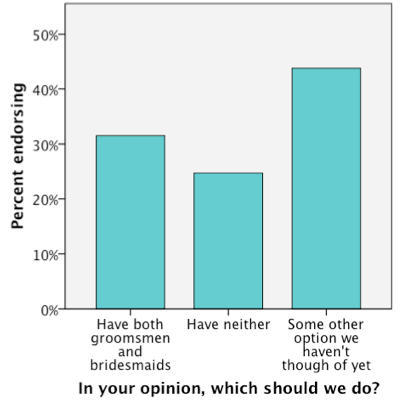
As the graph illustrates, of the two options I presented, having attendants won out, but not overwhelmingly. However, the most popular response was to propose a third option. The most common of these were:
- Have one of Matt’s bothers stand on my side, and the other on his side.
- Have no attendants, but give Matt’s brothers some other role of honor, such as giving toasts or readings.
- Have only groomsmen, and I should not worry what people infer about me.
Now it’s time to let you in on why I was asking for wedding advice on a blog about rationality and decision making. One motivation was that Dan and I were curious whether Matt’s “wanting” attendants carried more weight than my “not wanting” them. Many people (55%) said they simply chose the option they themselves prefer, or based on considerations of what is normal/typical (33%) or costly/effortful (31%). But, some (28%) did say that “wanting” is more important than “not wanting”. While I understand that feeling, I can’t figure out if it’s rational. What do you think?
Dan and I also wondered what people’s answers reveal about how they think people should resolve impasses like this. By far, the most common principle mentioned was that people in a relationship should take turns getting their way when it comes to big impasses. So, in our case, the idea was that since I conceded to Matt’s desire to have a big wedding, he should in turn concede to my desire not to have attendants.
But, we saw some very different principles advocated too, namely:
- People should not take turns getting their preferred outcome – scorekeeping and adversarial thinking are hurtful (though, an alternative method was not explicitly suggested).
- “Halfway” compromises (in this case, for example, a big wedding but no attendants) leave everyone unhappy – a couple should go all the way with one person’s preferences in a given situation.
Personally, one principle that stuck with me (and Matt, too) was brought up by the first commenter, Francesca: that what both of us should be doing is asking, “What will make this wedding great for the other person?” rather than concerning ourselves with our own interests. I thought this was very wise advice.
For those who are interested, we have ultimately decided to have my three sisters stand up as bridesmaids, and my brother, along with Matt’s brothers, stand up as groomsmen. Having just siblings as attendants avoids the political intricacies of picking friends, and Matt has offered to pay for the bridesmaids’ dresses (since my sisters are broke college students) as well as coordinate the fittings. My siblings are much more tradition-minded than I am, and they’re excited to be a part of the wedding.
FN LN
May brings more than flowers
 How the Start of a Month Changes Everything (or seems that way)
A couple days ago, we took advantage of the changing of the months to run a series of studies on people’s confidence in achieving their closely approaching goals.
We asked them questions about how successful they felt they would be in reaching their goals tomorrow and in the next few days and how different things would be. For some, we subtly reminded them of the upcoming May 1st.


We found that the reminder of “May” made people think that they and others would be far more successful. This was controlling for gender, level of current struggling, importance of the goal, and previous contentment with goal progress. And we looked at both specific and general sets of goals.
Why? Calendar boundaries show how relatively irrelevant boundaries can drastically change how we compartmentalize events (For an example of how statelines can ‘prevent’ earthquakes see here). In this instance, a simple reminder of the upcoming month does not lead people to think that they themselves will change a lot but that the externalities that have recently been in their way will wane.
An Upside to Irrationality?
So how should we view this new finding? Are people being rational, irrational, or strategically irrational? We know from tons of research that people ignore base rates and make egregious forecasting errors about their life.
I think that this is an upside to irrationality. The new month gives us the opportunity to refocus and pre-commit to our goals through new gym memberships or a trip to an organic grocery store (I just signed up for an organic vegetable/fruit/bread delivery service, which I highly recommend). Furthermore, these temporal boundaries fill us with self-efficacy, which have been shown to be positively related to accomplishing goals.
Industries of self-help could take advantage of these boundaries and possibly create more “meaningless” boundaries to help motivate their clients.
Irrational or not, putting the past in the past is a great way to motivate us in the present. May your May be full of success!
~Troy Campbell~
Wedding advice
Wedding planning: A case study in joint decision making
By an anonymous PhD
My fiancé, Matthew, and I are currently planning our wedding, an absolute adventure in joint decision making. I am learning that even though I am a decision researcher, I know surprisingly little about how to make decisions with another person.
Since both of us greatly value autonomy, in the past if we have had different preferences, we’ve simply done our own thing. For example, one afternoon while vacationing at Arches National Park last summer, Matt wanted to go on a 7-mile hike, and I wanted to read by the hotel pool. So, we went our separate ways and did precisely what we each wanted.
But, that doesn’t really work out in the wedding domain. Obviously, I can’t say, “Well, you can have a big fancy wedding, I’m going to elope.” Thus, we recently find ourselves repeatedly gridlocked.
Some background: I am not a fan of weddings in general, and my own is no exception. I don’t like the pomp and circumstance, I don’t like the symbolism behind a lot of the traditions, and I think it’s a silly thing to spend many thousands of dollars on. Matthew, on the other hand, is much more sentimental than I am, in a surprising bit of gender-role reversal. He values the ritual of weddings, and it’s important to him to have a large audience of his friends and family there.
So, while I would prefer to have a small handful of people at a justice-of-the-peace style affair, we’re planning a traditional wedding and reception for 150 guests because it is important to Matthew, and Matthew is important to me. Fine – one bit of joint decision making solved.
But: one decision point has not been so easily solved. Matt wants to have attendants (i.e., groomsmen, bridesmaids) so that his brothers can be his groomsmen; Matt was a groomsman at his brothers’ weddings, and thinks his brothers will feel honored at being selected. But, I really don’t want to have attendants, I think because it’s such a clear marker of a typical, traditional wedding. Plus, I then have to choose bridesmaid dresses, theme colors, and the actual bridesmaids (the politics of which are arguably much more complicated when choosing female attendants vs. males).
One option we entertained was to have groomsmen but no bridesmaids, but this is unpalatable because I’m worried that everyone will infer that no one would be my bridesmaids. This appears to be a win-lose sort of endgame, rather than those nice win-win solutions exhorted by the negotiation books I’ve read, and I don’t see a way around that. So, the options apparently are:
a) have both groomsmen and bridesmaids
b) have neither
Dan proposed that I use his blog as a forum to ask for advice. So, readers, which of the two options would you advise us to do, and how did you come to that conclusion? Or, are there other win-win options we haven’t thought of?
My Birthday
So, today is my birthday and this year it is also the wedding day of prince William and Kate.
How do I feel about this? Well, there is some interesting research showing that when kids have their birthday on a special day (Christmas, new year etc), they are likely to feel less special and suffer in terms of their confidence and social fit.
I was wondering if this would also happen to me, but then one of my friends made me realize that I need to be less selfish and also consider how this joint celebration might affect the well-being of prince William and Kate.
I do hope that they will continue to feel special despite the selection of their wedding day.
P.S I met the Duke of York earlier in the year and I asked him if the timing of this wedding means that I should be invited – but surprisingly he said “no.”
The Opportunity Cost of Sitting in the Back Seat: Wisdom Gleaned from Rebecca Black's "Friday"

The concept of opportunity cost can be seen in the emergent societal dilemma presented by Rebecca Black through her insightful lyrics:
“Kickin’ in the front seat
Sittin’ in the back seat
Gotta make my mind up
Which seat can I take?”
As we can see, Rebecca must choose between kicking in the front seat and sitting in the back seat – two mutually exclusive options where her choice of either eliminates the opportunity to choose the other.
The same evaluation of opportunity cost can be seen in monetary exchanges that we make every day. In my dissertation work, I’ve focused on when consumers are more or less likely to reframe purchase decisions (like “Do I buy Rebecca Black’s ‘Friday’ or not?”) as allocation decisions (like “Do I buy Rebecca Black’s ‘Friday,’ or do I spend my money on something else instead?”).
Two important drivers are:
1) how constrained consumers feel
2) how much their resources bring other purchases to mind
First, I find that when consumers face more constraints, they are more likely to incorporate other purchases into their decisions. This constraint can be driven by cash on hand, annual income, or even the cycle on which you are paid. People paid weekly face less constraints on average (at least until the end of the month) than those paid monthly. As a result, those paid monthly are more likely to think “Do I buy this CD or not?” whereas those paid weekly are more likely to think “Do I buy this CD or do I spend my money on something else instead?”
Second, consumers can actually be more likely to fixate on their opportunity costs when they use resources with specific associations. Think about spending a Starbucks gift card versus a Visa gift card to buy Rebecca Black’s CD (imagining that it could be on the eclectic menu of CDs at Starbucks). The Starbucks gift card immediately makes you think about the coffee you could buy, so the decision changes from “Do I buy the CD or not?” to “Do I buy the CD or coffee?” The Visa gift card could be used to buy nearly anything but it doesn’t make you think about something else in particular, so the decision remains “Do I buy the CD or not?” What does this mean in practice? Starbucks coffee lovers are actually more likely to spend the Visa gift card than the Starbucks gift card even though the Visa gift card could be used to buy anything – including a Starbucks gift card!
Here at the Center for Advanced Hindsight, we see these factors at play constantly — and not just when spending money. At the beginning of the day, I have plenty of time (or convince myself of that at least), so the decision to write a blog post is “Do I write it or not?” but at the end of the day, the decision is “Do I write it now, or do I work on my paper, or do I watch the ‘Friday’ video, or do I go to sleep?” Some times of day have specific associations, so at 10:00am, the question may be “Do I write the blog post or not?” whereas as at 12:00pm, the question is “Do I write the blog post or do I eat lunch?” Take a guess when I finally got around to writing this… But our discussion of procrastination will have to wait for another day.
For more details, see “Opportunity Cost Consideration,” forthcoming in the December 2011 issue of the Journal of Consumer Research.
~Stephen Spiller~
Can the tax code cause us to spend too much?
April 15th — Tax day is upon us, so it’s a perfect time to contemplate a few aspects of taxes.
In the past I’ve written about how I used to think that tax day was a wonderful day of civic engagement – a day to think about how much we make and contribute, what taxes we pay and what services we get in return. Of course, over the years, as my taxes have become more complex, this task becomes one that is less about civic engagement and thoughtfulness, and more about annoyance and frustration. But that’s for another time.
Today I want to talk about the fact that the US tax system makes it very difficult for us to understand how much money we make and how this may actually lead us to spend more money than we really have. Think about it for a moment—do you know your net monthly income? I suspect you don’t, and I think that the tax system is to blame.
In many other countries, the tax code does not allow for the same level of deductions we have, and because of that for most people the whole amount of taxes is automatically deducted from their paycheck – and this is it. Now, in this situation when you ask people how much they earn [and yes, in other countries people do actually ask each other what they make] they will tell you their net monthly income – the amount of money that they get to take home at the end of each month. How do they know? Well, it is the number that is printed in bold letters on their paystub.
Contrast this to the US. In the US, we all know the gross amount that we make a year, but it’s not as clear what our net income is. It’s actually very complex because we get our salary, some of which the employer withholds, and we have no idea what we’ll get back when tax day comes around. We can get back some money (depending on our expenses/deductibles), trends in our stock market portfolio, health care, etc. And we don’t figure this out until April 15th (if not later) of the following year!
And what are the consequences of knowing our gross yearly income and not much else? I think it causes us to feel richer than we really are and spend accordingly. Why would this be the case? There’s a phenomenon we call the “illusion of money,” which is the idea that we typically pay attention to nominal amounts of money rather than real amounts. For example, the illusion of money means that if inflation is 8%, and you get a 10% raise, you would feel better than if there was no inflation and you got a 3-4% raise. The basic idea is that we pay attention to the nominal amount rather than the purchasing power, and don’t realize what our money is really worth.
In terms of our tax code, this suggests that in the US we focus on our gross yearly income, feel richer than we really are, and consequently end up spending more money. If this is right, it means that changing the structure of deductions could be one way to help people understand how much money they actually have and how they can save more.
The Rationality of One-Star Reviews
When publisher Hachette Book Group set its price for Michael Connelly’s latest suspense thriller, The Fifth Witness, it decided to charge $14.99 for the Kindle version and $14.28 for the hardback version, a difference of $0.71.
From a utility point of view, charging more for the Kindle version seems quite reasonable considering that Kindle books are delivered instantly and for free, that they take up no additional space or weight, that they can be read on any computer, and that they come with handy bookmarks and highlights of what other readers find interesting.
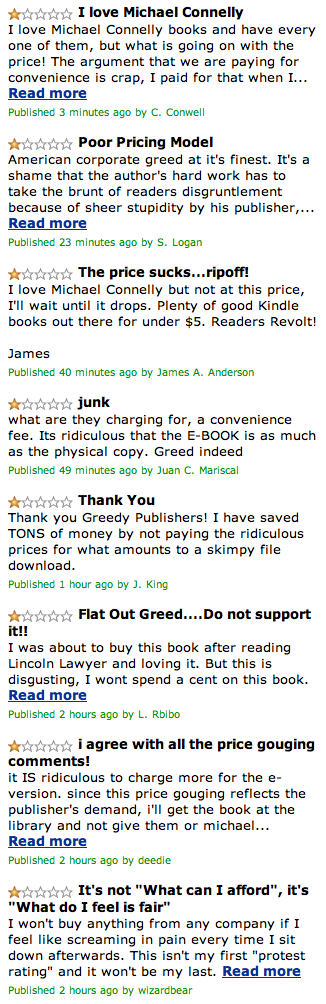
But how did customers respond to this pricing decision? They were outraged! As you can see on the product page, the book has been overwhelmed with one-star reviews based not on the quality of the book itself but instead on the perception of greed and unfairness on behalf of the publisher. “junk,” writes Amazon reviewer Juan M. “It’s ridiculous that the E-BOOK is as much as the physical copy. Greed indeed.”
Talia S. puts it this way: “I went and check the reviews and notice the many 1 star grading. I read some of them and changed my mind. I did not buy the book. We should not let the publishers hold us hostage because we prefer to read the electronic format.”
While standard rational economics tells us that consumers will be willing to pay more for items they derive more utility (pleasure and usefulness) from — in practice, other factors such as perceived fairness and perceived manufacturing costs play a very large role into our decisions of what to buy and how much we are willing to pay.
As someone who has published two books, and purchased a lot of them over the years, I find books to be one of the most puzzling categories in terms of how much attention people pay to their price. Think about it this way — if you were going to spend 10 hours with a book, do you really care if it costs $3 more? Shouldn’t you happily pay $0.30 more per hour of reading if the quality of the book was slightly higher or the experience was slightly better? Personally my more pressing problem is time, and if someone could assure me a better, even slightly better experience, I would pay a substantial amount more. And for some books, those I really treasure and that have changed my view on life — if I were just thinking about the utility of my experience I would pay hundreds of dollars.
The problem is that it is really hard to think this way. It is not easy to focus on what we really care about (the quality of the time we spend) rather than the salient attribute of price. And on top of that the unfairness of the differences in price can make us mad ….
I don’t know how the book industry will deal with this problem, and I am looking forward to seeing how this story develops. But, I do know that as readers we should pay a little less attention to minor differences in price and more attention to the quality of the way we spend our time.
Irrationally yours
Dan
Squash and Our Intuitive Strategic Thinking
As you may or may not know, I am a fairly avid squash player (not so good but I love the game). One of my favorite aspects of squash, aside from being a great source of exercise, is the strategic thinking required.
The other day while playing, I had a slight itch to change strategies. It wasn’t a conscious, logical process, and it was more like a kind of the desire to itch or pick a scab. Like picking a scab, my better judgment told me that making this switch would be a bad idea, but the urge was too great, and I switched my playing style. And it worked!
After the game I wondered, where does this itch come from? Is it part of our creative instinct for exploring and trying out new strategies? Do we have a desire to try new things?