7 ideas for a smarter Black Friday
Every day of the year, American shoppers act irrationally. On Black Friday, however, shoppers’ irrationality and wildness climb to dangerously high levels. Why does Black Friday lead shoppers to grab and fight, especially when the stakes are often as low as fifty percent off toasters?
Over the last few decades, social scientists have cataloged the many different factors that lead to irrational consumer behavior, and Black Friday touches on nearly that entire list.
Luckily though, if shoppers stay aware of how Black Friday is designed to make them irrational—and if they take breaks, eat snacks, plan ahead, and keep a clear mind—then they can avoid falling victim to the “holiday.”
Here are seven reasons shoppers become so irrational and committed to deals on Black Friday, as well as a few ways you can protect yourself.
#1
Black Friday is like a hazing ritual
 Black Friday shoppers are dedicated—they sacrifice sleep, football games, and significant others’ approval to make the early bird sales.
When people go through pain and effort to reach a goal, then the goal actually looks more attractive in an attempt to justify the unpleasant struggle. Effects like this are common—think of brutal college hazing rituals, where new members commit more intensely to the group rather than turn away.
A shopper’s first sleepless Black Friday is like a hazing ritual that makes the deals seem that much more attractive—they must be worth it after all that effort.
#2
Shoppers are too “depleted” to be rational
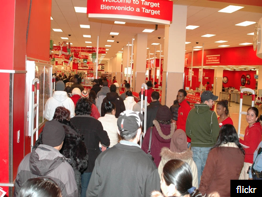
People are vulnerable to irrational tendencies all the time, but they are at their most vulnerable when they’re tired and overwhelmed. Behavioral scientists call this state “depletion.”
In a state of depletion, people just don’t have enough willpower to resist temptation or the cognitive faculties to make complex decisions. Even math whizzes and businesses majors will falter when depleted.
Black Friday shoppers arrive sleep-deprived and stressed from the holidays. For companies, Black Friday can seem like taking candy from a baby. Only here the baby resists even less.
#3
What’s another $10 after the first $500?
 It hurts to spend money. There’s pain in parting with $10 for a flash stick. However, after spending $899 on a TV, the pain one feels parting with a Hamilton for a flash stick is practically gone.
Restraint on Black Friday is even more unlikely because many shoppers tend to begin with the purchase of a large ticket item, like a TV or computer. After the big purchase, every $10 flash stick, $11 dollar t-shirt, or $13 kitchen knife, will not lead to the “pain of paying” that keeps people from buying every random thing on aisle during the other 364 days of the year.
Nobel Prize winners Daniel Kahneman and Amos Tversky explain that people are initially “loss averse”: initially people really do not like losing money. However, once people start losing money, their aversion to losing money starts to go away. Accordingly, cautious spenders can quickly become big spenders.
#4
The shopping momentum phenomenon
 Ever thought your friends turn into entirely different people when they go shopping? Well, scientific research suggests that indeed shopping does change people.
Yale consumer researcher Ravi Dhar and colleagues find we are in a careful “deliberative” mind-set before purchasing an item—carefully weighing the pros and cons. Yet after the first purchase, a floodgate of “shopping momentum” opens up, and we make purchases more readily after.
Fortunately, the phenomenon of “shopping momentum” can be interrupted by a break in shopping. However, on frantic Black Friday breaks rarely occur, so shopping momentum is likely to persist for hours, if not the entire day.
#5
The Halo Effect — Amazing By Association
 One problem for shopper rationality is that the amazing door buster deals on Black Friday may create a “Halo Effect” such that even the bad deals seem amazing by association.
Black Friday shoppers are better off thinking of Black Friday as a day that has both good and some bad deals. Not every sale is a bargain.
#6
Black Friday requires math skills many consumers don’t have
 To distinguish the good from the bad deals, it takes a little bit of math. But research shows many adult Americans lack the basic math skills necessary to evaluate the merits of a deal. For instance, many Americans don’t know that 10 percent of 1,000 is 100 or that 1/4 is larger than 3/20.
Many Americans have what is known as “low numeracy” which means missing questions that national standards say elementary children should know. Are shoppers smarter than a 5th grader? Most often, the answer is no.
If shoppers don’t have the math skills, they are likely to get swept up in Black Friday. Shoppers without strong math skills should feel encouraged to bring along a friend who does, or even utilize smart phone applications that allow for better product evaluation.
#7
There’s no guilt when everybody’s doing it
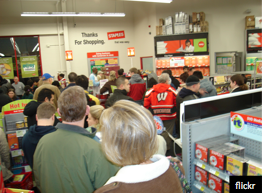 Businesses want Black Friday to be crowded. Not just because they want lots of wallets, but because crowds change people. In the case of Black Friday, crowds can remove all sense of guilt.
Few shoppers feel guilty buying another half-off toaster when the customers next to them have flat screens in their carts. When everybody’s peers are doing it and some peers are “doing it worse,” the painful experience of parting with money becomes a joyous spending spree.
Indeed, research on “social influence” finds that the examples of others can drive people to irrational and even unethical behavior.
Final Reminders
Don’t get too tired. Use a calculator. Decide what you want ahead of time. And don’t get brainwashed. Yes, Black Friday is fun. Yes, Black Friday is a day of great deals. But Black Friday is also a trap that’s very easy to fall into. Happy and responsible shopping everyone!
~Troy Campbell~
 Tweet
Tweet  Like
Like Ask Ariely: On Feeling Gypped, Dishing out for Wine, and Dressing Down
Here’s my Q&A column from the WSJ this week — and if you have any questions for me, you can tweet them to @danariely with the hashtag #askariely, post a comment on my Ask Ariely Facebook page, or email them to AskAriely@wsj.com.
______________________________________________________
Dear Dan,
I am the president of a local union that represents many federal workers. We are dealing with an interesting complaint stemming from the days during the government shutdown when employees were furloughed. Staffers who were furloughed are getting back pay for the days they were off, and because of this the employees who were designated as exempted from the furloughs (who originally felt special about their status and contribution) now feel gypped: Some of them expressed feeling like “a fool for working while others got to stay home.” Any advice?
—Robert
The current approach is clearly the wrong way to design paybacks after a furlough. Since we are likely to experience more government shutdowns in the years to come, maybe we should have a strategy for handling such situations.
I would suggest creating small groups composed of both furloughed and exempt employees and letting each furloughed worker decide how much of their back pay he or she is willing to contribute to the exempt workers in that group. A lot of research shows that people care to some degree about the welfare of others and about fairness, and we do so even at a cost to our own pocket. This kind of social utility should get the furloughed employees to act fairly, and they are even likely to be extra fair if the amount that they would give is going to be posted publicly and contribute to their reputation.
It’s possible that the government at some point will step in and do something to correct the issue. But while this local approach won’t completely fix the problem, it should make the distribution of income more equitable and, just as important, increase camaraderie among employees.
______________________________________________________
Dear Dan,
I love drinking good wine. Each time I go to a restaurant I wonder what is the ideal amount of money to spend on a bottle. What do you do?
—John
A recent experiment suggests an answer. Ayelet and Uri Gneezy from the University of California, San Diego, teamed up with a winery owner in their state to figure out, experimentally, the best price for his Cabernet. On some days they sold the wine for $10, on others for $20 or $40. Demand fell off at $40, but the winery sold more bottles of its Cabernet when the price was $20 than $10. On top of that, the customers who paid more indicated that the wine tasted better!
Uri and John List describe that experiment in their new book “The Why Axis,” in which they use field experiments as a method to look at many of life’s questions, from wine to love to the workplace. Their main advice is that we should all do more experiments.
So, the next time that you go to a restaurant, order two glasses of the same varietal of wine, one rather basic and one fancy, and tell the waiter to write down which is which and not to tell you. Then see if you can tell the difference. Of course, trying this experiment with just two wines is bad science, because you could be correct by chance, so you need to repeat the experiment many times. My guess? Your ability to tell the price difference will be indistinguishable from random guesses.
______________________________________________________
Dear Dan,
I recently watched your presentation at a professional conference and was wondering why an Israeli guy telling Jewish jokes is wearing an Indian shirt?
—Janet
In general I am not someone who should be asked for fashion tips, but this might be an exception. I like to dress comfortably, but in many professional meetings there is a code of uncomfortable dress: suits. My solution? I figured that as long as I am wearing clothes from a different culture, no one who is politically correct would complain that I’m underdressed. After all, the critics could be offending a whole subcontinent. Now that I think about it, maybe I should start giving fashion tips.
See the original article in the Wall Street Journal here.
Salacious Rat King


We all occasionally find ourselves paralyzed by looming decisions, unable to make up our minds with time running out. I was recently afflicted in just this way—I had no idea what to be for Halloween.
Costume ideas will usually just come to me, allowing enough time to prepare at a leisurely pace. I’d then confidently strut my way through Halloween parties full of friends in hand-sewn outfits with witty pop-culture references.
This year was different, though. My anxiety mounted as the big night approached and I had yet to pick a costume idea (let alone gather and assemble the required supplies). Before I knew it, it was the morning of the 31st and my Halloween-induced stress was at an all-time high. As the resident artist for the lab, my calling card is coming up with creative things.
Hundreds of ideas ran through my head, but everything was too difficult, expensive, or obscure. What to do?!
Fortunately, a friend directed me to a simple website which suggested a different nonsensical costume with each visit. Among the suggestions were ideas as disparate as “smutty rice cooker,” “exotic forklift,” and “immoral waffle.” Just a few quick clicks in and I knew what my Halloween costume would be: “The Salacious Rat King.”
Relief washed over me, and I began to mentally piece together my outfit. I could wear my sheepskin rug as a furry cape! I could make a mask from the box of desperately stale breakfast cereal! Suddenly, I was eager to go home and create my salacious rat king ensemble.
How did I go from immobilized by indecision to optimistic and enthusiastic about dressing up for Halloween in just a couple minutes?
By outsourcing my costume decision-making to a website, I was able to relinquish some responsibility over the outcome, lifting a weight from my shoulders. Instead of continuing to fret all day about my choices, the assistance of the costume-suggester gave me one humorous option at a time.
I no longer had to think, “What in the whole universe should I choose to assume as my identity for the night,” and instead, “am I more rakish ironing board or seductive mastiff?” This simplification of the process may have closed off some great costume options, but my enjoyment of Halloween was markedly increased once I accepted the computer’s suggestion.
In the end, my salacious rat king costume was a great success, and my Halloween was saved thanks to outsourcing my decision.
For more on the process of outsourcing decision making and the influence it has on stress and choice, we recommend this paper by fellow Duke Professor Gráinne Fitzsimons and this emotional TEDx talk by Stanford Professor and friend of the lab Baba Shiv.
~Matt Trower~
http://intl-pss.sagepub.com/content/22/3/369.full – paper
http://www.ted.com/talks/baba_shiv_sometimes_it_s_good_to_give_up_the_driver_s_seat.html
Ask Ariely: On the Lottery, Corporate Charity, and Maternalism
Here’s my Q&A column from the WSJ this week — and if you have any questions for me, you can tweet them to @danariely with the hashtag #askariely, post a comment on my Ask Ariely Facebook page, or email them to AskAriely@wsj.com.
______________________________________________________
Dear Dan,
A strange thing happened to me a few days ago. One of my employees came into my office holding a few lottery tickets and asked, “You in? It’s 45 bucks.” I never play the lottery, but I felt an inexplicable urge to say yes–and I did. Was I being grossly irrational?
—Itay
You were indeed irrational, but in a very common way. Usually, when you are considering whether or not to buy a lottery ticket, you take into account how your life would change if you won and contrast this with the cost of the ticket and the slim chance of winning. After making this quick computation, you decide not to buy a ticket.
But when another person asks you to “go half” with them on a tickets that they’ve already purchased, another factor comes into play: regret. Now you can’t help thinking how you would feel if that other person won. You quickly conclude that it would make you feel terrible and you also realize that you would keep on thinking about this forgone fortune for a very long time.
I think that too many people are currently losing too much money on various lotteries (often state sponsored), and I wouldn’t want more people to keep losing money this way. But if I were looking for a way to get more people to gamble, I would certainly try to play on our capacity for regret.
______________________________________________________
Dear Dan,
On a recent flight, the attendants declared it was “Breast Cancer Awareness” month and asked for donations from the passengers for this worthwhile cause. I give to a multitude of breast-cancer organizations, but this approach offended me. Maybe if the airline had offered to match my contribution dollar for dollar it would have made me feel we were partnering in this effort, but the way it was handled just annoyed me. Is it just me or were they doing this the wrong way and actually hurting the cause they are trying to help?
—Rob
I suspect that many companies trying this approach to corporate responsibility don’t get much of a boost from it in terms of internal morale or customer loyalty. It turns out that companies get the most credit for donating to charity in two cases: One is when they give first and then tell the customers, “Look, we’ve already given on your behalf, now you can contribute as well.” The second is when they empower their customers to give themselves (“here is a $5 voucher for you to give to any organization you value”). The approach you describe, where the company simply says, “We have a charity that we like and want you to give to it,” is ineffective in every way.
______________________________________________________
Dear Dan,
It seems to me that any reading of social science research implies that we are all less capable in making our own decisions and that as a consequence we need help. Yet, it seems that Americans are emotionally against any hint of paternalism. Any idea how we can overcome this barrier?
—Tom
I agree with your general position. I think that part of the problem is that, while we see irrationalities and bad decision-making in those around us, we don’t see these mistakes as readily in our own behavior. Because of this partial blindness, we are not as interested in limiting our freedom to make our own stupid decisions. I’m not sure what we can do to fix this part of the problem. But perhaps we can think about how to market paternalism in a better way. As a first step, I would change the term and call it maternalism. After all, who could object to listening to a mother figure?
See the original article in the Wall Street Journal here.
Addressing Inequality with Behavioral Economics
Tomorrow (Tuesday, October 15 from 6-7pm), the Center for Advanced Hindsight will host a discussion on behavioral economics and applications in financial services. We are seeking partnerships with local financial services organizations that are interested in using behavioral-based strategies to help them better serve their mission. The attached Request for Proposals provides a summary of our proposed program. We will also be discussing the RFP on Tuesday and answering questions about the program.
The event is RSVP only. If you are interested in attending, please email rebecca.kelley@duke.edu

More than Friendship: The Importance of Student Peers

Time and time again, you hear students talk about how lonely graduate school can be. To fight the loneliness, graduate students often befriend each other, play board games together, go to trivia nights together, or yes even party together—only on weekends and always responsibly of course. Even though this makes graduate school less lonely, the research itself may remain a lonely enterprise.
Yet it doesn’t have to be: future professors, inventors, and intellectual powerhouses are residing on the desk across from you, why not take advantage of that?
On day one of graduate school I wished someone would have told me so many things (e.g. difference between theory-application, how run certain models) but most of all I wish someone would simply have told me: “Student peers are fundamentally important to your academic life.”
Of course, everyone knows you want to befriend and get along with the students in your department. However, unlike during your undergraduate studies where friendship is the ultimate goal, in graduate school so much more can occur. Graduate students are not just potential friends, they are potential colleagues, co-authors, discussion partners, support networks, and walking encyclopaedias of various literatures. Fellow students are the one of the biggest and most powerful resources in graduate school, yet we often overlook this fact.
No matter who your advisor is, he or she will not be around as much as your fellow students who are almost always there. They hear your ideas in class and lab, attend your conference presentations, talk at length with you over coffee and lunches, and see your ideas develop from day one. In many ways your peers often know your ideas, thought processes, passions, and weaknesses better than anyone else. This is especially true for students working with multiple advisors or switching between advisors.
Yet, often we simply don’t take advantage of our friendly fellow students. We don’t follow the example of the Psych Your Mind students who spend one lunch a week talking about ideas just amongst themselves. We don’t take the time to kick ideas back and forth, or just be someone’s sounding board. Instead, we stumble into advisor meetings will ill-prepared pitches, when a pre-conversation with a peer could have drastically improved them.
Recently, a group of students at a conference agreed to start a purposefully small and private online message board group, so they could communicate about important topics and questions. With this message board system, these students can get insight on complicated questions, methods, cites, and theories within an hour. A network of graduate students supporting each other can be at times more powerful than any individual meeting with a faculty member.
Lastly, even if we talk together or form networks, we don’t tend to co-author with each other. Remember last time you just couldn’t figure out the right stimuli, couldn’t handle the stress of a revision, and got writers block? Or remember that time you needed feedback from your advisor, but the advisor was in a conference in Spain? That’s when a student co-author would have saved you.
Professor Gavan Fitzsimons at Duke University often gets praised for one interesting talent: he’s good at putting graduate students together and building research teams. He knows how powerful a network of graduate students, senior professors, and often also young professors can be and his CV is a testimony of that.
There’s a belief in Improv Comedy that when two performers get on stage and make up a scene together, the performers create something that is greater than either performer would have created own their own. Improv performers believe that putting two passionate people together creates true greatness as they positively build upon one another’s ideas. Whether it is as co-authors, giving feedback on manuscripts, or just chatting about research over lunch, togetherness is a path to greater things.
~Troy Campbell~
Originally posted on InDecision Blog.
Ask Ariely: On Cross-cultural Obesity, Taking Time for Exercise, and Smoking Surcharges
Here’s my Q&A column from the WSJ this week — and if you have any questions for me, you can tweet them to @danariely with the hashtag #askariely, post a comment on my Ask Ariely Facebook page, or email them to AskAriely@wsj.com.
______________________________________________________
Dear Dan,
I just got back from a trip to Europe, and although I knew that Europeans were much less obese than Americans, it was still shocking to see the difference. It is also not true that they don’t have fast food joints. Can you shed some light on these national differences?
—Alvin
Some think that the key factor is the European diet: more homemade food and less prepackaged food, smaller portion sizes, less sugar and corn syrup, etc. I have no doubt that there is some truth to this, but I would propose that our differences in weight also have to do with the fact that Europeans use kilograms while Americans use pounds.
Here is my proposed logic, using me as an example: I weigh 170 pounds, which is also 77 kilograms (well, the truth is that right now I might be closer to 174 pounds, but my real weight is 170). Depending on the time of day and what we eat, our weight fluctuates by a pound or more, as most of us know. This kind of fluctuation lets us convince ourselves that when the scale shows 172, our real weight is still 170, even if it has not shown 170 for a while.
If one day our weight is 174, would we say to ourselves “I am gaining weight, and I need to change what I eat” or would we be able to justify this as part of the random fluctuation around our supposed real weight of 170? By contrast, if we were using the kilogram system, the fluctuations would be much smaller, and when we learned that we were one kilogram heavier, we might act on this change more quickly.
My suggestion: Switch to kilograms (and while we’re at it, maybe we can move to the metric system more generally).
______________________________________________________
Dear Dan,
There are people in my office who have a hard time focusing for even 20 minutes on their jobs. Nevertheless, they seem perfectly capable of exercising for long stretches, and they are quite persistent in that. Can you explain this contradiction?
—Michael
This might actually not be a contradiction but rather, as I learned recently, two faces of the same mechanism. A few weeks ago, I flew to California for some meetings. I left home at 4:30 a.m. and got to San Francisco at 10 a.m. I had a few meetings, and by 5 p.m. was exhausted. I had a lot of work-related tasks and was determined to get at least some of them done, but I felt devoid of energy. So I went for a run.
Ordinarily, I go for a run maybe once every 10 years. But this run was fantastic! I ran a bit, walked a bit, listened to music along the way. It was challenging, and I ran out of breath, but in no way was it even close to the mental exhaustion of doing the things I was supposed to work on.
Here is my new understanding: I think that people who either don’t enjoy what they’re doing for work or don’t have the mental stamina to focus on it can take long breaks for exercise. On top of that if your co-workers took a two-hour book or movie break, they would be seen as selfish slackers, wasting time. But because society tells us that exercising is good for our health, it is a perfectly good excuse to escape work. Now that I have discovered this way to take time for myself and not feel guilty about it, I am going to do more of it.
______________________________________________________
Dear Dan,
The health-care benefits provided by my employer have just been updated to include a hefty monthly surcharge to smokers. I put little effort into quitting smoking, although I know this is the right thing to do. This smoking tax might motivate me to quit, but at the same time it infuriates me that my employer has the power to charge me for smoking. What is your opinion?
—Anonymous
The smoking rate in the U.S. is about 20%, and companies that add such smoking surcharges usually find that the smoking rate drops overnight to less than 10%. Or, more precisely, they find that the smoking surcharge dramatically reduces the number of people who say that they smoke.
See the original article in the Wall Street Journal here.
Monday is good for something after all: surgery.
According to a report that came out in the British Medical Journal, the risk of death after undergoing non-emergency surgery is lowest on Monday (1%), and goes up every day of the week thereafter. People who have surgery on Friday are 44% more likely to die than those who have it on Monday (the rate increases from 1% to 1.44%). The news is still worse for the small number of people who have surgery on the weekends, when the risk of death from complications rises 82% compared to Monday (the rate increases to 1.82%).
It’s important to note that the risk is still low (it reaches around 1.82% on for people who have weekend surgeries, an increase of 0.82%). That said, obviously there should not be such a notable variation in mortality based on day of the week surgery is scheduled. One solution might be that going forward, high-risk or major surgeries should only be performed in the beginning of the week, saving lower-risk procedures for later in the week. Combined with increased efforts to educate patients on recognizing signs that they need to seek medical attention, perhaps this increased risk can be brought back in line.
Ask Ariely: On Deadlines, Getting Promoted, and the Art of Multitasking
Here’s my Q&A column from the WSJ this week — and if you have any questions for me, you can tweet them to @danariely with the hashtag #askariely, post a comment on my Ask Ariely Facebook page, or email them to AskAriely@wsj.com.
______________________________________________________
Dear Dan,
From personal experience, I know that some people delay making a choice as long as possible, while others make quick decisions. What differentiates these two types and what advice would you give to get people to make decisions faster and to feel better about them?
—Amy
In my own studies, we hardly ever find large differences among individuals. In the social sciences in general, individual differences are usually smaller than people expect and matter less than the environment. So if we look at your question, I would phrase it slightly differently and ask, “What kinds of things get people to delay decisions and what kinds of environments get people to take immediate action?”
I would suggest that things like deadlines are incredibly helpful. One British granting agency used to have two deadlines for professors to submit grant applications. When this system was in place, everybody was rushing to submit papers and proposals in time for those grant deadlines. Then the agency let people submit proposals whenever they wished, with decisions on grants made twice a year. No more rushing! But the number of proposals submitted dropped dramatically. Why? Because deadlines allow us to clarify our thoughts and create an action plan. They are good at getting people to perform a particular act, like submitting a grant proposal.
______________________________________________________
Dear Dan,
I work in high tech but can’t seem to get ahead. A good friend of mine on the police force gets promoted all the time. He claims that it has to do not with him but with the lower quality of the people working there. Would it be better to choose a line of work where everybody is mediocre and I’m the best, instead of a high-profile workplace?
—David
The problem has to do with the joy people derive from feeling that they are advancing and developing in their careers. This sensation really is important. It provides gratification, self-esteem and recognition from your peers.
Widespread recognition of this need explains why so many companies have invented titles and intermediate positions for senior executives, vice presidents and deputy CEOs. They want managers to experience the gratification of moving ahead even when they have reached the top of the ladder.
At first, this trend only affected management—engineers remained engineers, even when their salaries increased and responsibilities expanded. But over the years, companies made up new titles for lower-level employees as well. And for clear and justified reasons, it seems that you are in need of such a title.
Your predicament is whether to be a small fish in a big pond, as you are now, or a big fish in a small pond, like your friend—a situation that would seem easier and more gratifying.
But before you quit your job for one where the people aren’t as good, I would advise you to try two things: First, see if you can receive, or even create, a promotion. Speak to your boss. Try for a change in your responsibilities and thereby your feeling of accomplishment. Second, talk to more friends, maybe even find some new ones who are not doing as well as your policeman friend. You may find that you are extremely successful compared with some.
______________________________________________________
Dear Dan,
I spend a lot of time in not-very-interesting conferences calls using Skype and Google Hangout. I try to get things done during this time by using my computer to answer emails: I turn off the video capability, so that no one can see me, and try to type quietly, so that no one can hear. But the sound of the keyboard seems to vibrate through the computer, and the person on the other side knows I am not paying attention. Any advice?
—Kristen
This is exactly what tablets are for.
______________________________________________________
See the original article in the Wall Street Journal here.
Ask Ariely: On Commuting, Being One’s Own Advisor, and Democracy
Here’s my Q&A column from the WSJ this week — and if you have any questions for me, you can tweet them to @danariely with the hashtag #askariely, post a comment on my Ask Ariely Facebook page, or email them to AskAriely@wsj.com.
______________________________________________________
Dear Dan,
We recently got married and are having a hard time deciding where to live. Should we live in the city, close to where we work? Or would we be better off finding some place cheaper, greener and farther away from the city?
—A Couple from the Center
Your decision should take a few things into account. First, most of us can get used to most things: houses of different sizes, for instance, or a neighborhood that is green or drab. And we adapt to most changes faster than we expect. Many years ago, for example, I suffered a serious injury that changed my life dramatically. But over time I got used to these changes, and now my life is much better than I would have expected.
But there are some things that we don’t get used to, at least not that easily. One of these, sadly, is commuting—that annoying daily trip from the small neighborhood where we live to our place of work in the big city. We don’t get used to such trips because we never know what’s in store for us in traffic. If we know that we can leave home each day at 7:30 a.m. and arrive at 9 a.m., we can live with that. But because of traffic and bottlenecks, we never know when we might arrive. And this uncertainty makes it difficult to get used to commuting, making each day start out so badly.
This is why I suggest that you take distance from work into account as a significant factor in deciding where to live. It will play a larger role in your life than you think.
______________________________________________________
Dear Dan,
What is the best way to inject some rationality into our decision-making?
—Joe
I am not certain of the best way, but here is one approach that might help: When we face decisions, we are trapped within our own perspective—our own special motivations and emotions, our egocentric view of the world at that moment. To make decisions that are more rational, we want to eliminate those barriers and look at the situation more objectively. One way to do this is to think not of making a decision for yourself but of recommending a decision for somebody else whom you like. This lets you view the situation in a colder, more detached way, and make better decisions.
For example, in one experiment we told people, “Imagine you went to your doctor and the doctor recommended a very expensive treatment. You’ve been seeing this doctor for 10 years. Would you go for a second opinion?” Most people said “no.” We asked another group to imagine a friend in the same situation. Would they recommend that a friend seek out a second opinion? Most people said “yes.”
This suggests that when we think about other people, we take our emotions out of the picture and are able to recommend something more useful—such as going for a second opinion.
But when it’s us, and we have a longtime commitment to a particular doctor, it’s hard to ignore this relationship and our feeling of obligation. Taking the advice approach may not be the best way to inject some rationality into your decision-making (and it’s certainly not the only way), but it is useful to imagine how you would advise another person, particularly someone you care about.
______________________________________________________
Dear Dan,
What do you think about democracy, since everybody gets the same right to vote, whether they are smart or less smart? Because the number of the less smart is so large, in a democracy they end up having greater influence. Is this kind of equality in choice good for society?
—Dina
Churchill answered this one: “Democracy is the worst form of government, except for all those other forms that have been tried from time to time.” (from a speech in the House of Commons, Nov. 11, 1947)
See the original article in the Wall Street Journal here.