Dear Irrational (driving fast and police cars)
Dear Irrational,
A practice I often noticed on the I-90 in New York State (Or I-25 where I now live) is that people speed on the highway until they see a police officer with a speed gun (or with flashing lights writing a ticket to some poor driver on the side of the road), and then they slow down and drive at the speed limit for a while. (more…)
 Tweet
 Like
Thursday night on a beach in NYC
The wonderful people from Radio Lab organized an event Thursday evening at a beach in NYC. This was part of the World Science Festival and it was called: “You and Your Irrational Brain: An Evening of Experimentation Under the Stars.”
It was tremendously fun to hang out on the beach, drink beer, and talk about behavioral economics and mistakes people make in decisions (for some pictures and a more detailed report see this link). When it was over, I was deeply disappointed.
Look at the picture below. Isn’t this the ideal setting to have a chat about science? Maybe I will try to move my class next term to that wonderful beach (or maybe it was the beer).
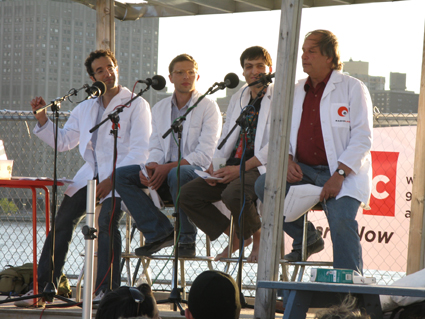
A critic that will become more critical of me over time
Placebo for kids?
The New York Times today had a story about Jennifer Buettner, who is trying to make a placebo pill for kids, but maybe for all of us.
Is this a good idea?
We know that in many cases placebos do work, and we also know that they have very few side effects — a point for placebo pills! (more…)
Motivating Employees With Cash or Gifts?
Girl Scout sets record ..
Jennifer Sharpe knows how to sell Girl Scout cookies. In fact, she managed to sell 17.323 boxes for $3.50 each! (see full story)
As she said: “I know how to get people to buy more,” said Jennifer, a sophomore at Edsel Ford High School . “If they buy two boxes and they hand me a 10, I’d be like, ‘For 50 cents more, you can get three”
Why is this trick likely to work (it reminds me a bit of the movie paper moon)? Why is it likely to work better than simply offering people to buy 3 packages for $10.50
First, it is possible that making an initial offer below $10 (compared to one above $10) causes more people to be willing to buy — so it increases the market size.
Second, it is possible that once people had out their $10 they don’t think about the change they are about to get and as a consequence Jennifer’s offer of “just another 50 cents” does not register as another $3.50 for another box!
In any case, I suspect that Jennifer’s trip to Europe (which is what she collected the money for) will give her new ideas about new approaches to framing.
Medicine: A Lesson In Efficient Markets
The market for medicine is incredibly interesting. Almost every day we learn something new about a treatment that we thought would work but does not, or about a treatment that we didn’t think would work but does. Beyond the particular fascination, I think that the medicine market can also teach us important lessons about rationality, economics, and by analogy, also about the stock market. (more…)
Running to the subway — irrational or not?
Dan,
My son (9 years) and I are huge fans of yours.
We have both read your book and gotten hours of pleasure discussing your experiments with friends and family.
My son came up with an interesting example of irrationality I would like to share with you: Every morning, I take him to school via subway from downtown Manhattan to the Upper Westside. We take the D train to Columbus Circle then switch to the 1 train headed uptown. He noticed that when switching, we leave the D train, walk to the 1 train platform, and then if we see that the train is there or just arriving, we immediately start running to catch the train. (more…)
An interesting analysis of the market…
3 main lessons of Psychology
In my mind we have learned three main lessons in these two sub-fields: 1) that the environment has a large, yet unrecognized, effect on our behavior, 2) that our intuitions about what drives our behaviors are flawed, 3) and that emotions play a large role in our decision making. Let me give some examples. (more…)