Events: StartupOnomics and Open Mic
I’m excited to announce two upcoming events in August in sunny Palo Alto. One is called StartupOnomics, which is a summit for people involved in start up companies seeking to make the world better, whether it’s through preserving earth, health, youth, or money (August 24-25). This summit will help you, prospective world-savers, understand how people make decisions so that whatever product or service you’re working on can make an impact.
The summit comprises two days of interactive sessions, work sessions, and lectures with experts in behavioral economics (August 24 and 25). It will be a veritable smorgasbord of events designed to help people think and plan all aspects of their start up.
The other event is an open mic night with me on the evening of August 23. This is separate and open to anyone who reserves a spot. I’ll make a brief presentation and then open the floor for any questions from the audience.
We’ll need your application by July 15th, so hurry! And I look forward to meeting all of you who join us. Reserve your spot for the open mic night as soon as possible!
 Tweet
Tweet  Like
Like In Praise of Dishonesty
It was gratifying when I recently received some unexpected praise for the new book. If you’re having doubts about whether to read it, maybe this will help you decide…
“I’ve been handing out copies to everyone I know!”
– Robin Hood
“The world is full of small cheaters, but what separates those amateurs from us pros is dedication and effort. Understanding dishonesty has made us not only more efficient, but it also kept us out of jail.”
– Everyone responsible for the 2008 financial crisis
“In The Honest Truth About Dishonesty, Ariely shows that our ability to cheat is based on our ability to make ourselves feel good about lying. As a master of this skill, I can personally attest to his insights and findings. I feel great!”
– Carlo Pietro Giovanni Guglielmo Tebaldo (“Charles”) Ponzi, (1882 –1949), inventor of the Ponzi scheme
“A princely read!”
– Nicolo Machiavelli
“There’s a sucker born every minute, and Ariely teaches us that we’re likely to be one as well.”
– Phineas Taylor Barnum (“P.T.”) Barnum, businessman, scam artist and entertainer
Religion and Research
Direct my steps by Your word, and let no iniquity have dominion over me.
Redeem me from the oppression of man, that I may keep Your precepts.
Make Your face shine upon Your servant, and teach me Your statutes.
Rivers of water run down from my eyes, because men do no keep Your law.
-Psalm 119: 133-136
If you read Predictably Irrational, you may recall that we carried out a study on cheating that assessed the value of moral reminders. In the experiment, we asked participants to complete a test, told them they’d receive cash for every correct answer, and made sure they knew they had ample room to cheat. Now here’s the kicker: prior to starting, we had half the participants list ten books off their high-school reading list, and the other half to recall the Ten Commandments, a manipulation that turned out to have a marked effect on the results: While many in the first group deceitfully reported a higher number of correct answers, no one in the second group cheated.
How do we explain the findings? A tempting conclusion to draw would be to equate religiosity with a higher morality; however, this argument doesn’t hold, since in a follow-up study with atheist participants, recalling the Ten Commandments had the exact same effect. Rather, what was at play here was the power of a moral reminder: Prime a person to think about ethics right before they have an opportunity to cheat, and they’ll avoid immoral behavior.
This experiment also suggests to me that religion can be a good source of ideas for social science research. If you think about religion as a social mechanism that has evolved over time, then you can ask what purpose(s) its many rules serve and how they can help us to better understand human nature.
For example, though religious leaders may not have understood the exact psychology of moral reminders, they’ve certainly had enough of an intuitive sense of their importance to circulate the Ten Commandments and emphasize a whole score of other religious tenets, statutes, and regulations. Whether or not they could cite the causes for it, somewhere along the line they gathered that a good way to keep people in check was to present them with a moral benchmark to keep in mind (e.g. reciting prayers, for instance, before dinner as a continual reminder of the standards).
Given religion’s role in society and the way it evolves over time, I think we could benefit from using its wisdom to direct social science research. The key is to zero in on a religious tenet and ask why it’s there and what it suggests about human behavior, and to then empirically test the hypothesis with the hopes of deriving science from religious texts.
God bless.
Social power and morality
The following is taken from the graduation speech of Michael Lewis at Princeton in 2012. In it, he discusses an experiment that explores the relationship between power and morality.
“…… a pair of researchers in the Cal psychology department staged an experiment. They began by grabbing students, as lab rats. Then they broke the students into teams, segregated by sex. Three men, or three women, per team. Then they put these teams of three into a room, and arbitrarily assigned one of the three to act as leader. Then they gave them some complicated moral problem to solve: say what should be done about academic cheating, or how to regulate drinking on campus.
Exactly 30 minutes into the problem-solving the researchers interrupted each group. They entered the room bearing a plate of cookies. Four cookies. The team consisted of three people, but there were these four cookies. Every team member obviously got one cookie, but that left a fourth cookie, just sitting there. It should have been awkward. But it wasn’t. With incredible consistency the person arbitrarily appointed leader of the group grabbed the fourth cookie, and ate it. Not only ate it, but ate it with gusto: lips smacking, mouth open, drool at the corners of their mouths. In the end all that was left of the extra cookie were crumbs on the leader’s shirt.
This leader had performed no special task. He had no special virtue. He’d been chosen at random, 30 minutes earlier. His status was nothing but luck. But it still left him with the sense that the cookie should be his.”
—–
We’ve probably all heard the saying “absolute power corrupts absolutely.” Well, there is a great deal of research concerning the link between social power and morality, and most of it suggests that absolute power is not required to change people’s morals; sadly it tends to show that more power leads to less care for others, and less moral behavior.
The Artistically Irrational Exhibition Series
When we decided to create the Artistically Irrational series, we hoped to catalyze the scientific process by bringing art directly into the place where we work and think.
Behavioral research is an indispensable tool for social scientists looking to understand and comment on the fascinating world in which we find ourselves. Controlled experiments allow us to measure and reflect on issues ranging from injustice to advertising, the taste of beer to medical conflicts of interest, and even social networks like Facebook or Twitter. Such experiments allow us to reliably test whether our intuitions about the world are true and figure out when, how, and why we are wrong. Art fills a similar void, filtering ideas and motivations through individual sensibilities, then taking the result and crystallizing it into something more or less universal. And although there are many differences between the worlds of Science and Art, both can provide useful social commentary. In fact, it is these very differences that invite a discussion between the two. We hope that, through this project, the scientific and artistic approaches can fertilize one another and expand the lines of communication between two fields that have so much in common but speak to one another so rarely.
The Artistically Irrational exhibition series is essentially an experiment in feedback loops. Each project begins with a discussion of social science research on a particular topic and a request for artists to express themselves through their art. Then, surrounded by the fruits of their labor, we get to further reflect on our research through their eyes, using their insights to enrich the meaning of our studies.
~ –– ~ –– ~ –– ~ –– ~ –– ~ –– ~ –– ~ –– ~ –– ~ ––
Creative Dishonesty: Cheat Codes
The first show revolved around our research on cheating and dishonesty. After I spoke to a group of artists, they went back to their studios and put together their interpretations of our findings. They came back with a range of pieces exploring the nature of dishonesty – especially as it related to their own practices. Several artists investigated the moral status of artistic “borrowing” and the thin line between appropriation and flat-out plagiarism. One artist played with the idea of citation, which is virtually nonexistent in art but is a practice with rigid requirements in the sciences (see APA, 2010). Another considered how the mere label of “art” affects how we experience something, whether it is a flattened steel grid or a topsy turvy urinal. Other artists examined the spiral of bad decisions that can spring from one little transgression, and how moral reminders or cleansing rituals can help us correct our misdeeds and start over. Many explored the ways that we lie to others and ourselves, how we hold distorted worldviews and memories – and the rationalizations that go along with them.
All of these pieces revolved around an interesting finding of our research: the tendency of creatives to be less honest than non-creatives. As David Hockney said, “the moment you cheat for the sake of beauty, you know you’re an artist.”
A Sample from the Show:
(click on images for larger view)
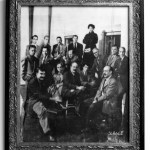

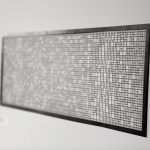
Photos taken by Aline Grüneisen
~ –– ~ –– ~ –– ~ –– ~ –– ~ –– ~ –– ~ –– ~ –– ~ ––
And because the Creative Dishonesty exhibit was such a success, we decided to host another art show, this time following the theme of social and economic inequality, wealth distribution, and what is so taxing about taxation. This exhibit, PoorQuality: Inequality has just been installed and will accompany me in the Center for Advanced Hindsight until August 31.
If you can make it, I highly recommend coming to our opening reception on June 22 from 6 – 10 PM.
For more photos and information about the Artistically Irrational exhibition series, see our website or contact curator Catherine Howard at artisticallyirrational@gmail.com
A year in the life of a city bike.
At one point the people who run Hudson Urban Bikes, a bike rental company in the West Village, wondered what would happen to a bike if it was left chained to a post in the city for one year, and they took a picture of it each day to document its progress. The bicycle began its experimental journey equipped with all necessary equipment plus a basket, water bottle, splashguard and a few other goodies.
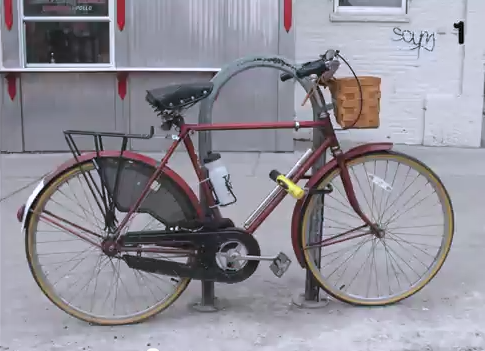
For quite a while the bike sits quietly chained next to a host of other bikes, retaining all of its accouterment. Then, on day 160 all of a sudden the water bottle goes missing. Then a few weeks later on day 212, both the lock and the basket walk off. From there things really begin to deteriorate, and it’s not long before the seat is missing, followed soon after by the front tire, splashguard, and handle bars.

Finally the forlorn frame itself disappears.
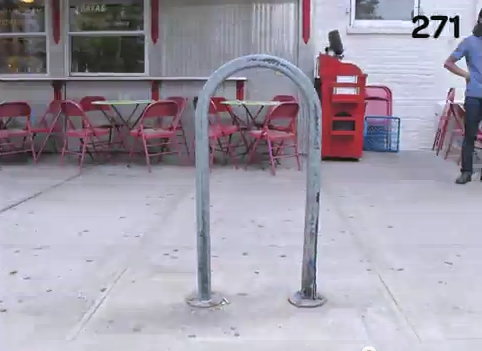
To my mind, this experiment cleverly mimics several aspects of dishonesty. People are basically fairly honest most of the time, but at some point they are tempted to cheat or take one small thing, or they see someone else do so. Over time this works through them, and maybe they take another small thing. After a while, this becomes habit, and people begin cheating at full throttle, and next thing you know, the whole bicycle is missing (figuratively).
That said, I think it bodes well that the bike lasted as long as it did, particularly after the lock was removed. It seems we can rest a little easier knowing that people, for the most part, don’t cheat as much as they could, or as much as we would expect them too, rationally speaking—after all, just think of how many people walked by the apparently free, unlocked bike and ignored it.
Women, Men, and Math Problems.
In the experiments my colleagues and I have run on cheating, we’ve used a task in which pride about personal performance and ability has no part. The matrix test is merely a search task (wherein participants find the two numbers out of 12 that add up to 10) rather than a skill. It’s not something you’re going to brag to your friends about in all likelihood.
Recent graduate Heidi Nicklaus of Rutgers University was interested in the opposite; she wondered how people’s pride about their perceived and imputed abilities would affect their dishonesty. Specifically, she was interested in gender stereotypes. We’ve all heard the stereotype that men tend to excel at math more than women, and that women can talk and write circles around men with their superior verbal skills. So the question was, if men are more proud of their mathematic ability and women of verbal, it might cause them to cheat more.
In her experiment, Heidi first primed her participants with two comical videos that exaggerate gender stereotypes (see below). Then participants were presented with one of two sets of fake data (presented as legitimate); one supported the math versus verbal aptitude stereotypes, the other countered them. Finally, participants took brief 10-question tests measuring both math and verbal aptitude, and were told they would receive $.50 for each correct answer. Similar to the experiments my colleagues and I have run on cheating, half of participants in each condition could cheat while the other half could not.
The results showed that when people could cheat, they generally did, which is what I’ve always found in cheating experiments. On average, people claimed one extra correct answer than when cheating was not possible (an average of 4 instead of 3 correct answers out of 10 on both math and verbal tests). No news here, so what about the effect of gender stereotypes? Did having them reinforced or, alternatively, countered before taking the test have any influence on cheating?
First, the hypothesis. What Heidi expected to find was that men and women would cheat along stereotypical lines, that is, that men would cheat more on math (to show that they did, indeed, excel in mathematics) and women would cheat more on the verbal portion for the same reason. So it was intriguing when Heidi found that men cheated more on math question than expected, but men and women cheated equally on verbal questions (rather than women cheating more as anticipated).
These findings—that people did not cheat more to keep up with perceived higher achievement by others—are similar to what my colleagues and I have found. In one experiment our results showed, similarly, that people cheated by the same amount regardless of whether they thought their peers solved an average of 4 or 8 out of 20 questions in a given amount of time (reporting an average of 6 correct answers). People cheated as much as they could justify, and apparently others’ performance is not of any great concern in this justification.
Oh, and as for the stereotype that kicked off the experiment: there were no differences in performance on math or verbal questions based on gender. So hopefully this harmful stereotype will fall by the wayside sooner rather than later, since nearly all similar studies yield the same conclusion.
The (Mostly) Honest Introduction to the (Honest) Truth about Dishonesty.
Conscience+
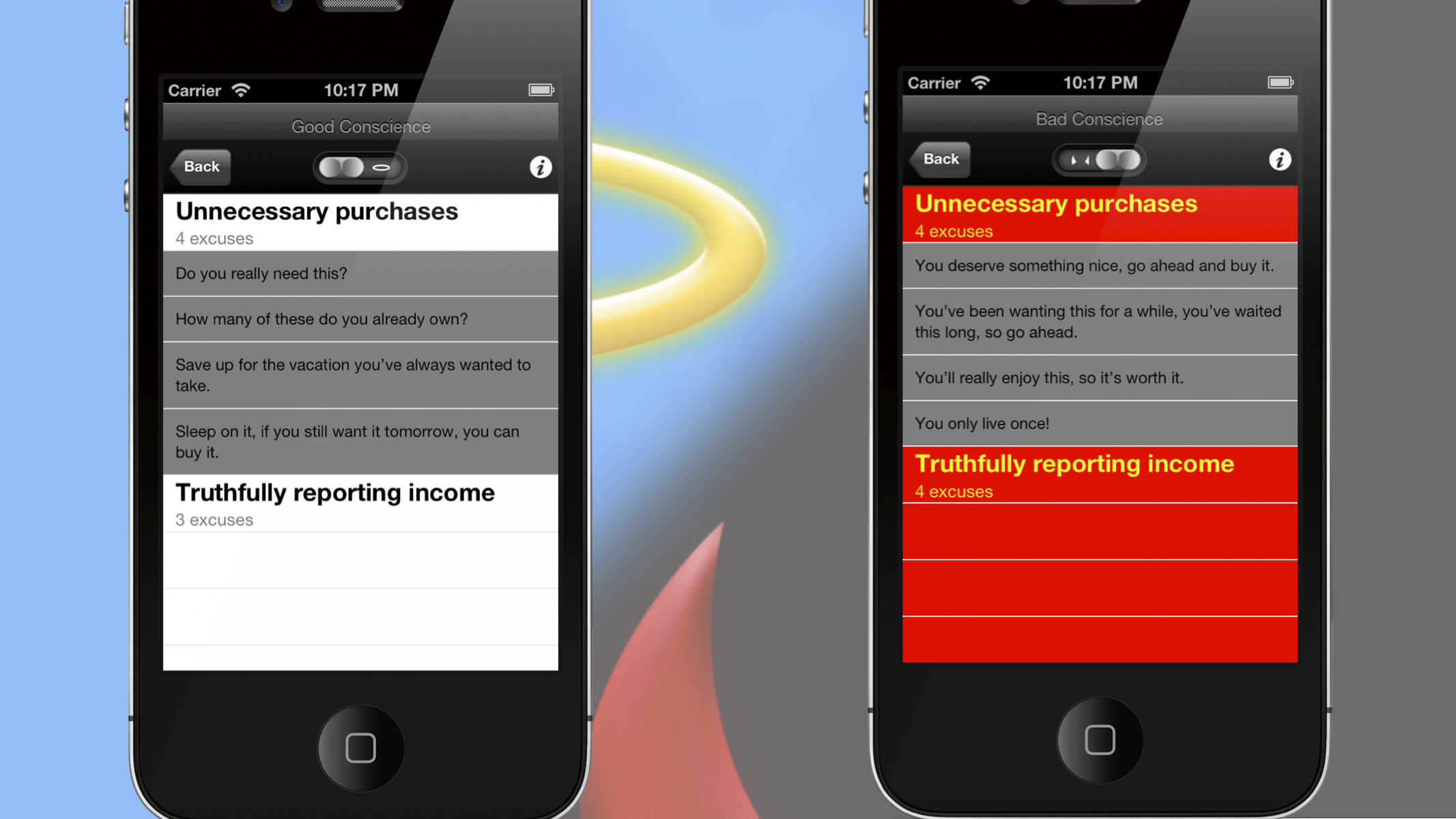
I’m pleased to announce that I have a new app available at the App Store called Conscience+.
Conscience+ helps you reason through moral dilemmas by providing you with little “shoulder angels” that can help you argue either side of a decision. Simply flip the switch at the top of the app to move between good conscience and bad conscience. Whether you need the extra push to go through with a selfish deed or words of wisdom to resist a bad temptation, Conscience+ has you covered.
- turning away the dessert menu
- splurging on a new electronic gadget
- staying faithful to your romantic partner
- padding your expense report on your boss’s dime
- lying on your college application
- and much, much more!
Get Conscience+ free from the App Store here! Once you’ve played with the app yourself, let us know in the comments if you have any suggested excuses. If we like them, we’ll put them in the next update.
Why We Lie (from WSJ)
Why We Lie (from the WSJ)
We like to believe that a few bad apples spoil the virtuous bunch. But research shows that everyone cheats a little—right up to the point where they lose their sense of integrity.
Not too long ago, one of my students, named Peter, told me a story that captures rather nicely our society’s misguided efforts to deal with dishonesty. One day, Peter locked himself out of his house. After a spell, the locksmith pulled up in his truck and picked the lock in about a minute.
“I was amazed at how quickly and easily this guy was able to open the door,” Peter said. The locksmith told him that locks are on doors only to keep honest people honest. One percent of people will always be honest and never steal. Another 1% will always be dishonest and always try to pick your lock and steal your television; locks won’t do much to protect you from the hardened thieves, who can get into your house if they really want to. The purpose of locks, the locksmith said, is to protect you from the 98% of mostly honest people who might be tempted to try your door if it had no lock.
We tend to think that people are either honest or dishonest. In the age of Bernie Madoff and Mark McGwire, James Frey and John Edwards, we like to believe that most people are virtuous, but a few bad apples spoil the bunch. If this were true, society might easily remedy its problems with cheating and dishonesty. Human-resources departments could screen for cheaters when hiring. Dishonest financial advisers or building contractors could be flagged quickly and shunned. Cheaters in sports and other arenas would be easy to spot before they rose to the tops of their professions.
But that is not how dishonesty works. Over the past decade or so, my colleagues and I have taken a close look at why people cheat, using a variety of experiments and looking at a panoply of unique data sets—from insurance claims to employment histories to the treatment records of doctors and dentists. What we have found, in a nutshell: Everybody has the capacity to be dishonest, and almost everybody cheats—just by a little. Except for a few outliers at the top and bottom, the behavior of almost everyone is driven by two opposing motivations. On the one hand, we want to benefit from cheating and get as much money and glory as possible; on the other hand, we want to view ourselves as honest, honorable people. Sadly, it is this kind of small-scale mass cheating, not the high-profile cases, that is most corrosive to society…..
For the rest of the article, please see the WSJ