Online course archive
A Beginner's Guide to Irrational Behavior
"A Beginner's Guide to Irrational Behavior" was an online course I taught through Coursera in 2013, and ran again in 2014. Each time, almost 200,000 people from around the world signed up — and over the years I've kept meeting them. At airports, at conferences, in restaurants and on planes. They tell me the course was useful to them, that it changed how they thought about their own decisions, and they ask me, often, where they can find it now. I wanted there to be an answer.
The course is an introduction to behavioral economics: the study of why human beings — who like to think of themselves as rational creatures — make so many decisions that work against their own interests. About money, about work, about food, about health, about love and risk and time and almost everything else. Across six weeks we look at the systematic ways our intuitions mislead us, the experiments that have made those failures visible, and the practical ways we can design around them.
I taught the course because I think behavioral economics is most useful when you actually use it. This site is here so you can.
Most of the work for this course was done by Aline Grueneisen-Holzwarth. It was really her project and I mostly did what I was told. We are both grateful to Matthew Duckworth for his amazing help in filming and editing the material.
Section 01 — Introduction
Setting the stage
A short framing of what this course is and what I hope you will get out of it. The big question — the one that animates everything that follows — is simple: if we are as smart and as well‑meaning as we like to believe, why do we keep making the same kinds of decisions that we know will leave us worse off? In this opening lecture I lay out the basic premise of behavioral economics: that the mistakes we make are not random, but predictable, and that once you understand the patterns, you can begin to change them. Everything in the next six weeks builds from here.
Introduction
Section 02 — Weekly modules
Six weeks of lectures
The heart of the course. Each week takes one big idea — irrationality, money, dishonesty, work, self‑control, and emotion — and breaks it into short lectures that combine experiments, stories, and surprising results. The weeks build on each other but each can be watched on its own.
Week 1
Irrationality
The first week is about the most basic claim of behavioral economics: that our intuitions about how we make decisions are usually wrong. We start where it is hardest to argue — with optical illusions. When you look at the Adelson checker shadow or the Müller‑Lyer arrows, you don't just see a trick; you see a trick you cannot un‑see, even after you know exactly what it is. Vision is the system we trust the most, and it fails in predictable ways. The argument of the week is that decision‑making fails the same way.
From there we look at defaults — why a checkbox you never tick can change whether you become an organ donor, or how much you save for retirement. We examine choice sets and relativity (whether option C exists changes whether you choose A or B). We look at how a single decision can lock in long‑lasting consequences that we never quite revisit. And we end with the most unsettling result of all: how badly we learn from our own mistakes.
By the end of the week, "irrationality" should look less like a flaw and more like a feature — a predictable, designable feature of how human minds actually work.
Visual and Decision Illusions

Defaults
Do We Know Our Preferences?

Choice Sets and Relativity
The Long‑lasting Effects of Decisions
Learning from Our Mistakes
Week 2
The Psychology of Money
Money should be the easiest thing in the world for an economist to model. Every dollar is interchangeable with every other; a gain of ten dollars is the mirror image of a loss of ten; the cost of one thing should be measured against everything else you could have bought with the same money. None of this turns out to be how people actually think.
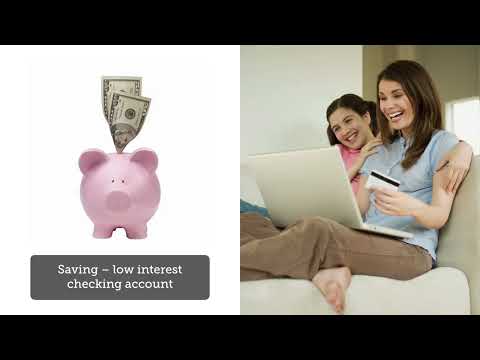
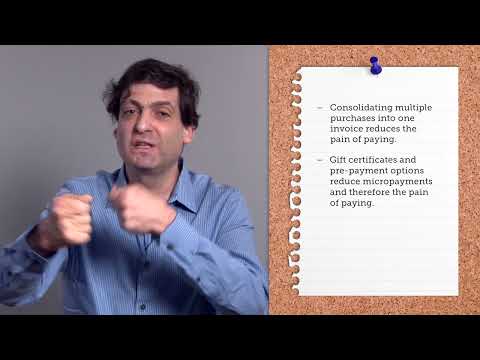
Week 2 walks through the systematic ways our relationship with money breaks the standard model. We look at opportunity cost — and how almost no one thinks about it correctly — and at relativity, which lets a $4,000 wedding meal feel cheap next to a $15,000 one. We examine the pain of paying (and why credit cards anesthetize it), mental accounting (why "vacation money" and "rent money" feel like different kinds of money), and fairness — why people will reject good deals out of spite when they feel cheated. We meet loss aversion and the endowment effect, the line between market norms and social norms (and why mixing them ends badly), the strange power of the word free, and the hidden cost of micro‑payments.
The aim is not to make you cynical about money. It is to help you notice when your wallet is making decisions for you.

Opportunity Cost
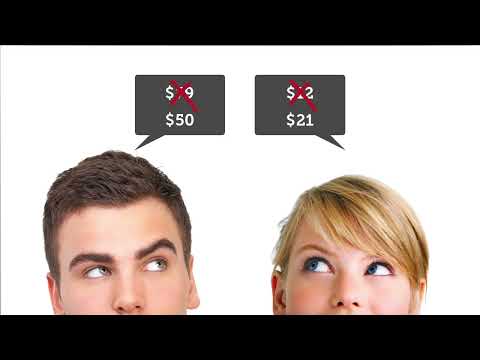
Relativity

The Pain of Paying
Mental Accounting
Fairness and Reciprocity
Loss Aversion and the Endowment Effect

Market and Social Norms

The Price of FREE
Micro‑payments
Week 3
Dishonesty
Week 3 is about cheating, and how very different real cheating looks from the cheating in economic textbooks. The standard model — which the economist Gary Becker proposed in the 1960s — says people cheat when the expected gain is greater than the expected cost: the size of the prize, multiplied against the chance of getting caught and the size of the punishment. It is a clean theory. It is also, almost entirely, wrong.
What our experiments have found, again and again, is that almost everyone cheats a little, almost no one cheats a lot, and the size of the bribe and the probability of getting caught barely move the needle. What does move it is something subtler: the gap between how we behave and how we still want to see ourselves — what we call the fudge factor. We will look at what shrinks the fudge factor (a small reminder of honesty, a signature at the top of the form rather than the bottom) and what expands it (conflicts of interest, fatigue, watching someone else get away with it, distance from the act). We close with how cheating drifts over time and across cultures.
The takeaway is not that people are bad. It is that almost all of us are good — and slightly dishonest — at the same time.

The Simple Model of Rational Crime
Shrinking and Expanding the Fudge Factor

Conflicts of Interest

Cheating Over Time and Across Cultures
Week 4
Labor and Motivation
What gets people to do good work? The standard answer — pay them more — turns out to be only a small part of the story, and sometimes the wrong part. Week 4 is about what really moves people in their jobs.
We start with the contrast between extrinsic motivation (rewards and punishments imposed from outside) and intrinsic motivation (the wanting that comes from inside) — and the surprising ways that paying people for things they used to enjoy can kill the joy. From there we look at meaning: how the smallest acknowledgement of effort, or its absence, can change how hard people are willing to work, and how much they need to be paid to keep working. We examine the IKEA effect — why we overvalue what we ourselves have made — and the not‑invented‑here bias, its cousin in the world of ideas. We look at cognitive dissonance and how it quietly rewrites our preferences after the fact. And we close with two of my favorite, most uncomfortable results: how monetary stress and social stress affect performance, and what very large bonuses actually do to the people who receive them.
The week is meant for anyone who manages, is managed, or has ever wondered why a job they once loved became a job they barely tolerate.
Extrinsic versus Intrinsic Motivation

Meaning

Acknowledgement

The IKEA Effect
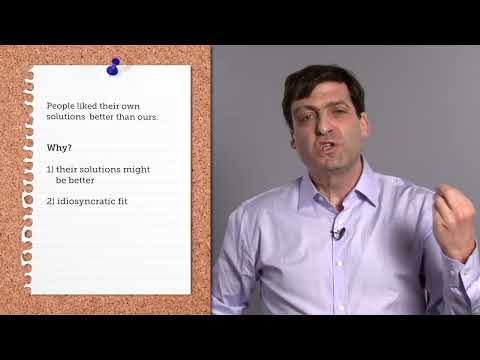
Not‑Invented‑Here Bias

Cognitive Dissonance
Monetary Stress and Performance

Social Stress and Performance
Bonuses, Labor and Motivation
Week 5
Self‑Control
We know what we should do. We don't always do it. Week 5 is about the gap between the two — the most universal experience of irrationality, and the one that costs us the most over a lifetime.
We begin with the structure of the problem: present pleasures are vivid and immediate, while their future costs are abstract and discounted. The cigarette is real; the lung is theoretical. The cake is now; the regret is later. From there we look at reward substitution, the trick of attaching a present‑self pleasure to a future‑self goal so that the two stop fighting. We examine Ulysses contracts — commitments we make in advance to bind our later, weaker selves: locked savings accounts, gym buddies, prescriptions we send to ourselves a month at a time. We talk about what works and what merely feels like it works.
The week closes with what I think is the most important argument in the whole course: if self‑control is this hard for everyone, then how much of "willpower" is really an environmental design problem? The right question is rarely "how do I become a better person." It is usually "how do I arrange the world so that being a good version of myself stops being so expensive?"
Difficulty with Self‑Control
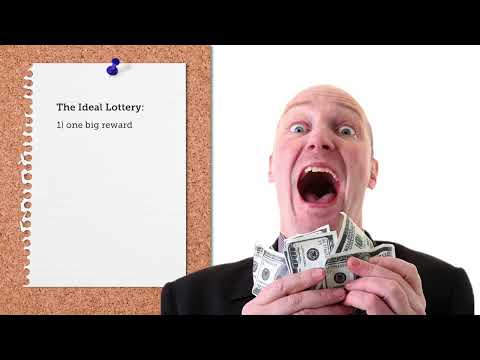
Reward Substitution
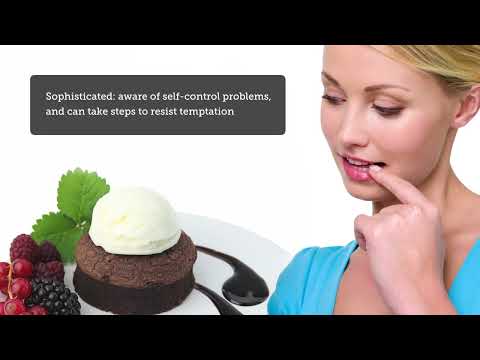
Ulysses Contracts
The Importance of Self‑Control: The Individual and the Environment
Week 6
Emotion
The final week is about feelings — the part of decision‑making that economics, for most of its history, has tried to leave out, and that turns out to be the hardest part to leave out.
We start with the two‑systems framing made famous by Daniel Kahneman: the fast, automatic, emotional system and the slow, deliberate, analytical one, and the way each of them quietly takes over different kinds of choices. We look at the identifiable victim effect — why a single name and face raise more money than a hundred thousand statistical lives — and at intra‑empathy mismatch, the strange phenomenon that in a calm state we cannot accurately predict how we will feel, or behave, in a hot one. (This has implications for everything from dieting to negotiating to how the criminal justice system imagines a person's "real" self.) We examine emotional decision‑making more directly — how a feeling carried over from one situation can quietly distort the next — and we close with risk: how dramatically our perception of danger is shaped by what is recent, what is vivid, and what we can see other people fearing.
By the end, the picture is not that emotion is the enemy of good decisions. It is that emotion is decisions, and pretending otherwise is the most expensive mistake of all.

Two Systems
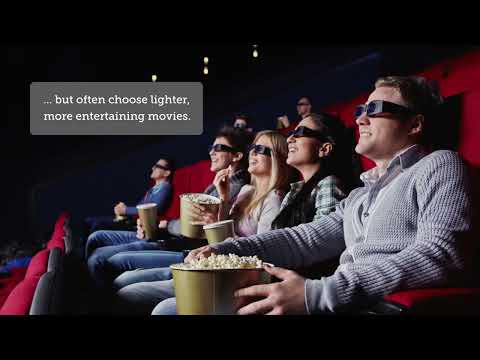
Intra‑empathy Mismatch

The Identifiable Victim Effect

Emotional Decision Making
Risk Assessment
Section 03 — Conclusion
Pulling the threads together
A closing reflection — not a summary of what came before, but an attempt to say what I think behavioral economics is actually good for once you have it. The takeaway of these six weeks is not that we are doomed to bad decisions: it is the opposite. Knowing how we actually think, rather than how we wish we thought, gives us a fighting chance — to design our own lives a little better, to build products and policies that work with the people we are instead of against them, and to be a little gentler with the irrationality of the people around us, including ourselves.
Conclusion
Section 04 — Guest lectures
Voices from the field
Across the course, thirteen guest researchers contributed lectures of their own — colleagues whose work I admire, and whose research expands on the themes of the weekly modules. Some go deeper on motivation, money, dishonesty, or self‑control; others open new doors entirely, into humor, disgust, romance, medicine, voting, and the economics of sex. Each talk is short, self‑contained, and worth its own afternoon. Together they are a small portrait of the field as it looked at the moment we filmed the course — and most of it has only become more relevant since.

Lionel Messi meets Salvador Dali: A motivation(al) story

Do Green Products Make Us Better People?

What Makes Things Funny?
The Surprising Way Disgust Shapes Our Thinking

The Delusion of Romantic Self‑Insight
Self‑regulation

Using People's Biases to do Good
Persuasion: Provincial Norms

Sexual Economics: A model of heterosexual sexual behavior

Money, Time, and Happiness: Giving and Getting
Medical Decision Making Gone Wild?

The Unconscious Consumer